
1 · SNAPSHOT
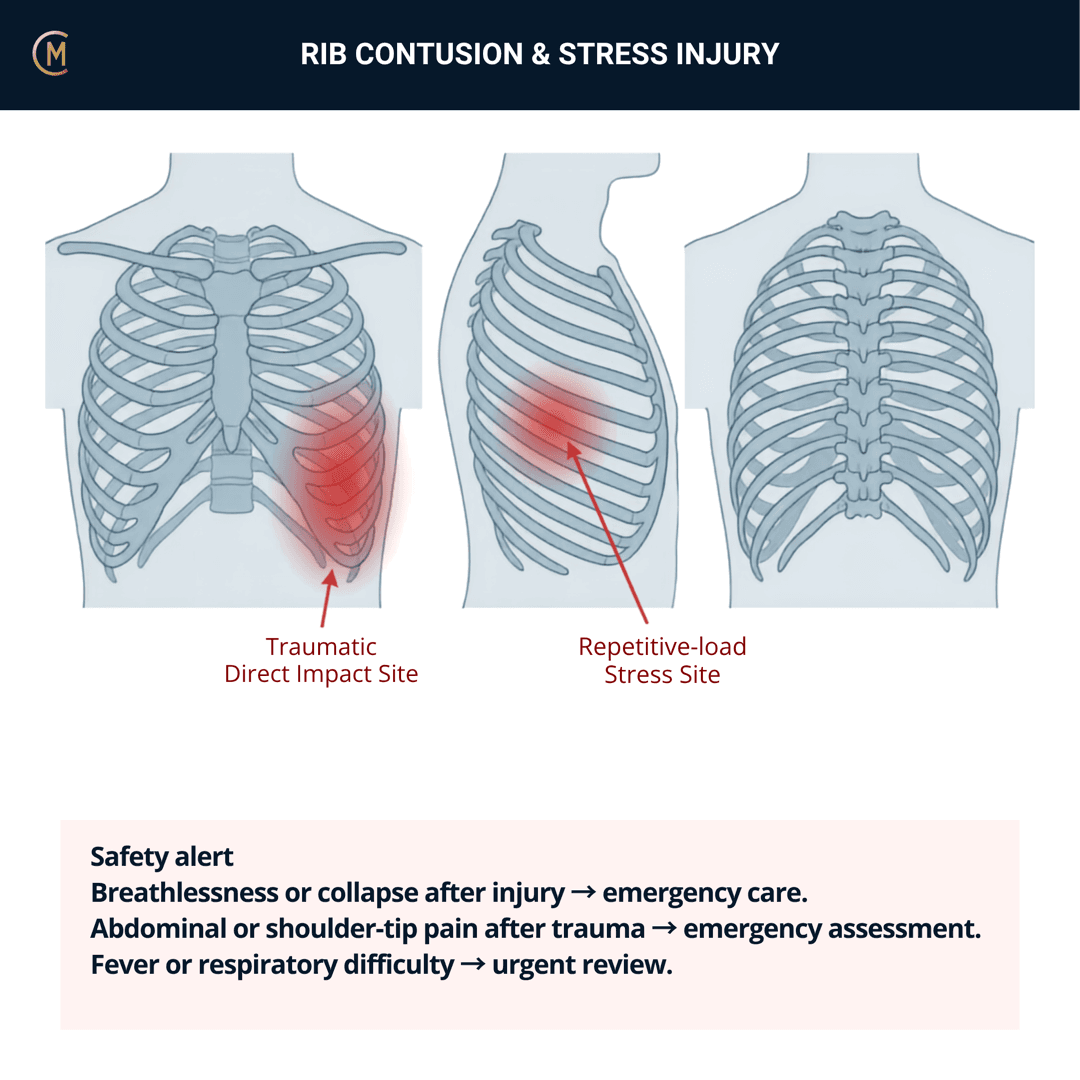
Who: Contact sport, rowers, swimmers, throwers, and anyone after a fall or a blow to the chest. Older adults are a separate risk group entirely.
What: Contusion, stress reaction or fracture of the rib or its junctions.
How it behaves: Sharp, localised. Aggs: deep inspiration, coughing, sneezing, laughing, trunk rotation, lying on it. Eases: rest — and splinting, which is the problem.
The one thing to take from this page:
The rib heals on its own. The complication is respiratory. Splinting the chest, breathing shallowly and suppressing a cough is the path from a sore rib to atelectasis to pneumonia — so your job is pain control good enough to allow a deep breath, not comfort achieved by not breathing.
Two pathways, kept separate
| Traumatic rib fracture | Athletic rib stress injury | |
|---|---|---|
| Mechanism | A blow, a fall, a tackle | Repetitive load — rowing, throwing, swimming, lifting |
| Onset | Instant | Gradual, and often ignored for weeks |
| The literature | Large, surgical, hospital-based | Case-level |
| The risk | Respiratory complication | Missed diagnosis and continued loading |
Don't borrow numbers from one pathway for the other. That's the whole reason this box is here.
2 · SE — THE SUBJECTIVE PATTERN (the 70%)
Five stages. Acute and traumatic reorders to main problem → body chart → history → behaviour.
MAIN PROBLEM
"I got hit in the ribs and now I can't take a deep breath."
"It's been building for a few weeks in the boat and now it's sharp."
"It hurts when I laugh."
BODY CHART
- One finger. Localised is the pattern. Map the rib and the level.
- Front, side or back? Costovertebral junction posteriorly, costochondral anteriorly, mid-shaft laterally.
- Mark bruising, swelling, deformity.
- Mark referral. Shoulder tip pain is a diaphragm and viscera question, not a rib question.
HISTORY — this comes early on the traumatic presentation
- Mechanism. Direct blow, fall, height, speed, what they landed on.
- Or: what load, over what period? Rowing volume, throwing volume, a change in technique or equipment. Rib stress fracture in a female athlete after a change in lifting technique is described [1].
- Which rib? The first rib is different — first rib stress fracture in an adolescent elite tennis player is described [2], and vascular injury with first rib fracture has been reported [3].
- Age, bone health, medication, previous fractures.
- Any coexisting clavicle injury? Read further: combined clavicle and rib fractures [4].
BEHAVIOUR
- Aggs: deep breath, cough, sneeze, laugh, rotation, lying on the side, getting out of bed.
- Eases: rest, shallow breathing, holding it — note that as a finding, not a solution.
- Night: lying on the side is in the Aggs. Atraumatic or night rib pain is a referral trigger in §6.
- Severity: VAS 0–10 at best / at worst / right now.
- Irritability: resting symptoms + vigour of the provoking activity + time to settle.
- The key question: how deep a breath can they take, and are they avoiding coughing?
SPECIAL / SCREENING QUESTIONS
- Any breathlessness, or has the breathing changed?
- Any coughing up blood, fever, or coloured sputum?
- Any abdominal pain, shoulder tip pain, nausea, or feeling faint?
- No trauma at all? Then: night pain, rest pain, weight loss, cancer history.
Assessing this region? Download the Thoracic Spine assessment template →
3 · HYPOTHESIS RANKING
| Competing pattern | The one discriminating feature |
|---|---|
| Costovertebral / costotransverse dysfunction | Reproduced by rib springing and segmental PA, no trauma, no focal bony tenderness. |
| Costochondritis | Anterior, at the junctions, tender across several, no trauma or overuse story. |
| Thoracic facet (PIV) joint | Segmental, extension- and rotation-provoked, may wrap — the classic confusion. |
| Intercostal muscle strain | Diffuse along the interspace, stretch- and contraction-provoked more than point-tender on bone. |
| Rib stress fracture | Gradual onset in a loading athlete, focal bony tenderness, night pain. This is what the overuse story becomes if you keep loading it. |
| Abdominal or visceral referral | Lower ribs. Shoulder tip pain, nausea, abdominal signs. |
The ones that outrank the table
- Pneumothorax or haemothorax. Breathlessness after a rib injury is not pain.
- Underlying visceral injury. Lower ribs — liver on the right, spleen on the left. Abdominal pain, shoulder tip pain, feeling faint.
- First rib injury. Vascular injury has been reported with first rib fracture.
- Malignancy. Clinical pearl: atraumatic or persistent rib pain screens for metastasis. It is the best line on the page.
- Multiple fractures, or an older adult. Read further: rib fractures in the elderly [5][6], number of fractures and delayed complications [7].
4 · RED FLAGS — DON'T MISS THIS
This section is free, on every pattern, forever. Safety is never gated.
This pattern needs a red-flag layer — the injury is the trivial part.
| Finding | What it suggests | What you do |
|---|---|---|
| Breathlessness, rapid or shallow breathing, low saturations | Pneumothorax, haemothorax, pulmonary contusion | EMERGENCY |
| Abdominal pain, shoulder tip pain, faintness after a lower rib injury | Splenic or hepatic injury | EMERGENCY |
| Fever, productive cough, worsening breathing days later | Pneumonia — the complication this page exists for | Urgent medical review |
| Coughing up blood | Pulmonary injury | Urgent medical review |
| First rib injury | Vascular injury has been reported | Medical review |
| Multiple ribs, or a flail segment | Chest wall instability | EMERGENCY |
| Older adult with rib fractures | Disproportionate risk | Lower your threshold. Medical review |
| Atraumatic, persistent or night rib pain | Stress fracture or metastasis | Medical review and imaging |
| Low-energy mechanism causing a fracture | Bone health | Medical review |
The rule: the rib heals by itself. The chain that hurts people is pain → splinting → shallow breathing → atelectasis → pneumonia. Your job is to break that chain.
One imaging rule
A negative chest X-ray does not exclude a rib fracture. Read further: CT for radiographically occult rib fractures [8][9], chest ultrasonography test characteristics [10], ACR Appropriateness Criteria [11]. "The X-ray was clear" is not a discharge.
Cross-links: Costochondritis / Tietze's · Costovertebral / costotransverse dysfunction · Cardiac / pulmonary referred pain · Thoracic facet (PIV) joint dysfunction
5 · OE — THE OBJECTIVE (the 30%)
Members
Sections 5 to 7 are for members
The objective exam, management and pearls, plus the six-minute lesson and the debrief. Free with an account.
Sign in or join free6 · MX — MANAGEMENT ESSENTIALS
Members
Sections 5 to 7 are for members
The objective exam, management and pearls, plus the six-minute lesson and the debrief. Free with an account.
Sign in or join free7 · CLINICAL PEARLS + RETRIEVAL CHECK
Members
Sections 5 to 7 are for members
The objective exam, management and pearls, plus the six-minute lesson and the debrief. Free with an account.
Sign in or join freeMembers
The 4-minute lesson is for members
Twelve slides on this pattern: what you'll hear, what to examine, what to do. Free with an account.
Sign in or join freeGuideline anchor
No Australian guideline for this presentation.
More
Anchored to For traumatic chest wall injury, the Australian anchor is Queensland Health's Blunt chest trauma clinical practice guideline (state; revised 2024): contusions, rib fractures, analgesia, physiotherapy and discharge advice, with nothing on rib stress injury. There is another Australian anchor worth having — a rib fracture management pathway has been evaluated in an Australian tertiary centre (Morrison et al. 2026, PMID 42536040) — and the physiotherapy anchor is Australian too: physiotherapy management of rib fractures in Journal of Physiotherapy (Elkins 2023, PMID 37714770). Imaging is anchored to the ACR Appropriateness Criteria for rib fractures (Henry et al. 2019, PMID 31054749). Surgical stabilisation is anchored to the WSES/CWIS position paper (Sermonesi et al. 2024, PMID 39425134).
None of these is an Australian clinical practice guideline for the athlete with a rib stress injury. The traumatic rib fracture literature is large, surgical and hospital-based; the athletic rib stress injury literature is case-level. This page keeps the two pathways separate rather than borrowing numbers from one for the other.
Members
The evidence summary is for members
Verified diagnostic accuracy, where the evidence stands and what it doesn't settle. Free with an account.
Sign in or join freeSources · 20
ShowHide
Every source on this page resolves and title-verifies against PubMed. Newest first.
- 2024Fukuda et al. (2024). Rib stress fracture in a female athlete caused by bouncing the barbell in bench press exercise: A case report. SAGE open medical case reports, 12, 2050313X241232863. https://doi.org/10.1177/2050313X241232863
- 2023Wahle et al. (2023). First Rib Stress Fracture in an Adolescent Elite Tennis Player: A Case Report. JBJS case connector, 13(1). https://doi.org/10.2106/JBJS.CC.22.00519
- 1981Phillips et al. (1981). First rib fractures: incidence of vascular injury and indications for angiography. Surgery, 89(1), 42-7. PubMed 7466610
- 2022Sweet et al. (2022). Epidemiology of combined clavicle and rib fractures: a systematic review. European journal of trauma and emergency surgery : official publication of the European Trauma Society, 48(5), 3513-3520. https://doi.org/10.1007/s00068-021-01701-4
- 2023Hoepelman et al. (2023). Rib fractures in the elderly population: a systematic review. Archives of orthopaedic and trauma surgery, 143(2), 887-893. https://doi.org/10.1007/s00402-022-04362-z
- 2020Coary et al. (2020). New horizons in rib fracture management in the older adult. Age and ageing, 49(2), 161-167. https://doi.org/10.1093/ageing/afz157
- 2020Flores-Funes et al. (2020). Is the number of rib fractures a risk factor for delayed complications? A case-control study. European journal of trauma and emergency surgery : official publication of the European Trauma Society, 46(2), 435-440. https://doi.org/10.1007/s00068-018-1012-x
- 2019Singleton et al. (2019). Chest computed tomography imaging utility for radiographically occult rib fractures in elderly fall-injured patients. The journal of trauma and acute care surgery, 86(5), 838-843. https://doi.org/10.1097/TA.0000000000002208
- 2021Alzahrani et al. (2021). The diagnostic performance of chest computed tomography in the detection of rib fractures in children investigated for suspected physical abuse: a systematic review and meta-analysis. European radiology, 31(9), 7088-7097. https://doi.org/10.1007/s00330-021-07775-3
- 2022Gilbertson et al. (2022). Test Characteristics of Chest Ultrasonography for Rib Fractures Following Blunt Chest Trauma: A Systematic Review and Meta-analysis. Annals of emergency medicine, 79(6), 529-539. https://doi.org/10.1016/j.annemergmed.2022.02.006
- 2019Henry et al. (2019). ACR Appropriateness Criteria(®) Rib Fractures. Journal of the American College of Radiology : JACR, 16(5S), S227-S234. https://doi.org/10.1016/j.jacr.2019.02.019
- 2024Sharma et al. (2024). Surgical stabilisation of rib fractures: A meta-analysis of randomised controlled trials. Injury, 55(8), 111705. https://doi.org/10.1016/j.injury.2024.111705
- 2024Sermonesi et al. (2024). Surgical stabilization of rib fractures (SSRF): the WSES and CWIS position paper. World journal of emergency surgery : WJES, 19(1), 33. https://doi.org/10.1186/s13017-024-00559-2
- 2025Yoon et al. (2025). Innovative Dynamic Ultrasound Diagnosis of First Rib Stress Fracture in an Adolescent Athlete-A Case Report. Diagnostics (Basel, Switzerland), 15(19). https://doi.org/10.3390/diagnostics15192437
- 2020Marco et al. (2020). Risk factors for pneumonia following rib fractures. The American journal of emergency medicine, 38(3), 610-612. https://doi.org/10.1016/j.ajem.2019.10.021
- 2024Anderson et al. (2024). The role of respiratory therapy in rib fracture management. Current problems in surgery, 61(12), 101664. https://doi.org/10.1016/j.cpsurg.2024.101664
- 2023Elkins (2023). Physiotherapy management of rib fractures. Journal of physiotherapy, 69(4), 211-219. https://doi.org/10.1016/j.jphys.2023.08.016
- 2026Morrison et al. (2026). Evaluation of a rib fracture management pathway in an Australian tertiary trauma hospital. The Journal of international medical research, 54(8), 3000605261471253. https://doi.org/10.1177/03000605261471253
- 2025Bresgen et al. (2025). Acute pain management of rib fractures: a narrative review. Injury, 56(12), 112857. https://doi.org/10.1016/j.injury.2025.112857
- 2022Peek et al. (2022). Epidemiology and outcome of rib fractures: a nationwide study in the Netherlands. European journal of trauma and emergency surgery : official publication of the European Trauma Society, 48(1), 265-271. https://doi.org/10.1007/s00068-020-01412-2
Mapped to this pattern
Generic measures that also apply
- Borg RPE
Borg Rating of Perceived Exertion Scale (6-20)
perceived exertion · 1 items · 1 min
- GROC
Global Rating of Change Scale
perceived change since baseline · 1 items · 1 min
- NPRS
Numeric Pain Rating Scale
pain intensity · 1 items · 1 min
- PGIC
Patient Global Impression of Change
perceived change since baseline · 1 items · 1 min
- PSFS
Patient-Specific Functional Scale
patient-generated function · 3 items · 2 min
- SANE
Single Assessment Numeric Evaluation
patient-rated function as a percentage of normal · 1 items · 1 min
- VAS
Visual Analogue Scale
pain intensity · 1 items · 1 min
- Borg CR10
Borg Category Ratio 10 Scale
perceived exertion or symptom intensity, ratio scale · 1 items · 1 min
- GAS
Goal Attainment Scaling
individualised goal achievement · 10 min
Did this page do its job?
CliniStudy is in beta. One tap is enough — it decides what gets fixed first.