
1 · SNAPSHOT
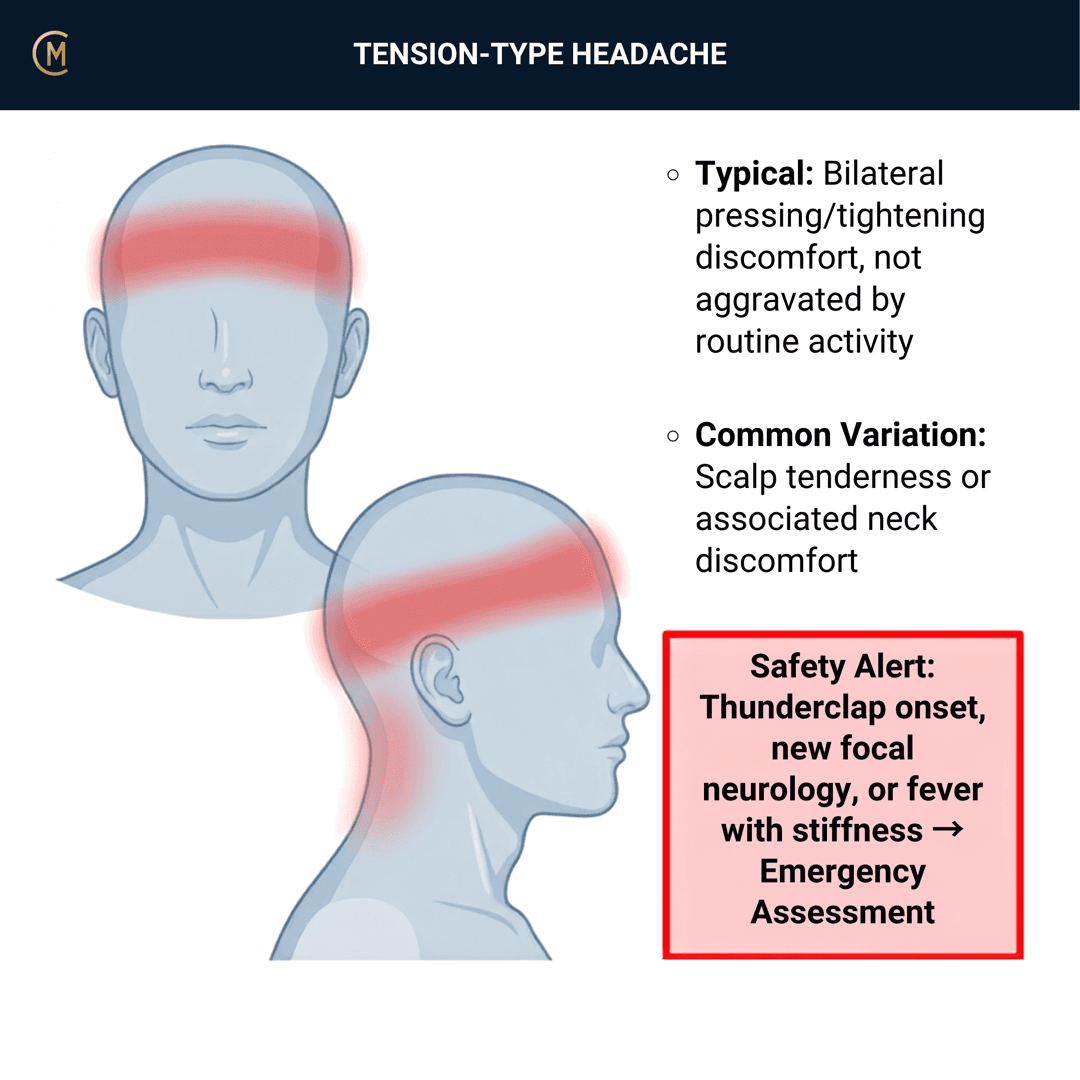
The most common primary headache, and the one students most often manage without asking the two questions that matter.
Illness script in one line: bilateral, band-like pressing or tightening head pain, mild to moderate, dull and non-pulsating, not made worse by walking up stairs, with no nausea and at most one of light or sound sensitivity.
Caseload frequency: very high. Read further: epidemiology [1], burden of migraine and tension-type headache [2]. That it is the most common primary headache is what you need.
The two questions that matter
1. "Does it get worse walking up stairs?" Not aggravated by routine physical activity is a formal diagnostic criterion for tension-type headache. Migraine is aggravated by activity. This isn't. It's the cleanest single discriminator you have and it takes four seconds.
2. "How many days a month do you take something for it?" Medication overuse headache is the single most common reason a frequent headache stops responding to anything [3]. Ask, every time.
2 · SE — THE SUBJECTIVE PATTERN (the 70%)
MAIN PROBLEM
"A tight band around my head." Or: pressure · a vice · a weight · my head feels squeezed.
They rarely say "pain". Listen for pressure words.
BODY CHART
- Bilateral. Unilateral should make you re-rank immediately.
- Band-like: frontal, temporal, occipital, or all three.
- ± suboccipital, upper trapezius and temporalis tenderness. Common.
- ± neck stiffness. Common, and not the same as causal.
BEHAVIOUR — and this is where the criteria live
| Feature | Tension-type headache |
|---|---|
| Quality | Pressing or tightening. NON-pulsating. |
| Intensity | Mild to moderate. Usually gets through the day. |
| Effect of routine physical activity | NOT aggravated. ← the cleanest discriminator |
| Nausea or vomiting | Absent. |
| Photophobia / phonophobia | At most ONE. Never both. |
| Duration | Minutes to days. Variable. |
- Aggs: stress, fatigue, sustained desk work, eye strain, poor sleep, missed meals.
- Eases: movement, rest, sleep, getting away from the trigger. Often eases with activity, which is the opposite of migraine.
- Irritability: typically low.
HISTORY — five things, and two of them are new
- Frequency: episodic or chronic? Under 15 days a month, or 15 and over? That single number changes the management and the prognosis conversation.
- Analgesic days per month. The medication overuse question. Ask it as a number, not as "do you take much?"
- A headache diary. Read further: development of a headache diary and the diagnostic criteria [4]. Give them one at session one. It is the highest-yield thing you'll do.
- Jaw: clenching, grinding, clicking, morning jaw ache. Read further: temporomandibular disorders in migraine and tension-type headache [5]. Examine the jaw.
- Sleep, workload, mood and stress load.
SPECIAL / SCREENING QUESTIONS — every time
Thunderclap onset. New headache over 50. Progressive or changing pattern. Positional change. Fever. Neurological deficit. Cancer or immunosuppression history. Papilloedema. Trauma. Pregnancy or postpartum. Painful eye with autonomic features.
Red and orange flags for secondary headaches are set out as the SNNOOP10 list [6]. Read further: its sensitivity in high-risk secondary headache detection [7]. No verified accuracy data in our library. Use it as a checklist, not a score.
Plus the CAD/VBI screen if there's any neck involvement — the 5 D's and 3 N's.
Assessing this region? Download the Cervical Spine assessment template →
3 · HYPOTHESIS RANKING
Top three, and the one feature that separates each
| Pattern | The discriminating feature |
|---|---|
| 1. Tension-type headache | Bilateral, pressing, mild–moderate, NOT aggravated by routine activity, no nausea, at most one of photo/phonophobia. |
| 2. Migraine | Unilateral, throbbing, moderate–severe, AGGRAVATED by routine activity, nausea, both photophobia and phonophobia. Every row is the opposite. |
| 3. Cervicogenic headache | Unilateral, side-locked, reproduced from the upper cervical segments, provoked by neck movement or sustained posture. Its own page — go there. |
And the one that mimics it
| Pattern | The discriminating feature |
|---|---|
| Medication overuse headache | Headache on 15 or more days a month in someone taking acute medication regularly. It looks like chronic TTH and won't respond until the medication is addressed. |
Also on the list
| Pattern | The discriminating feature |
|---|---|
| Temporomandibular disorder | Jaw pain, clicking, limited opening. Overlaps with TTH; systematically reviewed. Examine the jaw. |
| Cluster headache | Severe unilateral orbital pain, short-lasting, autonomic features, restless. |
| Secondary headache | Any SNNOOP10 flag. |
Read further: differences and similarities between tension-type headache and migraine [8], clinical overviews of both [9][10]. They overlap, and they coexist. Use three discriminators, not one.
4 · RED FLAGS — DON'T MISS THIS
Free forever. Safety is never behind a paywall.
Every headache page needs this section, and this one needs it most, because tension-type headache is the diagnosis a benign-looking secondary headache gets given by default.
| Finding | What it means |
|---|---|
| Thunderclap — maximal within seconds to a minute | Subarachnoid haemorrhage until proven otherwise. EMERGENCY. |
| New or changed headache over 50 | Giant cell arteritis, tumour. Urgent. |
| Progressive, or a clear change in the established pattern | Urgent. |
| New neurological deficit, seizure, or altered consciousness | EMERGENCY. |
| Worse lying flat, worse on waking, worse with valsalva | Raised intracranial pressure. Urgent. |
| Fever, neck stiffness, rash | Meningitis. EMERGENCY. |
| Cancer history, immunosuppression, HIV | Urgent. |
| Papilloedema | Urgent. |
| Trauma, pregnancy or postpartum, painful eye with autonomic features | Urgent. |
| Any of the 5 D's or 3 N's with neck involvement | CAD/VBI. Do not manipulate. Escalate. |
Two things to hold onto
The SNNOOP10 list exists so you don't have to hold ten things in your head. Use it as a checklist, not a score. No verified accuracy data in our library.
"No neurological findings" describes the typical case. It is not permission to skip the screen.
Any red flag: stop, escalate, and check it with your educator.
5 · OE — THE OBJECTIVE (the 30%)
Members
Sections 5 to 7 are for members
The objective exam, management and pearls, plus the six-minute lesson and the debrief. Free with an account.
Sign in or join free6 · MX — MANAGEMENT ESSENTIALS
Members
Sections 5 to 7 are for members
The objective exam, management and pearls, plus the six-minute lesson and the debrief. Free with an account.
Sign in or join free7 · CLINICAL PEARLS + RETRIEVAL CHECK
Members
Sections 5 to 7 are for members
The objective exam, management and pearls, plus the six-minute lesson and the debrief. Free with an account.
Sign in or join freeMembers
The 4-minute lesson is for members
Twelve slides on this pattern: what you'll hear, what to examine, what to do. Free with an account.
Sign in or join freeGuideline anchor
No Australian guideline for this presentation; anchored to the EFNS guideline on the treatment of tension-type headache (Bendtsen et al. 2010, PMID 20482606) for treatment.
More
The safety anchor is the SNNOOP10 list of red and orange flags for secondary headaches, published in Neurology (Do et al. 2019, PMID 30587518), with its sensitivity in high-risk secondary headache detection examined (García-Azorín et al. 2022, PMID 36003002). No physiotherapy guideline exists; the physiotherapy evidence is anchored to a systematic review and meta-analysis of physiotherapy approaches in chronic tension-type headache (Onan et al. 2025, PMID 40129422).
The EFNS guideline is a pharmacological treatment guideline written for neurologists. It is not a physiotherapy management guideline — none exists for this condition.
Members
The evidence summary is for members
Verified diagnostic accuracy, where the evidence stands and what it doesn't settle. Free with an account.
Sign in or join freeSources · 20
ShowHide
Every source on this page resolves and title-verifies against PubMed. Newest first.
- 1998Schwartz et al. (1998). Epidemiology of tension-type headache. JAMA, 279(5), 381-3. https://doi.org/10.1001/jama.279.5.381
- 2025Zhao et al. (2025). The burden of migraine and tension-type headache in Asia from 1990 to 2021. The journal of headache and pain, 26(1), 49. https://doi.org/10.1186/s10194-025-01990-9
- 2023Ashina et al. (2023). Medication overuse headache. Nature reviews. Disease primers, 9(1), 5. https://doi.org/10.1038/s41572-022-00415-0
- 2024González-González & Herrero (2024). Development of a Headache Diary and Assessment of Tension-Type Headache Diagnostic Criteria and Oral Behaviors, Joint Range of Motion, and Tenderness to Palpation: An Observational Study. Journal of chiropractic medicine, 23(1-2), 37-46. https://doi.org/10.1016/j.jcm.2024.02.003
- 2024Bizzarri et al. (2024). Temporomandibular disorders in migraine and tension-type headache patients: a systematic review with meta-analysis. Journal of oral & facial pain and headache, 38(2), 11-24. https://doi.org/10.22514/jofph.2024.011
- 2019Do et al. (2019). Red and orange flags for secondary headaches in clinical practice: SNNOOP10 list. Neurology, 92(3), 134-144. https://doi.org/10.1212/WNL.0000000000006697
- 2022García-Azorín et al. (2022). Sensitivity of the SNNOOP10 list in the high-risk secondary headache detection. Cephalalgia : an international journal of headache, 42(14), 1521-1531. https://doi.org/10.1177/03331024221120249
- 2023Onan et al. (2023). Debate: differences and similarities between tension-type headache and migraine. The journal of headache and pain, 24(1), 92. https://doi.org/10.1186/s10194-023-01614-0
- 2019Burch (2019). Migraine and Tension-Type Headache: Diagnosis and Treatment. The Medical clinics of North America, 103(2), 215-233. https://doi.org/10.1016/j.mcna.2018.10.003
- 2025Pan et al. (2025). Hallmarks of primary headache: part 2- Tension-type headache. The journal of headache and pain, 26(1), 164. https://doi.org/10.1186/s10194-025-02098-w
- 2023Fernández-de-Las-Peñas et al. (2023). The cervical spine in tension type headache. Musculoskeletal science & practice, 66, 102780. https://doi.org/10.1016/j.msksp.2023.102780
- 2025Onan et al. (2025). The efficacy of physiotherapy approaches in chronic tension-type headache: a systematic review and meta-analysis. Journal of oral & facial pain and headache, 39(1), 34-48. https://doi.org/10.22514/jofph.2025.003
- 2024Jung et al. (2024). Physical Therapist Interventions to Reduce Headache Intensity, Frequency, and Duration in Patients With Cervicogenic Headache: A Systematic Review and Network Meta-Analysis. Physical therapy, 104(2). https://doi.org/10.1093/ptj/pzad154
- 2023Repiso-Guardeño et al. (2023). Physical Therapy in Tension-Type Headache: A Systematic Review of Randomized Controlled Trials. International journal of environmental research and public health, 20(5). https://doi.org/10.3390/ijerph20054466
- 2024Lu et al. (2024). Myofascial Release for the Treatment of Tension-Type, Cervicogenic Headache or Migraine: A Systematic Review and Meta-Analysis. Pain research & management, 2024, 2042069. https://doi.org/10.1155/2024/2042069
- 2024Park et al. (2024). Improving Function and Quality of Life in Patients with Chronic Neck Pain, Tension-Type Headache, and Forward Head Posture: The Role of Eyeball Exercise and Cervical Stabilization Programs. Medical science monitor : international medical journal of experimental and clinical research, 30, e944315. https://doi.org/10.12659/MSM.944315
- 2024Xie et al. (2024). Efficacy and safety of simple analgesics for acute treatment of episodic tension-type headache in adults: a network meta-analysis. Annals of medicine, 56(1), 2357235. https://doi.org/10.1080/07853890.2024.2357235
- 2010Bendtsen et al. (2010). EFNS guideline on the treatment of tension-type headache - report of an EFNS task force. European journal of neurology, 17(11), 1318-25. https://doi.org/10.1111/j.1468-1331.2010.03070.x
- 2024Gopichandran et al. (2024). Effectiveness of Progressive Muscle Relaxation and Deep Breathing Exercise on Pain, Disability, and Sleep Among Patients With Chronic Tension-Type Headache: A Randomized Control Trial. Holistic nursing practice, 38(5), 285-296. https://doi.org/10.1097/HNP.0000000000000460
- 2018Kong et al. (2018). Testing of diagnosis criteria of tension-type headache: A multicenter clinical study. Cephalalgia : an international journal of headache, 38(12), 1833-1840. https://doi.org/10.1177/0333102418759784
Mapped to this pattern
Generic measures that also apply
- Borg RPE
Borg Rating of Perceived Exertion Scale (6-20)
perceived exertion · 1 items · 1 min
- GROC
Global Rating of Change Scale
perceived change since baseline · 1 items · 1 min
- NPRS
Numeric Pain Rating Scale
pain intensity · 1 items · 1 min
- PGIC
Patient Global Impression of Change
perceived change since baseline · 1 items · 1 min
- PSFS
Patient-Specific Functional Scale
patient-generated function · 3 items · 2 min
- SANE
Single Assessment Numeric Evaluation
patient-rated function as a percentage of normal · 1 items · 1 min
- VAS
Visual Analogue Scale
pain intensity · 1 items · 1 min
- Borg CR10
Borg Category Ratio 10 Scale
perceived exertion or symptom intensity, ratio scale · 1 items · 1 min
- GAS
Goal Attainment Scaling
individualised goal achievement · 10 min
Did this page do its job?
CliniStudy is in beta. One tap is enough — it decides what gets fixed first.