
1 · SNAPSHOT
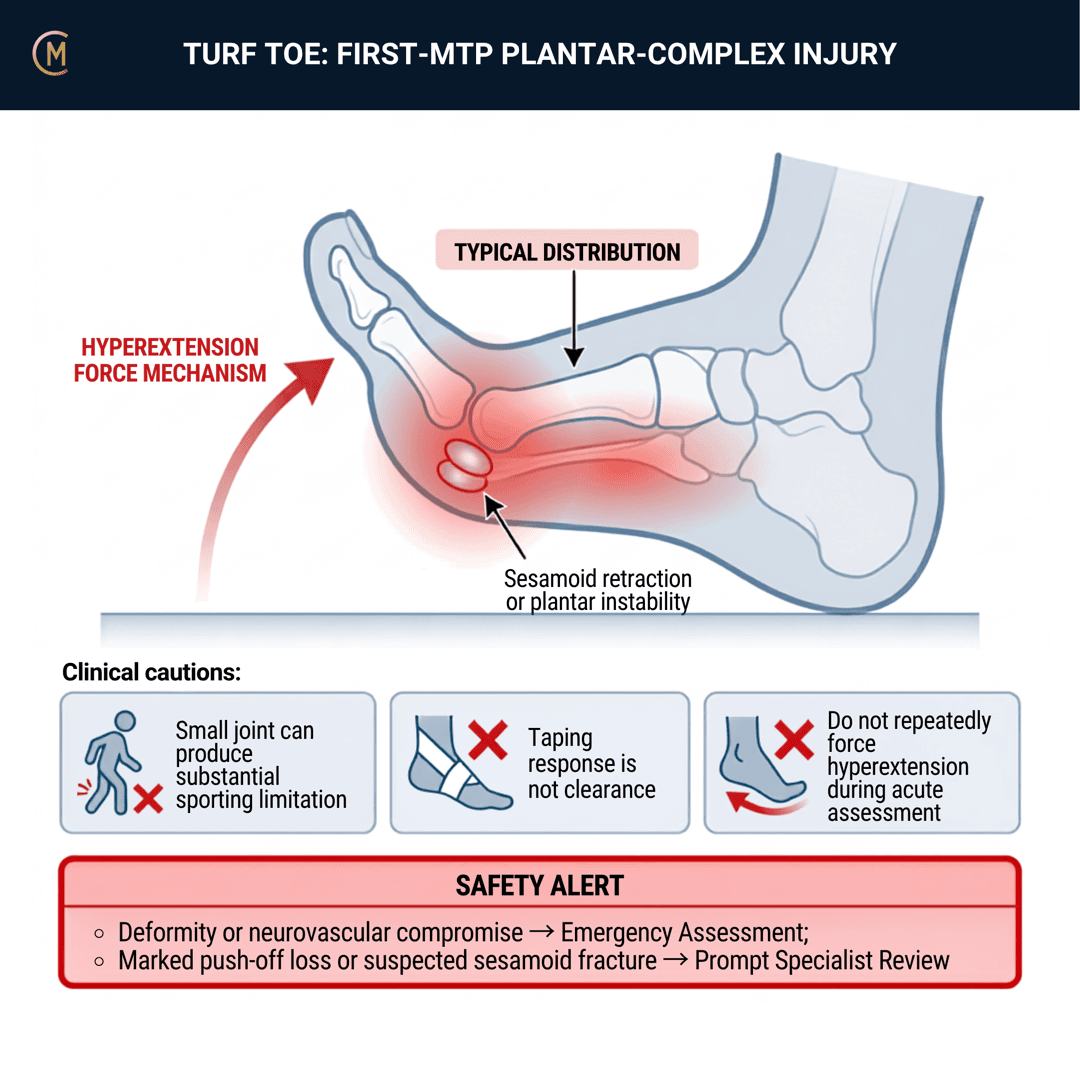
Who: Cutting and push-off sports, often on turf or court. Football, gridiron, court sports, dance.
What: A plantar capsuloligamentous (plantar plate) injury of the first MTP, from forced hyperextension with axial load.
How it behaves: Plantar first MTP pain and swelling, difficulty with propulsion and sprinting. Sometimes a pop with immediate loss of push-off strength. Worse in flexible shoes, better in stiffer soles.
The one thing to take from this page:
Under-protected Grade II–III can progress to hallux rigidus. The cost of under-treating this isn't a slower return — it's a different diagnosis.
The grade drives everything
| Grade | What it is | What it needs |
|---|---|---|
| I | Stretch injury, minimal swelling, able to push off | Stiff sole, tape, early pain-free range |
| II | Partial tear, more swelling, painful push-off, some laxity | Real protection. This is the one that gets under-treated |
| III | Complete disruption, plantar bruising, sesamoid migration, instability, loss of propulsion | Early specialist review |
⚠️ No guideline exists, anywhere — the surgical literature itself notes there are no universal guidelines. Anchored to the return-to-sport meta-analysis [1] and the treatment systematic review [2].
2 · SE — THE SUBJECTIVE PATTERN (the 70%)
Acute trauma, so your course reorders it: MAIN PROBLEM → BODY CHART → HISTORY → BEHAVIOUR.
MAIN PROBLEM
"My toe got bent right back when I planted."
"I heard something and I couldn't push off after."
"It's swollen underneath and I can't sprint."
BODY CHART
- Mark it plantar, over the capsule and the sesamoid complex.
- Mark bruising, and where. Plantar bruising is a Grade III flag (Drakos et al. 2015).
- Mark the dorsal joint line separately — that's the hallux rigidus question, now and later.
HISTORY
The mechanism is the diagnosis.
- Forced hyperextension with axial load, during push-off, cutting, sprinting or a contact event.
- Surface — turf, court, hard ground.
- Was there a pop? And could they push off immediately after? Those two questions do more grading work than anything in your hands.
- Footwear — flexible-soled boots increase the risk profile.
BEHAVIOUR
- Worse in flexible shoes, better in stiffer soles. That is diagnostic and it is also the first treatment.
- Severity: VAS 0–10 at best / at worst / right now.
- Propulsion and sprinting are the functional complaints, not walking.
SPECIAL / SCREENING QUESTIONS
- Any sense of the toe being unstable or giving way?
- Previous first MTP injury — and how it was managed.
- Sport demands and timeline. You will be having a grade-versus-calendar conversation, so get the context first.
Assessing this region? Download the Ankle & Foot assessment template →
3 · HYPOTHESIS RANKING
| Competing pattern | The one discriminating feature |
|---|---|
| Sesamoiditis | Chronic plantar first MTP ache with a bruised feel, gradual onset. Turf toe is an acute hyperextension event. |
| Hallux rigidus | Dorsal jamming with reduced dorsiflexion. And an under-protected turf toe can progress to it — so it is both a differential and an outcome. |
| Sesamoid fracture or retraction | Always screen the sesamoids and the plantar plate. A missed injury prolongs disability. |
The one that changes the destination
Complete plantar plate disruption. It can be career-limiting, and plantar bruising, sesamoid migration and instability deserve early specialist review [3]. This is not a "let's see how it goes over two weeks" injury.
And know the whole differential for athlete first MTP pain: turf toe, sesamoiditis, sand toe, tendinopathy and metatarsalgia (Lim & Liem 2023).
4 · RED FLAGS — DON'T MISS THIS
This section is free, on every pattern, forever. Safety is never gated.
| Finding | What it suggests | What you do |
|---|---|---|
| A pop with immediate loss of push-off | Grade III, plantar plate rupture | Protect and image. Specialist review |
| Plantar bruising | Higher-grade injury | Image. Specialist review |
| Sesamoid migration — proximal drift on imaging or palpation | Plantar plate disruption | Urgent specialist review |
| Frank instability on drawer or valgus/varus stress | Grade III | Specialist review |
| Loss of hallux flexor power | Flexor hallucis brevis or plantar plate involvement | Image |
| Focal bony tenderness with a load history | Sesamoid fracture or stress injury | Offload and image |
| Deformity or neurovascular compromise | Dislocation or significant trauma | 🚑 Emergency department |
| Hot, swollen joint without a convincing injury | Infection or crystal arthritis | Same-day medical review |
| Not settling on appropriate protection | Missed component, or higher grade than assigned | Re-image, reassess the grade |
The rule: protect first, grade second, and refer on instability, bruising or sesamoid migration. Under-protection is the failure mode this page exists to prevent.
Cross-links: Sesamoiditis · Hallux rigidus · Metatarsalgia
5 · OE — THE OBJECTIVE (the 30%)
Members
Sections 5 to 7 are for members
The objective exam, management and pearls, plus the six-minute lesson and the debrief. Free with an account.
Sign in or join free6 · MX — MANAGEMENT ESSENTIALS
Members
Sections 5 to 7 are for members
The objective exam, management and pearls, plus the six-minute lesson and the debrief. Free with an account.
Sign in or join free7 · CLINICAL PEARLS + RETRIEVAL CHECK
Members
Sections 5 to 7 are for members
The objective exam, management and pearls, plus the six-minute lesson and the debrief. Free with an account.
Sign in or join freeMembers
The 4-minute lesson is for members
Twelve slides on this pattern: what you'll hear, what to examine, what to do. Free with an account.
Sign in or join freeGuideline anchor
No guideline exists for turf toe, in Australia or anywhere.
More
Anchored to the systematic review and meta-analysis of return to sport (Vopat et al. 2019, PMID 31663005) and the systematic review of treatment options (Seow et al. 2020, PMID 31882133), with the current clinical picture from the updated review (Gupta et al. 2023, PMID 37789169).
There is no guideline and no consensus pathway. The surgical literature itself notes there are no universal guidelines. The grade-based approach on this page comes from the reviews, and the specific week ranges are labelled as a working guide rather than verified data.
Members
The evidence summary is for members
Verified diagnostic accuracy, where the evidence stands and what it doesn't settle. Free with an account.
Sign in or join freeSources · 17
ShowHide
Every source on this page resolves and title-verifies against PubMed. Newest first.
- 2019Vopat et al. (2019). Return to Sport After Turf Toe Injuries: A Systematic Review and Meta-analysis. Orthopaedic journal of sports medicine, 7(10), 2325967119875133. https://doi.org/10.1177/2325967119875133
- 2020Seow et al. (2020). Treatment Options for Turf Toe: A Systematic Review. The Journal of foot and ankle surgery : official publication of the American College of Foot and Ankle Surgeons, 59(1), 112-116. https://doi.org/10.1053/j.jfas.2018.12.041
- 2015Drakos et al. (2015). Plantar-plate disruptions: "the severe turf-toe injury." three cases in contact athletes. Journal of athletic training, 50(5), 553-60. https://doi.org/10.4085/1062-6050-49.6.05
- 2018Ashimolowo et al. (2018). Turf Toe: An Update and Comprehensive Review. Radiologic clinics of North America, 56(6), 847-858. https://doi.org/10.1016/j.rcl.2018.06.002
- 2024Azab et al. (2024). From injury to rehabilitation: How kinesiology taping helps patients with first metatarsophalangeal joint sprain (turf toe) in pain reduction, gait parameters and functional ability improvement. A randomized clinical trial. Heliyon, 10(8), e29746. https://doi.org/10.1016/j.heliyon.2024.e29746
- 2009Brophy et al. (2009). Effect of turf toe on foot contact pressures in professional American football players. Foot & ankle international, 30(5), 405-9. https://doi.org/10.3113/FAI-2009-0405
- 2014George et al. (2014). Incidence and risk factors for turf toe injuries in intercollegiate football: data from the national collegiate athletic association injury surveillance system. Foot & ankle international, 35(2), 108-15. https://doi.org/10.1177/1071100713514038
- 2018Najefi et al. (2018). Turf toe: A clinical update. EFORT open reviews, 3(9), 501-506. https://doi.org/10.1302/2058-5241.3.180012
- 2019Poppe et al. (2019). Turf Toe: Presentation, Diagnosis, and Management. JBJS reviews, 7(8), e7. https://doi.org/10.2106/JBJS.RVW.18.00188
- 2020Pinter et al. (2020). Outcomes of Chronic Turf Toe Repair in Non-athlete Population: A Retrospective Study. Indian journal of orthopaedics, 54(1), 43-48. https://doi.org/10.1007/s43465-019-00010-8
- 2020Hallinan et al. (2020). High-Resolution MRI of the First Metatarsophalangeal Joint: Gross Anatomy and Injury Characterization. Radiographics : a review publication of the Radiological Society of North America, Inc, 40(4), 1107-1124. https://doi.org/10.1148/rg.2020190145
- 2022Dimmick et al. (2022). Presurgical Perspective and Postsurgical Evaluation of Plantar Plate and Turf Toe. Seminars in musculoskeletal radiology, 26(6), 695-709. https://doi.org/10.1055/s-0042-1760221
- 2023Lim & Liem (2023). First Metatarsophalangeal Joint Pain in Athletes: Diagnosis, Management, and Return to Play Considerations. Current sports medicine reports, 22(6), 217-223. https://doi.org/10.1249/JSR.0000000000001076
- 2023Gupta et al. (2023). Turf Toe Injuries in the Athlete: an Updated Review of Treatment Options, Rehabilitation Protocols, and Return-to-Play Outcomes. Current reviews in musculoskeletal medicine, 16(11), 563-574. https://doi.org/10.1007/s12178-023-09870-y
- 2024Claikens et al. (2024). Turf Toe Injury: A Pictorial Review and a Didactic Case Report. Seminars in musculoskeletal radiology, 28(2), 213-217. https://doi.org/10.1055/s-0043-1775863
- 2024Limaye et al. (2024). Outcomes of Surgical Management of Turf Toe: 12-Year Results. Cureus, 16(4), e57808. https://doi.org/10.7759/cureus.57808
- 2025Cho et al. (2025). Return to Sport and Radiographic Postoperative Outcomes After Grade 3 Turf Toe Surgical Repair. The American journal of sports medicine, 53(8), 1988-1995. https://doi.org/10.1177/03635465251344313
Mapped to this pattern
Generic measures that also apply
- Borg RPE
Borg Rating of Perceived Exertion Scale (6-20)
perceived exertion · 1 items · 1 min
- GROC
Global Rating of Change Scale
perceived change since baseline · 1 items · 1 min
- NPRS
Numeric Pain Rating Scale
pain intensity · 1 items · 1 min
- PGIC
Patient Global Impression of Change
perceived change since baseline · 1 items · 1 min
- PSFS
Patient-Specific Functional Scale
patient-generated function · 3 items · 2 min
- SANE
Single Assessment Numeric Evaluation
patient-rated function as a percentage of normal · 1 items · 1 min
- VAS
Visual Analogue Scale
pain intensity · 1 items · 1 min
- Borg CR10
Borg Category Ratio 10 Scale
perceived exertion or symptom intensity, ratio scale · 1 items · 1 min
- GAS
Goal Attainment Scaling
individualised goal achievement · 10 min
Did this page do its job?
CliniStudy is in beta. One tap is enough — it decides what gets fixed first.