
1 · SNAPSHOT
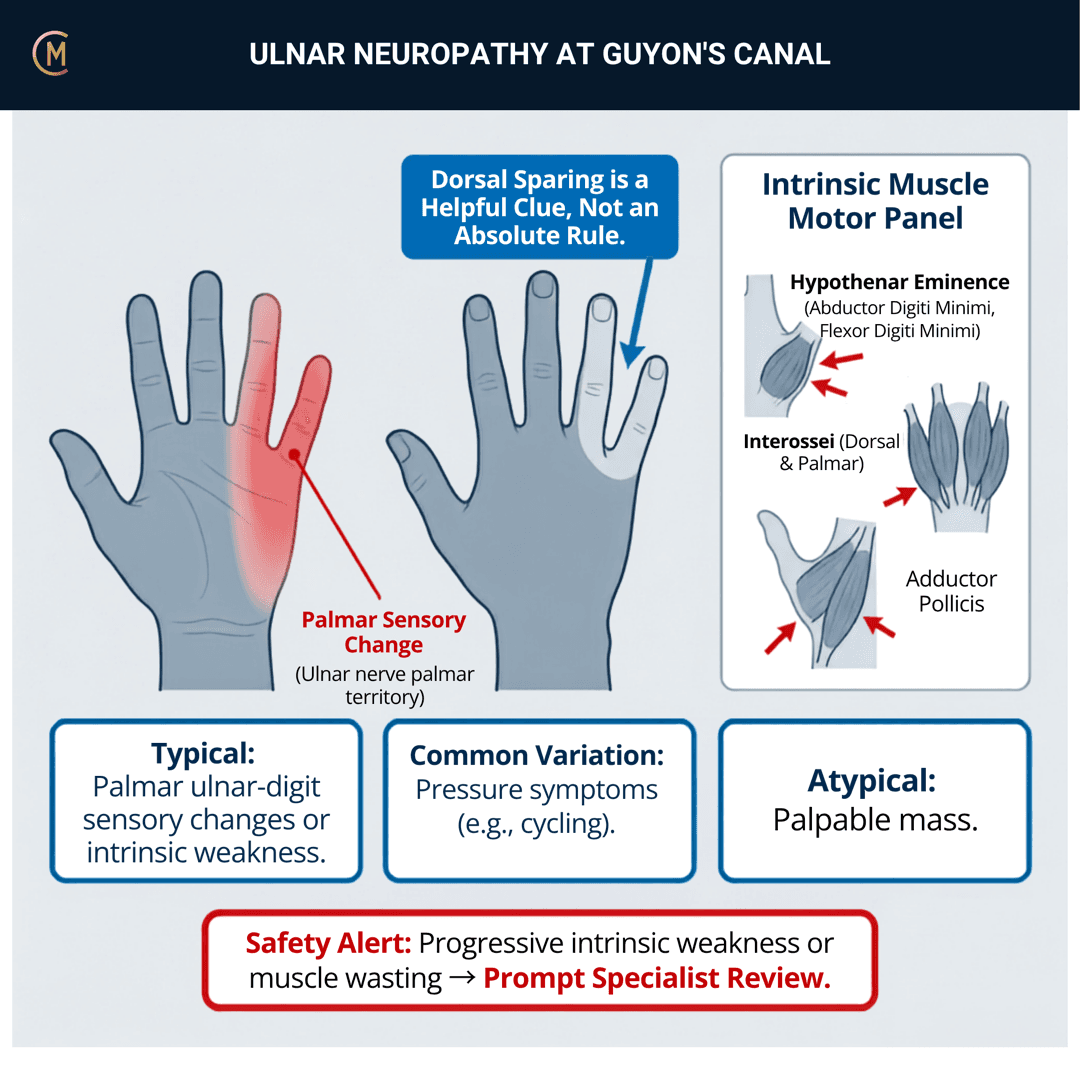
The ulnar nerve's other tunnel, and the one where a lump is a realistic cause rather than a rare one.
Illness script in one line: numbness in the ring and little fingers with a weak, clumsy hand, worse after sustained pressure through the heel of the hand — handlebars, tools, a crutch — with the back of the hand feeling completely normal.
Caseload frequency: uncommon. You will see far more carpal tunnel and far more cervical referral — which is exactly why the discriminator below is worth owning.
Check the back of the hand
This is the organising idea, and it is one of the few discriminators in the whole wrist chapter that rests on anatomy rather than on a test with no numbers.
The dorsal cutaneous branch of the ulnar nerve leaves the main trunk well above the wrist and never enters Guyon's canal. Read further: anatomy and topography of the distal ulnar nerve [1]. So the skin over the back of the little-finger side of the hand is supplied from above the canal.
| What you find | Where the problem is |
|---|---|
| Palmar ulnar numbness, dorsum normal | At or distal to the wrist — this page |
| Palmar and dorsal ulnar numbness | Proximal to the wrist — the elbow (cubital tunnel) |
| Ulnar numbness plus neck, scapular or arm symptoms, or a dermatomal pattern | Cervical — screen the neck |
One question — is the back of your hand numb too? — and one patch of skin to test. It takes ten seconds and it changes which end of the arm you examine.
2 · SE — THE SUBJECTIVE PATTERN (the 70%)
Main problem
"My ring and little fingers are numb and my hand's gone clumsy." numbness ring + little finger. Weak grip, clumsy fine motor.
Listen for clumsy as much as for numb. The deep branch of the ulnar nerve runs through the canal and supplies most of the intrinsics, so a purely motor presentation is possible — a hand that drops things, can't cross the fingers, or struggles with a key and a zip, with no sensory complaint at all.
Body chart
Palmar surface of the ring and little fingers and the ulnar palm. Then ask them to turn the hand over.
A normal dorsum is the finding. A numb dorsum sends you to the elbow. Also map: is it the whole little finger and half the ring finger, or is it a broader, less crisp area that crosses into the forearm? The second is not a peripheral nerve distribution.
Behaviour
Worse with pressure at heel of hand (handlebars, tools).
Aggs: sustained pressure through the hypothenar eminence — cycling on the drops, a long ride, hand tools, a crutch or a walking frame, resting the heel of the hand on a desk edge, leaning through the hand.
Eases: taking the pressure off, changing hand position, padded gloves, a break from the activity.
Severity: VAS 0–10 at best / at worst / right now.
Ask about the pattern over time. Symptoms that build through a long ride or a long shift and settle overnight are a compression story. Read further: elastography of the distal ulnar nerve branches in cyclists [2]. That this nerve is studied in cyclists tells you where the exposure is.
History
- What changed? New bike, new fit, new bar tape, a long event, a new tool, a new job, new crutches. With a compression neuropathy, something usually changed.
- Any wrist trauma? Read further: outcomes in traumatic versus non-traumatic presentations [3]. The split exists in the literature, which means it should exist in your history-taking.
- Any lump, and is anything getting worse rather than better? Section 4.
- Neck, shoulder or elbow symptoms? Screen them.
Special / screening questions
- Is the back of the hand numb? The question this page exists for.
- Is the weakness getting worse? Refer if weakness progresses. Section 4.
- Any wasting between the thumb and index finger, or on the ulnar border of the hand?
- Bilateral, or associated with systemic symptoms? Think wider.
Assessing this region? Download the Wrist & Hand assessment template →
3 · HYPOTHESIS RANKING
| Pattern | The one discriminating feature |
|---|---|
| Ulnar tunnel syndrome (Guyon's canal) | Ulnar sensory loss with a normal neck screen, positive Tinel's at the canal, weak interossei and hypothenar — and a normal dorsum. |
| Cubital tunnel syndrome (ulnar nerve at the elbow) | The dorsum of the ulnar hand is numb too, and elbow flexion provokes it. The single most important differential on this page. |
| Cervical radiculopathy (C8/T1) | Neck, scapular or arm symptoms, a dermatomal rather than peripheral-nerve pattern, and a positive neck screen. ulnar sensory loss with normal neck screen implies you did the screen. |
| Carpal tunnel syndrome | Thumb, index and middle fingers, night waking, relieved by shaking. Different nerve, different fingers — and the two can coexist, with pseudogout reported as a rare cause of both simultaneously [4]. |
| A mass in the canal | Progressive, unrelated to activity, sometimes palpable. Ganglion [5], schwannoma [6][7]. Section 4. |
| Anatomical variant causing dynamic compression | Symptoms only under load or in a specific position, with a normal static examination. Described repeatedly [8][9][10]. |
| Thoracic outlet / other proximal source | Broader, less crisp distribution; positional; often with vascular or postural features. |
The discriminator that does most of the work: the dorsum of the hand, and whether the neck screen is clean.
4 · RED FLAGS — DON'T MISS THIS
Free forever. Never gated.
1. Progressive weakness is the line that matters
Refer if weakness progresses. It is the most important line on the page and it is worth saying why.
In the carpal tunnel, a space-occupying lesion is unusual. In Guyon's canal it is a realistic cause. Read further: an occult ganglion on ultrasonography [5], zone 3 schwannomas without neurological symptoms [6], a recurrent schwannoma of the distal ulnar nerve [7].
What that means for you: weakness that is getting worse, wasting between the thumb and index finger, or symptoms that progress without an activity to explain them, is a referral for imaging and an opinion — not a longer trial of nerve glides.
2. The dorsum tells you you're at the wrong end of the arm
A numb dorsum of the ulnar hand is not a Guyon's canal lesion. Examine the elbow, and screen the neck. Getting this wrong costs a patient weeks of treatment aimed at a tunnel their problem is not in.
3. Acute, hot, or systemically unwell
Pseudogout has been reported as a rare cause of acute carpal tunnel syndrome and acute Guyon canal syndrome [4].
An acutely painful, hot, swollen wrist with new neurological symptoms is not a compression neuropathy from handlebars. That is a same-day medical problem.
4. The handlebar palsy that nobody managed
A case of unresolved handlebar palsy has been reported specifically for the lack of management it received [11].
The trap is that this condition is often self-limiting once the pressure comes off, which makes "leave it and see" feel reasonable — right up until it doesn't resolve. Set a review date and a decision point rather than an open-ended wait.
5 · OE — THE OBJECTIVE (the 30%)
Members
Sections 5 to 7 are for members
The objective exam, management and pearls, plus the six-minute lesson and the debrief. Free with an account.
Sign in or join free6 · MX — MANAGEMENT ESSENTIALS
Members
Sections 5 to 7 are for members
The objective exam, management and pearls, plus the six-minute lesson and the debrief. Free with an account.
Sign in or join free7 · CLINICAL PEARLS + RETRIEVAL CHECK
Members
Sections 5 to 7 are for members
The objective exam, management and pearls, plus the six-minute lesson and the debrief. Free with an account.
Sign in or join freeMembers
The 4-minute lesson is for members
Twelve slides on this pattern: what you'll hear, what to examine, what to do. Free with an account.
Sign in or join freeGuideline anchor
No Australian guideline and no clinical practice guideline of any kind.
More
The clinical anchor is a review of pathoanatomy, clinical features and management (Scarborough et al. 2020, PMID 32990073). The most useful document for a physiotherapist is a study of the clinical features of ulnar tunnel syndrome and the diagnostic value of nerve conduction measurement, published in a rehabilitation journal (Nobuta et al. 2021, PMID 33598584). Outcome anchors: a prospective outcome analysis comparing traumatic and non-traumatic cases (Li et al. 2023, PMID 35305874) and a multicentre retrospective study of surgically treated Guyon canal syndrome (Lee et al. 2022, PMID 35654688).
Neither is a clinical practice guideline. One is a narrative hospital-medicine review and one is a clinical-features study. The conservative literature in our library is a single case report.
Members
The evidence summary is for members
Verified diagnostic accuracy, where the evidence stands and what it doesn't settle. Free with an account.
Sign in or join freeSources · 20
ShowHide
Every source on this page resolves and title-verifies against PubMed. Newest first.
- 2026Pautler et al. (2026). Anatomical Characterization and Topographic Mapping of the Distal Ulnar Nerve and Its Peripheral Branches: A Cadaveric Analysis. Hand (New York, N.Y.), 21(3), 402-409. https://doi.org/10.1177/15589447241306151
- 2024Dąbrowska et al. (2024). The elastography of distal ulnar nerve branches in cyclists. Journal of hand therapy : official journal of the American Society of Hand Therapists, 37(1), 53-59. https://doi.org/10.1016/j.jht.2023.05.011
- 2023Li et al. (2023). Prospective outcome analysis of ulnar tunnel syndrome: Comparing traumatic versus non-traumatic etiologies. Asian journal of surgery, 46(1), 180-186. https://doi.org/10.1016/j.asjsur.2022.03.006
- 2022Rackard et al. (2022). Pseudogout: A Rare Cause of Acute Carpal Tunnel Syndrome and Acute Guyon Canal Syndrome. Journal of hand surgery global online, 4(6), 375-378. https://doi.org/10.1016/j.jhsg.2022.07.010
- 2000Nakamichi et al. (2000). Ultrasonography in the diagnosis of ulnar tunnel syndrome caused by an occult ganglion. Journal of hand surgery (Edinburgh, Scotland), 25(5), 503-4. https://doi.org/10.1054/jhsb.2000.0405
- 2021Khajeh et al. (2021). Guyon Canal Syndrome Due to Schwannomas of Zone 3 Ulnar Nerve without Neurologic Symptoms: A Case Report. The archives of bone and joint surgery, 9(5), 598-600. https://doi.org/10.22038/abjs.2020.50869.2520
- 2024Morrey et al. (2024). A Recurrent Schwannoma in the Left Distal Ulnar Nerve. Cureus, 16(7), e64535. https://doi.org/10.7759/cureus.64535
- 2020Levina et al. (2020). Dynamic Nerve Compression of Guyon Canal Secondary to Variation of the Deep Branch of the Ulnar Artery: Etiology, Diagnosis, Treatment, and Outcome. Journal of hand surgery global online, 2(4), 256-259. https://doi.org/10.1016/j.jhsg.2020.04.010
- 2021Wang & Ng (2021). Accessory flexor carpi ulnaris: a rare cause of distal ulnar nerve compression. The Journal of hand surgery, European volume, 46(2), 197-199. https://doi.org/10.1177/1753193420943050
- 2026Stadelmeier et al. (2026). Ulnar tunnel syndrome caused by two anomalous muscle bellies: a rare etiology of dynamic ulnar nerve compression. Hand surgery & rehabilitation, 45(3), 102672. https://doi.org/10.1016/j.hansur.2026.102672
- 2014Brown et al. (2014). Guyon Canal Syndrome: lack of management in a case of unresolved handlebar palsy. The Journal of the Canadian Chiropractic Association, 58(4), 413-20. PubMed 25550666
- 2020Scarborough et al. (2020). Ulnar tunnel syndrome: pathoanatomy, clinical features and management. British journal of hospital medicine (London, England : 2005), 81(9), 1-9. https://doi.org/10.12968/hmed.2020.0298
- 2021Nobuta et al. (2021). Clinical Features of Ulnar Tunnel Syndrome and the Diagnostic Value of Nerve Conduction Measurements. Progress in rehabilitation medicine, 6, 20210010. https://doi.org/10.2490/prm.20210010
- 2021Iyer (2021). Ultrasonography in Distal Ulnar Nerve Neuropathy: Findings in 33 Patients. Journal of clinical neurophysiology : official publication of the American Electroencephalographic Society, 38(2), 156-159. https://doi.org/10.1097/WNP.0000000000000665
- 2015Yalcin et al. (2015). Ulnar tunnel syndrome with ultrasonographic nerve imaging. Pain physician, 18(3), E437-8. PubMed 26000694
- 2015Coraci & Padua (2015). Comment on: "Ulnar Tunnel Syndrome with Ultrasonographic Nerve Imaging". Pain physician, 18(4), E668. PubMed 26218962
- 2005Bozkurt et al. (2005). Anatomical variations as potential risk factors for ulnar tunnel syndrome: a cadaveric study. Clinical anatomy (New York, N.Y.), 18(4), 274-80. https://doi.org/10.1002/ca.20107
- 2012Sudhagar & Le blanc (2012). Conservative management of ulnar tunnel syndrome: secondary to excessive healing tissue; a rare complication after flexor tendon injury--a case report. Techniques in hand & upper extremity surgery, 16(2), 64-6. https://doi.org/10.1097/BTH.0b013e31823f06f6
- 2022Lee et al. (2022). Characteristics of surgically treated Guyon canal syndrome: A multicenter retrospective study. Journal of plastic, reconstructive & aesthetic surgery : JPRAS, 75(9), 3269-3278. https://doi.org/10.1016/j.bjps.2022.04.049
- 2024Simon et al. (2024). Recurrence of ulnar tunnel syndrome: Long-term clinical and functional results of surgical management using revision neurolysis and subcutaneous anterior transposition. Hand surgery & rehabilitation, 43(1), 101614. https://doi.org/10.1016/j.hansur.2023.10.008
Mapped to this pattern
Generic measures that also apply
- Borg RPE
Borg Rating of Perceived Exertion Scale (6-20)
perceived exertion · 1 items · 1 min
- DASH
Disabilities of the Arm, Shoulder and Hand
upper limb disability · 30 items · 8 min
- GROC
Global Rating of Change Scale
perceived change since baseline · 1 items · 1 min
- NPRS
Numeric Pain Rating Scale
pain intensity · 1 items · 1 min
- PGIC
Patient Global Impression of Change
perceived change since baseline · 1 items · 1 min
- PSFS
Patient-Specific Functional Scale
patient-generated function · 3 items · 2 min
- QuickDASH
QuickDASH
upper limb disability, short form · 11 items · 4 min
- SANE
Single Assessment Numeric Evaluation
patient-rated function as a percentage of normal · 1 items · 1 min
- UEFI
Upper Extremity Functional Index
upper limb function · 20 items · 5 min
- VAS
Visual Analogue Scale
pain intensity · 1 items · 1 min
- Borg CR10
Borg Category Ratio 10 Scale
perceived exertion or symptom intensity, ratio scale · 1 items · 1 min
- GAS
Goal Attainment Scaling
individualised goal achievement · 10 min
Did this page do its job?
CliniStudy is in beta. One tap is enough — it decides what gets fixed first.