
1 · SNAPSHOT
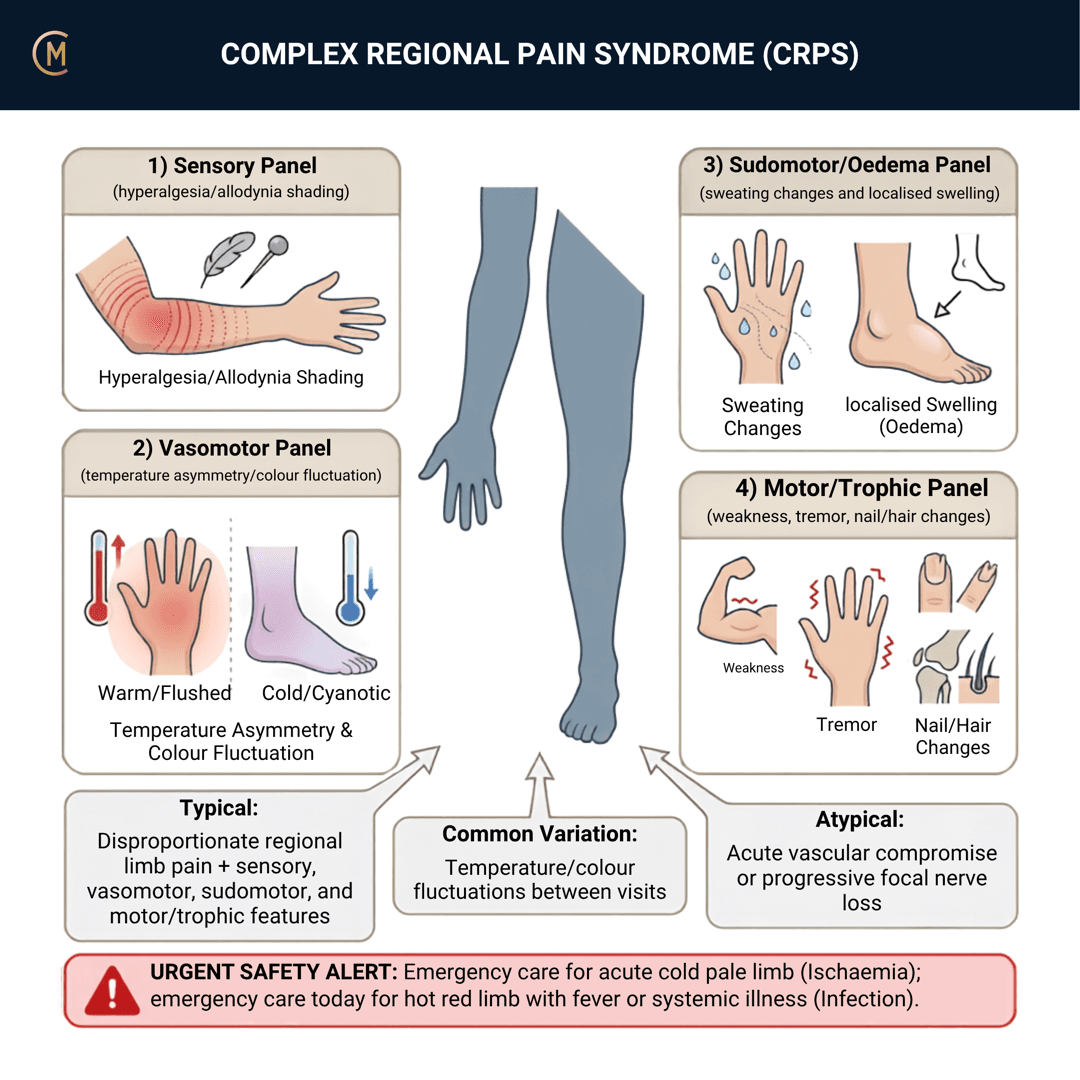
This entire page is free, permanently — all seven sections. Red flag content is never gated in CliniStudy, and on this pattern the safety issue is the treatment.
Who: After injury, surgery, fracture or immobilisation. Distal radius fracture is the classic setting.
What: A disproportionate regional pain syndrome with sensory, vasomotor, sudomotor and motor or trophic change.
How it behaves: Two lines that should converge, and don't. Expected pain falls with healing. This patient's doesn't — it flattens, or climbs.
The one thing to take from this page:
The gap between expected recovery and this recovery is the finding — and it has to arrive with autonomic change. Disproportionate pain on its own is not CRPS.
| The four Budapest categories | What you're looking for |
|---|---|
| Sensory | Allodynia · hyperalgesia · hypersensitivity to touch or temperature |
| Vasomotor | Temperature asymmetry · skin colour change or asymmetry |
| Sudomotor / oedema | Swelling · sweating change or asymmetry |
| Motor / trophic | Reduced range · weakness · tremor · dystonia · skin, hair or nail change |
Symptoms across categories, signs on examination, and no better diagnosis [1][2].
⚠️ No Australian guideline exists. Anchored to the international CRPS practice guidelines, 5th edition. Written for a multidisciplinary team, with the physiotherapy component described in principle rather than prescription — which reflects the evidence, not an oversight.
2 · SE — THE SUBJECTIVE PATTERN (the 70%)
Five stages, in your course's order — and note that the patient's own account of the mismatch is usually the first and best evidence.
MAIN PROBLEM
"It's a fracture that healed and it's worse than it was in the cast."
"I can't have the bedsheet touch it."
"It's a different colour to the other one and it's freezing."
"Everyone keeps telling me it should be better by now."
That last one matters. By the time you meet them, many of these patients have already been disbelieved.
BODY CHART
- Map the region, not a structure. CRPS is regional and does not respect a nerve or a single tissue.
- Mark colour, temperature and swelling asymmetry as observations, dated.
- Mark allodynic areas — where does light touch hurt?
BEHAVIOUR
| Expected post-injury pain | CRPS | |
|---|---|---|
| Trajectory | Falls with healing | Flattens or climbs |
| Quality | Aches, sharpens on load | Burning, throbbing, electric |
| Light touch | Tolerable | Painful (allodynia) |
| Temperature | Neutral | Sensitive to cold or warmth |
| Range loss | Mechanical end-feel | Pain, guarding and oedema — not a block |
HISTORY
- The index event — injury, surgery, fracture, or a period of immobilisation. And how long the immobilisation was.
- The trajectory since. This is the diagnosis-shaping question.
- What has been said to them already, and by whom. You need to know what you are working against.
SPECIAL / SCREENING QUESTIONS
Rule out the better explanation first — this is the part students skip because CRPS is interesting.
- Fever, systemic illness → infection.
- Calf or whole-limb swelling with a risk set → DVT.
- Escalating pain with a tight, tense compartment after trauma → compartment syndrome. Emergency.
- A named nerve territory → peripheral nerve injury.
- Ongoing fracture pain, non-union, or a change after a period of improvement → re-image.
And ask about distress directly, and kindly. Emotional distress and fear of movement are part of this presentation, and asking about them is part of the assessment — not an add-on and not a judgement.
3 · HYPOTHESIS RANKING
| Competing pattern | The one discriminating feature |
|---|---|
| Normal post-injury pain | Proportionate to the healing phase, and falling. CRPS pain is disproportionate and comes with autonomic change. |
| Peripheral nerve injury | Follows a defined nerve territory. CRPS is regional, spreads beyond it, and carries allodynia and trophic change. |
| Infection | Fever, systemic illness, rising inflammatory markers — rather than temperature and colour asymmetry without systemic features. |
The exclusions that come before the diagnosis
The Budapest criteria end with "no other diagnosis better explains the signs and symptoms." That clause is not a formality. Before this label goes anywhere near a note, rule out infection, DVT, fracture or non-union, inflammatory arthritis, peripheral nerve injury, vascular compromise, compartment syndrome and radiculopathy.
Diagnostic tools remain limited — there is no single test (Mesaroli et al. 2021). This is structured history and examination against validated criteria, and nothing else.
4 · RED FLAGS — DON'T MISS THIS
This section is free, on every pattern, forever. Safety is never gated.
The things to exclude, urgently
| Finding | What it suggests | What you do |
|---|---|---|
| Escalating pain, tense swollen compartment after trauma | Compartment syndrome | 🚑 Emergency department, now |
| Fever, systemic illness, hot red limb | Infection | 🚑 Emergency, today |
| Unilateral calf or whole-limb swelling + a risk set | DVT | Same-day medical review |
| Cold, pale, pulseless limb | Vascular compromise | 🚑 Emergency, now |
| Pain change after a period of improvement, post-fracture | Non-union or a new problem | Re-image |
| Progressive weakness or wasting | Nerve injury or something else | Medical referral |
The early warning after a wrist fracture
Average pain of 5/10 or more in the first week after a wrist fracture is a red flag for CRPS — one in 26 nonsurgically managed patients developed it within 4 months (Moseley et al. 2014) [20]. Write the pain score and any colour, temperature or swelling change down on day one: patients later recalled intense pain from the injury, but their records noted it in only 29.4% of CRPS type 1 cases (Lunden & Jorum 2021) [21]. Flag it to the treating team early, and check it with your educator.
And the red flag that is about you, not the patient
Immobilisation, forced range, aggressive manual therapy and fear-based messaging are the interventions most likely to make this condition worse. On this pattern, doing the wrong thing is not a neutral delay — it is an active harm. That is why it sits in the red flag section.
The words matter too
Never write or say "overreacting", "non-organic", or "functional overlay". The sensory, vasomotor, sudomotor and trophic changes are measurable signs. The patient is not exaggerating — their nervous and autonomic systems are behaving differently, and telling them so calmly is the first treatment.
Cross-links: Lateral ankle sprain · Peripheral nerve entrapments · Septic arthritis / DVT / tumour
5 · OE — THE OBJECTIVE (the 30%)
Members
Sections 5 to 7 are for members
The objective exam, management and pearls, plus the six-minute lesson and the debrief. Free with an account.
Sign in or join free6 · MX — MANAGEMENT ESSENTIALS
Members
Sections 5 to 7 are for members
The objective exam, management and pearls, plus the six-minute lesson and the debrief. Free with an account.
Sign in or join free7 · CLINICAL PEARLS + RETRIEVAL CHECK
Members
Sections 5 to 7 are for members
The objective exam, management and pearls, plus the six-minute lesson and the debrief. Free with an account.
Sign in or join freeMembers
The 5-minute lesson is for members
Twelve slides on this pattern: what you'll hear, what to examine, what to do. Free with an account.
Sign in or join freeGuideline anchor
No Australian guideline covers CRPS. Anchored to the international CRPS practice guidelines, 5th edition (Harden et al. 2022, PMID 35687369), with diagnosis anchored to the Budapest criteria validation study (Harden et al. 2010, PMID 20493633).
More
Physiotherapy effect estimates are anchored to the Cochrane review of physiotherapy for CRPS (Smart et al. 2022, PMID 35579382).
No Australian guideline exists for CRPS. The international guideline is written for a multidisciplinary team, and the physiotherapy component within it is described in principle rather than in prescription — which reflects the state of the evidence rather than an oversight.
Members
The evidence summary is for members
Verified diagnostic accuracy, where the evidence stands and what it doesn't settle. Free with an account.
Sign in or join freeSources · 19
ShowHide
Every source on this page resolves and title-verifies against PubMed. Newest first.
- 2010Harden et al. (2010). Validation of proposed diagnostic criteria (the "Budapest Criteria") for Complex Regional Pain Syndrome. Pain, 150(2), 268-274. https://doi.org/10.1016/j.pain.2010.04.030
- 2022Harden et al. (2022). Complex Regional Pain Syndrome: Practical Diagnostic and Treatment Guidelines, 5th Edition. Pain medicine (Malden, Mass.), 23(Suppl 1), S1-S53. https://doi.org/10.1093/pm/pnac046
- 2004Moseley (2004). Graded motor imagery is effective for long-standing complex regional pain syndrome: a randomised controlled trial. Pain, 108(1-2), 192-8. https://doi.org/10.1016/j.pain.2004.01.006
- 2006Moseley (2006). Graded motor imagery for pathologic pain: a randomized controlled trial. Neurology, 67(12), 2129-34. https://doi.org/10.1212/01.wnl.0000249112.56935.32
- 2013Cossins et al. (2013). Treatment of complex regional pain syndrome in adults: a systematic review of randomized controlled trials published from June 2000 to February 2012. European journal of pain (London, England), 17(2), 158-73. https://doi.org/10.1002/j.1532-2149.2012.00217.x
- 2013O'Connell et al. (2013). Interventions for treating pain and disability in adults with complex regional pain syndrome. The Cochrane database of systematic reviews, 2013(4), CD009416. https://doi.org/10.1002/14651858.CD009416.pub2
- 2014Malay & Chung (2014). Testing the validity of preventing chronic regional pain syndrome with vitamin C after distal radius fracture. [Corrected]. The Journal of hand surgery, 39(11), 2251-7. https://doi.org/10.1016/j.jhsa.2014.08.009
- 2016O'Connell et al. (2016). Local anaesthetic sympathetic blockade for complex regional pain syndrome. The Cochrane database of systematic reviews, 7(7), CD004598. https://doi.org/10.1002/14651858.CD004598.pub4
- 2017Méndez-Rebolledo et al. (2017). Update on the effects of graded motor imagery and mirror therapy on complex regional pain syndrome type 1: A systematic review. Journal of back and musculoskeletal rehabilitation, 30(3), 441-449. https://doi.org/10.3233/BMR-150500
- 2017Aïm et al. (2017). Efficacy of vitamin C in preventing complex regional pain syndrome after wrist fracture: A systematic review and meta-analysis. Orthopaedics & traumatology, surgery & research : OTSR, 103(3), 465-470. https://doi.org/10.1016/j.otsr.2016.12.021
- 2019Miller et al. (2019). Current practice in the rehabilitation of complex regional pain syndrome: a survey of practitioners. Disability and rehabilitation, 41(7), 847-853. https://doi.org/10.1080/09638288.2017.1407968
- 2021Mesaroli et al. (2021). Screening and diagnostic tools for complex regional pain syndrome: a systematic review. Pain, 162(5), 1295-1304. https://doi.org/10.1097/j.pain.0000000000002146
- 2022Smart et al. (2022). Physiotherapy for pain and disability in adults with complex regional pain syndrome (CRPS) types I and II. The Cochrane database of systematic reviews, 5(5), CD010853. https://doi.org/10.1002/14651858.CD010853.pub3
- 2022Acapo et al. (2022). Assessment of body perception disturbances in complex regional pain syndrome: A systematic review using the COSMIN guideline. European journal of pain (London, England), 26(10), 2060-2073. https://doi.org/10.1002/ejp.2032
- 2023Shafiee et al. (2023). The Effectiveness of Rehabilitation Interventions on Pain and Disability for Complex Regional Pain Syndrome: A Systematic Review and Meta-analysis. The Clinical journal of pain, 39(2), 91-105. https://doi.org/10.1097/AJP.0000000000001089
- 2024Ríos-León et al. (2024). Effectiveness of motor imagery in complex regional pain syndrome: A systematic review with meta-analysis. Pain practice : the official journal of World Institute of Pain, 24(5), 760-771. https://doi.org/10.1111/papr.13348
- 2024Donati et al. (2024). Breaking the Cycle of Pain: The Role of Graded Motor Imagery and Mirror Therapy in Complex Regional Pain Syndrome. Biomedicines, 12(9). https://doi.org/10.3390/biomedicines12092140
- 2024Teichmüller et al. (2024). Incidence and treatment of complex regional pain syndrome after surgery: analysis of claims data from Germany. Pain reports, 9(6), e1210. https://doi.org/10.1097/PR9.0000000000001210
- 2026Serôdio et al. (2026). Preventing Complex Regional Pain Syndrome After Distal Radius Fracture: A Systematic Review of Rehabilitation and Clinical Prophylaxis Strategies. Journal of functional morphology and kinesiology, 11(2). https://doi.org/10.3390/jfmk11020158
Mapped to this pattern
- CSS
CRPS Severity Score
CRPS severity, continuous · 16 items · 10 min
- PSEQ
Pain Self-Efficacy Questionnaire
confidence to function despite pain · 10 items · 3 min
- CSI
Central Sensitization Inventory
central sensitisation-related symptoms · 25 items · 6 min
- PCS
Pain Catastrophizing Scale
catastrophic thinking about pain · 13 items · 4 min
- PDI
Pain Disability Index
pain-related disability across life domains · 7 items · 3 min
- SF-MPQ
Short-Form McGill Pain Questionnaire
pain quality — sensory and affective · 15 items · 5 min
Generic measures that also apply
- Borg RPE
Borg Rating of Perceived Exertion Scale (6-20)
perceived exertion · 1 items · 1 min
- GROC
Global Rating of Change Scale
perceived change since baseline · 1 items · 1 min
- NPRS
Numeric Pain Rating Scale
pain intensity · 1 items · 1 min
- PGIC
Patient Global Impression of Change
perceived change since baseline · 1 items · 1 min
- PSFS
Patient-Specific Functional Scale
patient-generated function · 3 items · 2 min
- SANE
Single Assessment Numeric Evaluation
patient-rated function as a percentage of normal · 1 items · 1 min
- VAS
Visual Analogue Scale
pain intensity · 1 items · 1 min
- Borg CR10
Borg Category Ratio 10 Scale
perceived exertion or symptom intensity, ratio scale · 1 items · 1 min
- GAS
Goal Attainment Scaling
individualised goal achievement · 10 min
Did this page do its job?
CliniStudy is in beta. One tap is enough — it decides what gets fixed first.