
1 · SNAPSHOT
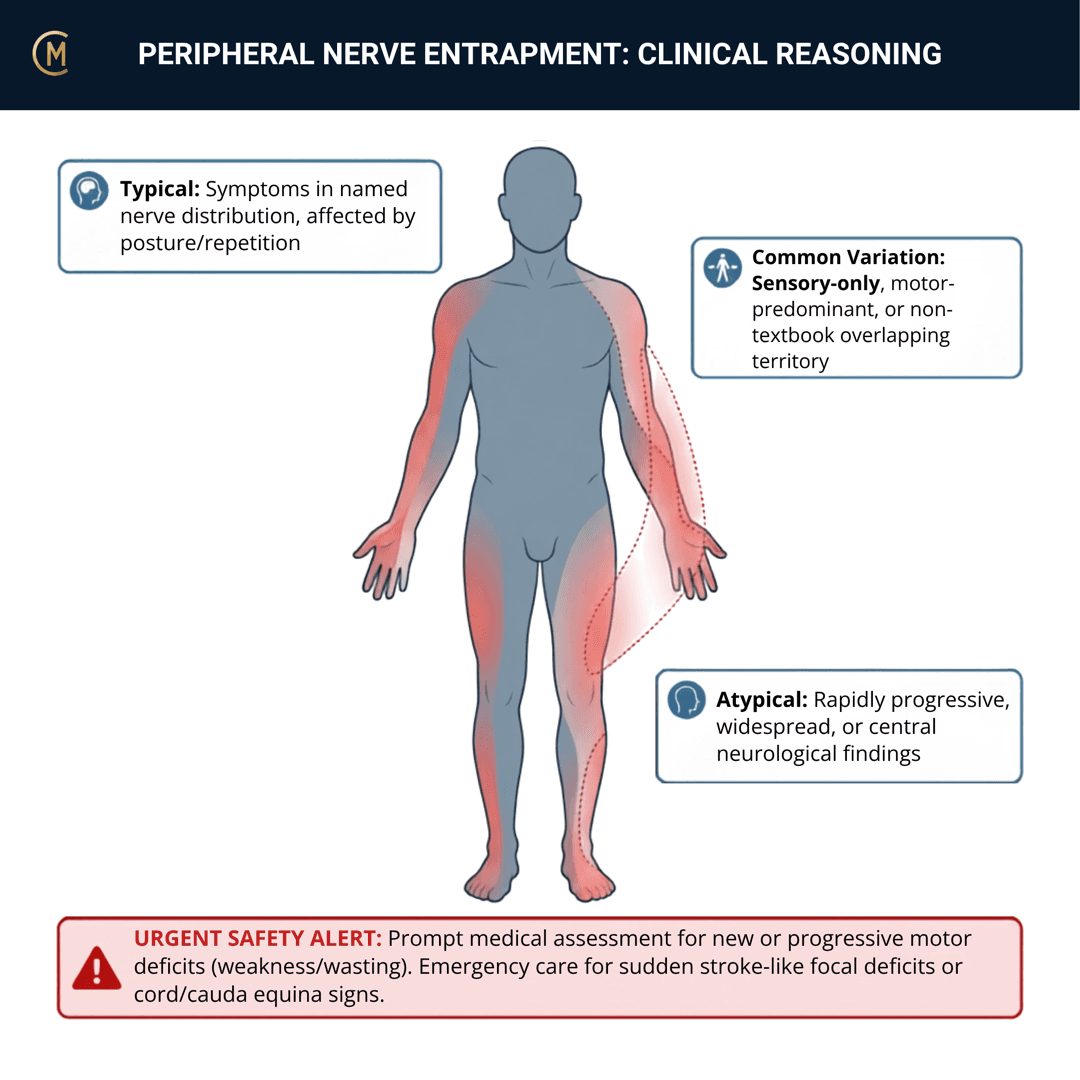
Who: Repetitive use, sustained posture, external compression, or a load spike. Diabetes and hereditary susceptibility make it easier to acquire (Smith 2014).
What: Local irritability or compression of a named peripheral nerve.
How it behaves: Burning, tingling, numbness, sometimes weakness or fatigue. Worse with sustained posture, compression or tension. Better with unloading or movement.
The one thing to take from this page:
The question is not "which nerve". It is "which level" — peripheral nerve, root, plexus, or something broader.
| Pattern | Follows a named nerve better than a tendon or joint |
| Behaviour | Posture, compression, repetition, tension — and relief on unloading |
| The trap | Expecting the symptoms to respect the textbook map |
| The escalation | Progressive weakness · wasting · unremitting sensory loss · multi-territory |
⚠️ No guideline covers conservative management of nerve entrapment as a category — in Australia or anywhere. What exists is condition-specific evidence, most of it in carpal tunnel syndrome, generalised across nerves by inference. This page says so where it matters.
2 · SE — THE SUBJECTIVE PATTERN (the 70%)
Five stages, in your course's order. BEHAVIOUR is the discriminator — this is a mechanically driven pattern, and it declares itself in what makes it worse and what settles it.
MAIN PROBLEM
"My hand goes to sleep at night and I have to shake it out."
"It burns down the outside of my thigh when I've been standing a while."
"My foot's numb after I've been sitting cross-legged."
BODY CHART
- Map the territory — and map it as a peripheral nerve, not a dermatome. They are different, and that difference is the whole differential.
- Mark what's outside the map too. Symptoms beyond the textbook territory are common and they are information, not a contradiction (Schmid et al. 2013).
- Note motor complaints separately: weakness, fatigue, dropping things.
BEHAVIOUR
| Fits entrapment | Points elsewhere | |
|---|---|---|
| Aggs | Sustained posture, direct compression, repetitive load, neural tension | Unrelated to position |
| Eases | Unloading, moving, changing position, shaking it out | Nothing changes it |
| Severity | VAS 0–10 at best / at worst / right now | — |
| Night | Often worse — a sustained position | Unremitting, and not positional |
| Course | Fluctuating, exposure-related | Progressive |
Irritability, three ways: what the symptoms are like at rest · how much of the provoking posture it takes · how long they take to settle. That third one drives your dosage more than anything else on this page.
HISTORY
- Repetitive use, trauma, postural strain, a new job or a new load.
- External compression — a tool, a strap, a brace, a way of sitting, a way of sleeping.
- Diabetes — focal neuropathies and mononeuropathies are mimics and cofactors, not just background (Smith 2014).
- Previous episodes, and whether they resolved.
SPECIAL / SCREENING QUESTIONS
- Progressive weakness, wasting, dropping things, gait change — the escalation set.
- Bilateral or multi-territory symptoms.
- Neck or back symptoms — the radiculopathy question.
- Overhead-provoked whole-limb heaviness ± colour or temperature change — thoracic outlet, which is a diagnosis of exclusion.
3 · HYPOTHESIS RANKING
| Competing pattern | The one discriminating feature |
|---|---|
| Cervical radiculopathy | Dermatomal and myotomal pattern with reflex change, positive Cervical Compression and ULNT, neck involvement. Entrapment follows a single peripheral nerve (Iyer & Kim 2016). |
| Progressive neuropathy | Multi-nerve involvement, wasting, absent reflexes, weakness beyond one nerve territory. Refer. |
| Thoracic outlet syndrome | Whole-limb heaviness with overhead activity ± vascular change. A diagnosis of exclusion — earned last, not reached for first. |
And the mimics behind the mimics
If the symptoms do not fit, or do not respond to a focused conservative block, broaden the differential: Charcot-Marie-Tooth, hereditary neuropathy with liability to pressure palsies, multifocal motor neuropathy, plexitis, myopathy, mononeuritis multiplex (Gilchrist & Dandapat 2020). Compressive labels become defaults, and the correction is a second look, not a longer program.
Lower limb entrapments carry a specific trap: peroneal, tibial, femoral and meralgia paraesthetica patterns are routinely mistaken for lumbar spine pathology (Bowley & Doughty 2019).
4 · RED FLAGS — DON'T MISS THIS
This section is free, on every pattern, forever. Safety is never gated.
| Finding | What it suggests | What you do |
|---|---|---|
| Progressive weakness | Not a local entrapment | Urgent medical referral |
| Wasting or fasciculations | Lower motor neuron involvement | Urgent neurology referral |
| Weakness without sensory symptoms, or bulbar signs — slurred speech, swallowing trouble, tongue fasciculations | Motor neuron disease mimicking carpal or cubital tunnel — 11% of surveyed hand surgeons had decompressed a nerve in someone later diagnosed with ALS (Thomson et al. 2023) [21] | Neurodiagnostic testing and prompt neurology referral |
| Unremitting sensory loss, not positional | Beyond mechanosensitivity | Medical referral |
| Bilateral or multi-territory | Systemic or central | Medical referral |
| Absent reflexes | Polyneuropathy or root | Medical referral |
| Gait imbalance, hand clumsiness | Myelopathy | 🚑 Urgent; emergency if new and rapidly progressive, or with bladder or saddle change |
| Suspected mass, or significant trauma | Structural | Imaging referral |
| Median nerve symptoms after wrist trauma, with pain and numbness getting progressively worse | Acute carpal tunnel syndrome — a surgical emergency, not an entrapment to rehab (Holbrook et al. 2022) [22] | 🚑 Emergency surgical referral |
| No response to a focused conservative block | The hypothesis was wrong | Reassess and refer |
The rule: intermittent sensory irritability is yours. Persistent numbness, motor loss, reflex change, atrophy or progression is not.
Cross-links: Cervical radiculopathy · Progressive neuropathy / compression syndrome · Lateral elbow tendinopathy
5 · OE — THE OBJECTIVE (the 30%)
Members
Sections 5 to 7 are for members
The objective exam, management and pearls, plus the six-minute lesson and the debrief. Free with an account.
Sign in or join free6 · MX — MANAGEMENT ESSENTIALS
Members
Sections 5 to 7 are for members
The objective exam, management and pearls, plus the six-minute lesson and the debrief. Free with an account.
Sign in or join free7 · CLINICAL PEARLS + RETRIEVAL CHECK
Members
Sections 5 to 7 are for members
The objective exam, management and pearls, plus the six-minute lesson and the debrief. Free with an account.
Sign in or join freeMembers
The 5-minute lesson is for members
Twelve slides on this pattern: what you'll hear, what to examine, what to do. Free with an account.
Sign in or join freeGuideline anchor
No Australian guideline covers conservative management of peripheral nerve entrapment.
More
Anchored for investigation to the electrodiagnostic testing guideline review for entrapment neuropathies (Pugdahl et al. 2020, PMID 33151661), and for clinical reasoning to the contemporary entrapment masterclass literature (Schmid et al. 2013, PMID 24008054; Schmid et al. 2020, PMID 32766466). Treatment effect estimates are anchored to the neural mobilisation systematic reviews and meta-analyses (Basson et al. 2017, PMID 28704626; Zaheer & Ahmed 2023, PMID 37568290; Bittencourt et al. 2024, PMID 39514600; Iogna Prat et al. 2024, PMID 38217928).
There is no Australian guideline and, more to the point, no guideline anywhere for the conservative management of peripheral nerve entrapment as a category. What exists is condition-specific evidence — most of it in carpal tunnel syndrome — generalised across nerves by inference. This page says so where it matters.
Members
The evidence summary is for members
Verified diagnostic accuracy, where the evidence stands and what it doesn't settle. Free with an account.
Sign in or join freeSources · 20
ShowHide
Every source on this page resolves and title-verifies against PubMed. Newest first.
- 2008Ellis & Hing (2008). Neural mobilization: a systematic review of randomized controlled trials with an analysis of therapeutic efficacy. The Journal of manual & manipulative therapy, 16(1), 8-22. https://doi.org/10.1179/106698108790818594
- 2013Bouche (2013). Compression and entrapment neuropathies. Handbook of clinical neurology, 115, 311-66. https://doi.org/10.1016/B978-0-444-52902-2.00019-9
- 2013Schmid et al. (2013). Reappraising entrapment neuropathies--mechanisms, diagnosis and management. Manual therapy, 18(6), 449-57. https://doi.org/10.1016/j.math.2013.07.006
- 2014Smith (2014). Focal and entrapment neuropathies. Handbook of clinical neurology, 126, 31-43. https://doi.org/10.1016/B978-0-444-53480-4.00003-5
- 2016Iyer & Kim (2016). Cervical radiculopathy. Current reviews in musculoskeletal medicine, 9(3), 272-80. https://doi.org/10.1007/s12178-016-9349-4
- 2017Hobson-Webb & Juel (2017). Common Entrapment Neuropathies. Continuum (Minneapolis, Minn.), 23(2, Selected Topics in Outpatient Neurology), 487-511. https://doi.org/10.1212/CON.0000000000000452
- 2017Basson et al. (2017). The Effectiveness of Neural Mobilization for Neuromusculoskeletal Conditions: A Systematic Review and Meta-analysis. The Journal of orthopaedic and sports physical therapy, 47(9), 593-615. https://doi.org/10.2519/jospt.2017.7117
- 2019Koulidis et al. (2019). Diagnostic accuracy of upper limb neurodynamic tests for the assessment of peripheral neuropathic pain: A systematic review. Musculoskeletal science & practice, 40, 21-33. https://doi.org/10.1016/j.msksp.2019.01.001
- 2019Doughty & Bowley (2019). Entrapment Neuropathies of the Upper Extremity. The Medical clinics of North America, 103(2), 357-370. https://doi.org/10.1016/j.mcna.2018.10.012
- 2019Bowley & Doughty (2019). Entrapment Neuropathies of the Lower Extremity. The Medical clinics of North America, 103(2), 371-382. https://doi.org/10.1016/j.mcna.2018.10.013
- 2019Malek & Salameh (2019). Common Entrapment Neuropathies. Seminars in neurology, 39(5), 549-559. https://doi.org/10.1055/s-0039-1693004
- 2020Gilchrist & Dandapat (2020). Neuromuscular Mimics of Entrapment Neuropathies of Upper Extremities. Hand (New York, N.Y.), 15(5), 599-607. https://doi.org/10.1177/1558944719898801
- 2020Schmid et al. (2020). Entrapment neuropathies: a contemporary approach to pathophysiology, clinical assessment, and management. Pain reports, 5(4), e829. https://doi.org/10.1097/PR9.0000000000000829
- 2020Pugdahl et al. (2020). Electrodiagnostic Testing of Entrapment Neuropathies: A Review of Existing Guidelines. Journal of clinical neurophysiology : official publication of the American Electroencephalographic Society, 37(4), 299-305. https://doi.org/10.1097/WNP.0000000000000668
- 2021Hannaford et al. (2021). Review Article "Spotlight on Ultrasonography in the Diagnosis of Peripheral Nerve Disease: The Evidence to Date". International journal of general medicine, 14, 4579-4604. https://doi.org/10.2147/IJGM.S295851
- 2023Schwabl et al. (2023). Nerve entrapment syndromes: detection by ultrasound. Ultrasonography (Seoul, Korea), 42(3), 376-387. https://doi.org/10.14366/usg.22186
- 2023McGurk et al. (2023). Diagnostic Considerations in Compressive Neuropathies. Journal of hand surgery global online, 5(4), 525-535. https://doi.org/10.1016/j.jhsg.2022.10.010
- 2023Zaheer & Ahmed (2023). Neurodynamic Techniques in the Treatment of Mild-to-Moderate Carpal Tunnel Syndrome: A Systematic Review and Meta-Analysis. Journal of clinical medicine, 12(15). https://doi.org/10.3390/jcm12154888
- 2024Iogna Prat et al. (2024). The effectiveness of nerve mechanical interface treatment for entrapment neuropathies in the limbs: A systematic review with metanalysis. Musculoskeletal science & practice, 69, 102907. https://doi.org/10.1016/j.msksp.2024.102907
- 2024Bittencourt et al. (2024). Neural mobilisation effects in nerve function and nerve structure of patients with peripheral neuropathic pain: A systematic review with meta-analysis. PloS one, 19(11), e0313025. https://doi.org/10.1371/journal.pone.0313025
Mapped to this pattern
Generic measures that also apply
- Borg RPE
Borg Rating of Perceived Exertion Scale (6-20)
perceived exertion · 1 items · 1 min
- GROC
Global Rating of Change Scale
perceived change since baseline · 1 items · 1 min
- NPRS
Numeric Pain Rating Scale
pain intensity · 1 items · 1 min
- PGIC
Patient Global Impression of Change
perceived change since baseline · 1 items · 1 min
- PSFS
Patient-Specific Functional Scale
patient-generated function · 3 items · 2 min
- SANE
Single Assessment Numeric Evaluation
patient-rated function as a percentage of normal · 1 items · 1 min
- VAS
Visual Analogue Scale
pain intensity · 1 items · 1 min
- Borg CR10
Borg Category Ratio 10 Scale
perceived exertion or symptom intensity, ratio scale · 1 items · 1 min
- GAS
Goal Attainment Scaling
individualised goal achievement · 10 min
Did this page do its job?
CliniStudy is in beta. One tap is enough — it decides what gets fixed first.