
1 · SNAPSHOT
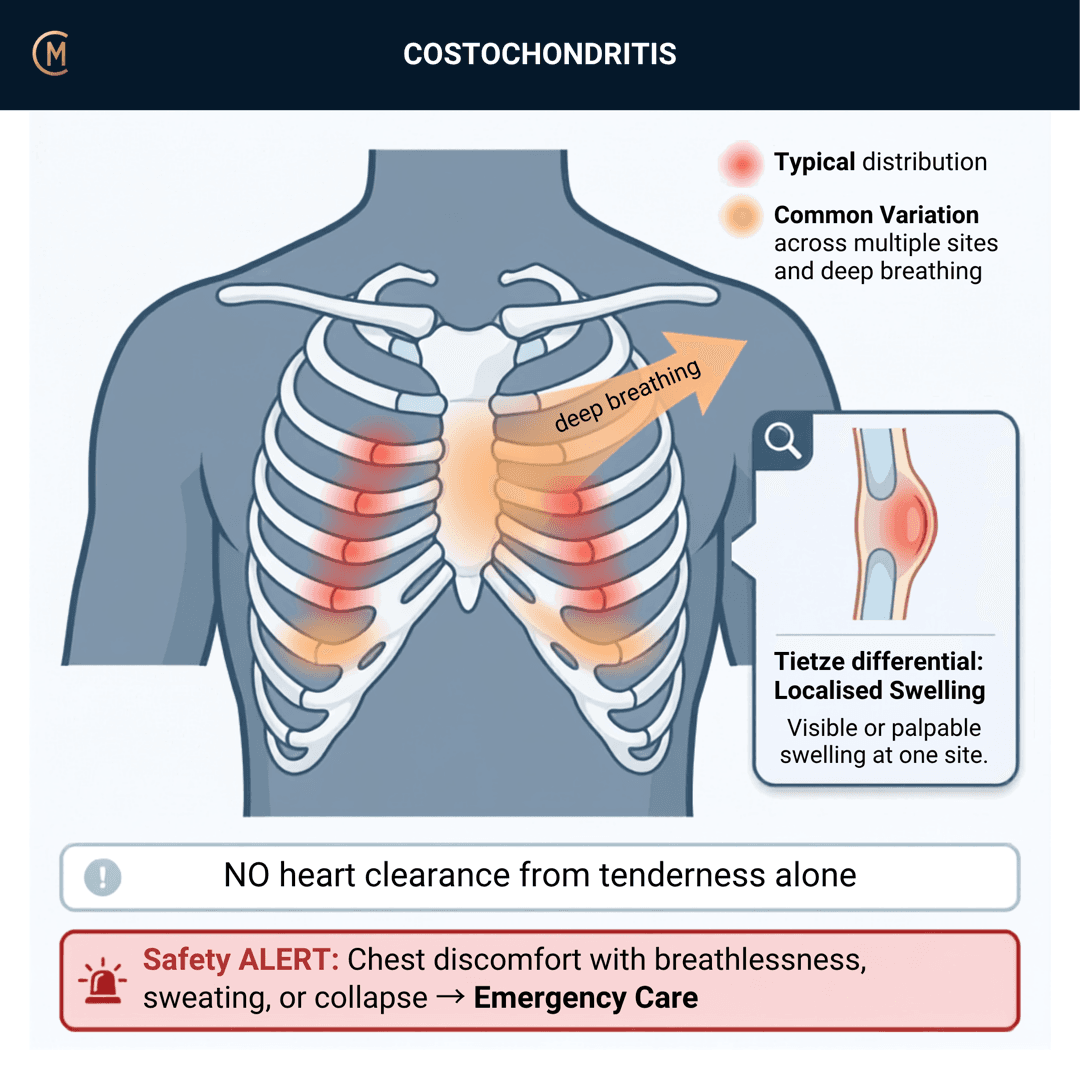
Who: Any age, including children and adolescents. Often post-viral or after a bout of postural or repetitive loading.
What: Pain at the costosternal or costochondral junctions.
How it behaves: Sharp, anterior, and localised. Aggs: deep breathing, coughing, trunk rotation. Eases: rest, heat, gentle mobility. Reproducible on palpation.
Costochondritis or Tietze's?
| Costochondritis | Tietze's syndrome | |
|---|---|---|
| Tenderness | Yes | Yes |
| Local swelling | No | Yes — that's the difference |
| Sites | Often multiple, 2nd–5th | Usually one, often 2nd or 3rd |
| Why it matters | Tietze's has its own small treatment literature |
The one thing to take from this page:
"If you can poke it and it hurts, it's not your heart" is a heuristic, not a test. Reproducible tenderness lowers the probability of something serious. It does not empty the box — the published mimics include tumour, tuberculosis and infection. Do the screen first, then reassure properly.
2 · SE — THE SUBJECTIVE PATTERN (the 70%)
Five stages, in your course's order.
MAIN PROBLEM
"There's a sharp pain right here at the front."
"It catches when I take a deep breath."
"It started after I had that chest infection."
BODY CHART
- Anterior chest, at the junctions. Get them to point with one finger. Localisable pain is the pattern.
- Mark any swelling. That's the Tietze's question and nobody asks it.
- Mark radiation. Radiation to the jaw, neck or left arm changes the conversation entirely.
BEHAVIOUR
- Aggs: deep breathing, coughing, sneezing, trunk rotation, pushing, lying on that side.
- Eases: rest, heat, gentle movement.
- 24-hr pattern: linked to breath and position rather than the clock — ask which. Exertion-linked is a different page.
- Night: lying on that side is in the Aggs. Pain at rest or at night unrelated to position is a §4 flag.
- Severity: VAS 0–10 at best / at worst / right now.
- Coding: M / In / P / Is as usual.
- Irritability: resting symptoms + vigour of the provoking activity + time to settle.
- The key behavioural question: is it linked to exertion, or to position and breath? Exertion-linked is a different page.
HISTORY
- Recent viral illness? Post-viral onset is described — including post-COVID cases in adults and in children [1][2].
- Recent trauma, however minor? Read further: chest wall pain after minor trauma [3].
- New or unaccustomed loading — rowing, throwing, pressing, a house move, prolonged coughing.
- Cardiac and respiratory history, risk factors, and family history.
- Any inflammatory or autoimmune history? Costochondritis is described as a presentation of relapsing polychondritis [4].
SPECIAL / SCREENING QUESTIONS — the ones that decide the page
- Any breathlessness, sweating, nausea, dizziness?
- Any fever, night sweats, weight loss?
- Any lump or swelling you can feel?
- Any history of cancer, tuberculosis exposure, immunosuppression, or recent surgery or procedure to the chest?
- Is the pain there at rest, or at night?
Assessing this region? Download the Thoracic Spine assessment template →
3 · HYPOTHESIS RANKING
| Competing pattern | The one discriminating feature |
|---|---|
| Costovertebral / costotransverse dysfunction | Posterior, reproduced by rib springing at the back rather than junction palpation at the front. |
| Rib contusion or stress injury | A trauma or overuse history, and tenderness over the rib rather than the junction. |
| Thoracic facet (PIV) joint | Posterior, provoked by unilateral PA, may wrap around — and wrapping pain is what gets confused with this. |
| Thoracic outlet syndrome | Arm symptoms, positional, with paraesthesia. Not junction tenderness. |
| Axial spondyloarthritis | Costosternal pain with the inflammatory time pattern — morning stiffness, relief with movement, under forty. |
| Sternal fracture | Trauma. Read further: ultrasound for sternal fracture [5]. |
The ones that outrank the table — and these are the page
These are not theoretical differentials. Each one is a published presentation.
| Mimic | What it looked like |
|---|---|
| Chest wall tumour | Liposarcoma mimicking an inflammatory chest wall condition [6]. |
| Tuberculosis | Paravertebral TB mimicking costochondritis [7]. |
| Infection | Infectious costochondritis with sternal osteomyelitis [8]. |
| Systemic inflammatory disease | Costochondritis in relapsing polychondritis [4]. |
| Cardiac and pulmonary causes | The reason anterior chest pain gets screened at all. |
Every one of those could be tender when you press it.
4 · RED FLAGS — DON'T MISS THIS
This section is free, on every pattern, forever. Safety is never gated.
On this pattern section 4 is deliberately longer than section 5. That is the correct weighting.
| Finding | What it suggests | What you do |
|---|---|---|
| Central or crushing chest pain, breathlessness, sweating, nausea, radiation to jaw or arm | Cardiac | 000 / EMERGENCY |
| Exertional onset, settling with rest | Cardiac until proven otherwise | Same-day medical review |
| Pleuritic pain with breathlessness, calf symptoms, recent immobility or surgery | Pulmonary embolus | EMERGENCY |
| Fever, night sweats, unexplained weight loss | Infection, tuberculosis, malignancy | Urgent medical review |
| A palpable mass, or swelling that is growing | Tumour | Urgent medical review |
| Immunosuppression, IV drug use, recent chest surgery or procedure | Infective costochondritis, osteomyelitis | Urgent medical review |
| Pain at rest or at night, unrelated to position | Not mechanical | Medical review |
| Known cancer history with new chest wall pain | Metastasis | Urgent medical review |
| Ear, nose or airway cartilage involvement alongside it | Relapsing polychondritis | Medical review |
| Significant trauma | Fracture | Medical review and imaging |
The pearl, corrected
A common teaching: "If you can poke it and it hurts, it's not your heart."
Keep it as a heuristic. Do not use it as a rule-out. Reproducible chest wall tenderness lowers the probability of a serious cause — no verified accuracy data for that claim exists in our library, and it certainly does not reach zero. Chest wall tumour, tuberculosis, infection and systemic inflammatory disease have all been published presenting exactly this way, and all of them can be tender to palpation.
Screen first. Reproduce second. Reassure third — and reassure properly, because you've earned it.
Cross-links: Cardiac / pulmonary referred pain · Rib contusion / stress injury · Costovertebral / costotransverse dysfunction · Ankylosing spondylitis / axSpA
5 · OE — THE OBJECTIVE (the 30%)
Members
Sections 5 to 7 are for members
The objective exam, management and pearls, plus the six-minute lesson and the debrief. Free with an account.
Sign in or join free6 · MX — MANAGEMENT ESSENTIALS
Members
Sections 5 to 7 are for members
The objective exam, management and pearls, plus the six-minute lesson and the debrief. Free with an account.
Sign in or join free7 · CLINICAL PEARLS + RETRIEVAL CHECK
Members
Sections 5 to 7 are for members
The objective exam, management and pearls, plus the six-minute lesson and the debrief. Free with an account.
Sign in or join freeMembers
The 4-minute lesson is for members
Twelve slides on this pattern: what you'll hear, what to examine, what to do. Free with an account.
Sign in or join freeGuideline anchor
No Australian guideline for this presentation.
More
Anchored to the ACR Appropriateness Criteria for nontraumatic chest wall pain (Stowell et al. 2021, PMID 34794596) for imaging, and to the rapid evidence review in Am Fam Physician (Mott et al. 2021, PMID 34264599) with its predecessor (Proulx et al. 2009, PMID 19817327) for clinical management. Physiotherapy-specific evidence is anchored to the OPTIMa systematic review of noninvasive interventions for musculoskeletal thoracic spine pain (Southerst et al. 2015, PMID 26141077) — everything below that is case-level.
There is no clinical practice guideline for costochondritis. The anchors above are an imaging appropriateness document and a primary-care evidence review. The physiotherapy evidence for this pattern is case reports and case series — this page says so rather than dressing it up.
Members
The evidence summary is for members
Verified diagnostic accuracy, where the evidence stands and what it doesn't settle. Free with an account.
Sign in or join freeSources · 20
ShowHide
Every source on this page resolves and title-verifies against PubMed. Newest first.
- 2023Kuridze et al. (2023). Tietze Syndrome as a Cause of Chest Pain in the Post-COVID-19 Period. Cureus, 15(4), e37360. https://doi.org/10.7759/cureus.37360
- 2022Collins et al. (2022). Severe post-COVID-19 costochondritis in children. Proceedings (Baylor University. Medical Center), 35(1), 56-57. https://doi.org/10.1080/08998280.2021.1973274
- 2020Chandwani et al. (2020). Chest Wall Pain after Minor Trauma. Clinical practice and cases in emergency medicine, 4(3), 468-469. https://doi.org/10.5811/cpcem.2020.6.46961
- 2025van Gaalen et al. (2025). Costochondritis in relapsing polychondritis. EULAR rheumatology open, 1(1), 4-5. https://doi.org/10.1016/j.ero.2025.01.001
- 2024Park et al. (2024). Diagnostic Value of Ultrasound for Sternal Fractures in Patients with Trauma Experiencing Anterior Chest Wall Pain. Journal of clinical medicine, 13(17). https://doi.org/10.3390/jcm13175123
- 2024Tully et al. (2024). Double diagnostic deviance: Case report of chest wall liposarcoma mimicking inflammatory myofibroblastic tumor mimicking costochondritis. SAGE open medical case reports, 12, 2050313X241289031. https://doi.org/10.1177/2050313X241289031
- 2025Amarnani et al. (2025). Atypical chest wall pain: paravertebral tuberculosis mimicking costochondritis. BMJ case reports, 18(10). https://doi.org/10.1136/bcr-2025-266521
- 2025Fujiu et al. (2025). Infectious Costochondritis With Sternal Osteomyelitis. Cureus, 17(3), e80132. https://doi.org/10.7759/cureus.80132
- 2021Stowell et al. (2021). ACR Appropriateness Criteria® Nontraumatic Chest Wall Pain. Journal of the American College of Radiology : JACR, 18(11S), S394-S405. https://doi.org/10.1016/j.jacr.2021.08.004
- 2007Aspegren et al. (2007). Conservative treatment of a female collegiate volleyball player with costochondritis. Journal of manipulative and physiological therapeutics, 30(4), 321-5. https://doi.org/10.1016/j.jmpt.2007.03.003
- 2010Grindstaff et al. (2010). Treatment of a female collegiate rower with costochondritis: a case report. The Journal of manual & manipulative therapy, 18(2), 64-8. https://doi.org/10.1179/106698110X12640740712653
- 2012Westrick et al. (2012). Evaluation and treatment of musculoskeletal chest wall pain in a military athlete. International journal of sports physical therapy, 7(3), 323-32. PubMed 22666647
- 2017Zaruba & Wilson (2017). IMPAIRMENT BASED EXAMINATION AND TREATMENT OF COSTOCHONDRITIS: A CASE SERIES. International journal of sports physical therapy, 12(3), 458-467. PubMed 28593100
- 2015Southerst et al. (2015). The effectiveness of noninvasive interventions for musculoskeletal thoracic spine and chest wall pain: a systematic review by the Ontario Protocol for Traffic Injury Management (OPTIMa) collaboration. Journal of manipulative and physiological therapeutics, 38(7), 521-31. https://doi.org/10.1016/j.jmpt.2015.06.001
- 2022Elsayed et al. (2022). The efficacy of oral corticosteroids for treatment of Tietze syndrome: A pragmatic randomized controlled trial. Journal of clinical pharmacy and therapeutics, 47(12), 2279-2286. https://doi.org/10.1111/jcpt.13810
- 2021Yıldız et al. (2021). Local treatment of pain in Tietze syndrome: A single-center experience. Turk gogus kalp damar cerrahisi dergisi, 29(2), 239-247. https://doi.org/10.5606/tgkdc.dergisi.2021.21120
- 2024Waggoner & Needleman (2024). Costochondritis. Pediatrics in review, 45(9), 543-545. https://doi.org/10.1542/pir.2023-006141
- 2009Proulx & Zryd (2009). Costochondritis: diagnosis and treatment. American family physician, 80(6), 617-20. PubMed 19817327
- 2020Mettola & Perricone (2020). Tietze Syndrome. Mediterranean journal of rheumatology, 31(2), 224. https://doi.org/10.31138/mjr.31.2.224
- 2021Mott et al. (2021). Costochondritis: Rapid Evidence Review. American family physician, 104(1), 73-78. PubMed 34264599
Generic measures that also apply
- Borg RPE
Borg Rating of Perceived Exertion Scale (6-20)
perceived exertion · 1 items · 1 min
- GROC
Global Rating of Change Scale
perceived change since baseline · 1 items · 1 min
- NPRS
Numeric Pain Rating Scale
pain intensity · 1 items · 1 min
- PGIC
Patient Global Impression of Change
perceived change since baseline · 1 items · 1 min
- PSFS
Patient-Specific Functional Scale
patient-generated function · 3 items · 2 min
- SANE
Single Assessment Numeric Evaluation
patient-rated function as a percentage of normal · 1 items · 1 min
- VAS
Visual Analogue Scale
pain intensity · 1 items · 1 min
- Borg CR10
Borg Category Ratio 10 Scale
perceived exertion or symptom intensity, ratio scale · 1 items · 1 min
- GAS
Goal Attainment Scaling
individualised goal achievement · 10 min
Did this page do its job?
CliniStudy is in beta. One tap is enough — it decides what gets fixed first.