
1 · SNAPSHOT
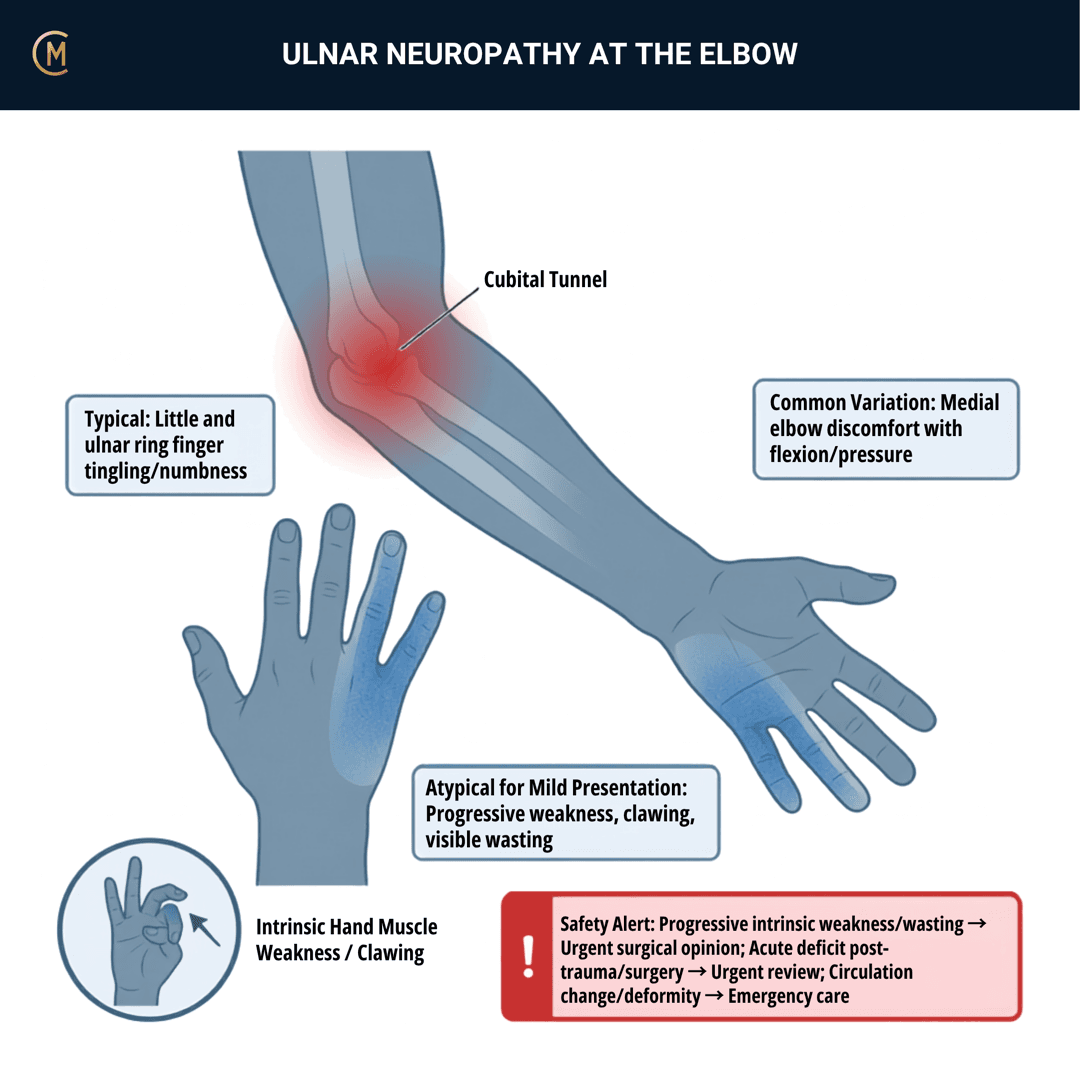
Who: Anyone who spends time in sustained elbow flexion or leaning on the elbow. Desk work, phone, driving, cycling handlebars, sleeping posture. Previous elbow trauma or subluxation.
What: Ulnar neuropathy at the elbow — a positional and compressive problem.
How it behaves: Numbness and tingling in the 4th and 5th digits, sometimes a medial elbow ache — but the ache doesn't point to the nerve: it was negatively correlated with a positive nerve conduction result (Speach et al. 2016) [22]. Worse with flexion or leaning. Eased by extension or shaking the arm. Night symptoms are common. "Phone elbow."
The one thing to take from this page:
You are not stretching the nerve. You are giving it room.
Elbow flexion increases both strain and compression at the tunnel ([1]; Wadsworth & Williams 1973). That single fact explains the provoking postures, the splint position, and why sliders come before tensioners.
Where the line sits
| Early — yours | Later — not yours |
|---|---|
| Intermittent, sensory | Constant numbness |
| Positional, eased by extension | Weak grip and interossei |
| No motor findings | Clawing, first dorsal interosseous wasting |
| Improving on a conservative block | Progressive |
⚠️ No Australian guideline exists. Anchored to the Cochrane review [2], whose position is that the conservative-versus-surgical choice is matched to severity, motor deficit and response over time — not to a fixed pathway.
2 · SE — THE SUBJECTIVE PATTERN (the 70%)
Five stages, in your course's order. The provoking postures are the history — and most of them happen when the patient isn't thinking about their elbow.
MAIN PROBLEM
"My little finger and the one next to it go numb."
"It wakes me up and I have to straighten my arm."
"If I lean on my elbow at the desk it starts within minutes."
BODY CHART
- Map the ulnar territory — 4th and 5th digits, and the dorsoulnar hand. That dorsal branch is what separates elbow-level from Guyon's canal.
- Mark the medial elbow ache separately from the hand symptoms.
- Draw both hands. Bilateral changes the thinking.
BEHAVIOUR
| Fits cubital tunnel | Points elsewhere | |
|---|---|---|
| Aggs | Sustained flexion, leaning on the elbow, phone, driving, sleeping | Wrist position → Guyon's canal |
| Eases | Extension, shaking the arm, changing position | Nothing changes it → screen wider |
| Severity | VAS 0–10 at best / at worst / right now | — |
| Night | Common — the elbow flexes in sleep | Constant, non-positional → escalate |
| Course | Intermittent, exposure-related | Progressive → escalate |
HISTORY
- Positional compression, in detail. How do they sit at a desk? Hold a phone? Drive? Sleep? Cycle?
- Occupational and sport load — gripping, lifting, throwing, handlebars.
- Previous elbow trauma, fracture or dislocation.
- Does the nerve ever feel like it flicks or clicks over the bone? That is the instability question.
SPECIAL / SCREENING QUESTIONS
- Dropping objects, difficulty spreading the fingers, losing pinch strength — the motor screen, and it changes the pathway.
- Neck symptoms — the C8 question, and the double-crush question.
- Diabetes or other systemic neuropathy risk.
- Bilateral or stocking-distribution symptoms — think systemic.
Assessing this region? Download the Elbow assessment template →
3 · HYPOTHESIS RANKING
| Competing pattern | The one discriminating feature |
|---|---|
| Ulnar collateral ligament injury | Medial pain during throwing, positive valgus and moving valgus stress, possible joint-line gapping. No 4th/5th digit numbness. |
| Medial elbow flexor tendinopathy | Tender at the medial epicondyle and flexor-pronator origin, pain on resisted wrist flexion and pronation. |
| C8 radiculopathy | Neck involvement with a root-level pattern. Cubital tunnel is a focal peripheral entrapment with a positive Tinel's at the tunnel. |
And the ones that live further along the same nerve
Guyon's canal compression at the wrist — spares the dorsoulnar hand, because that branch leaves before the wrist. Thoracic outlet features. Diabetic or other polyneuropathy. And double crush, where two levels coexist and neither alone explains the picture.
The ulnar nerve is also just variable. Anatomy, pathophysiology and biopsychosocial factors all contribute to why symptoms and outcomes differ between people who look similar on paper [3]. That is worth knowing before you promise a timeline.
4 · RED FLAGS — DON'T MISS THIS
This section is free, on every pattern, forever. Safety is never gated.
| Finding | What it suggests | What you do |
|---|---|---|
| Progressive weakness | Advancing neuropathy | Urgent surgical opinion |
| Intrinsic wasting, first dorsal interosseous | Established motor loss | Surgical opinion |
| Clawing of the 4th and 5th digits | Chronic severe involvement | Surgical opinion |
| Constant numbness, not positional | Beyond mechanosensitivity | Escalate |
| Nerve instability or subluxation over the epicondyle | Structural | Surgical opinion |
| Suspected mass or cyst | Space-occupying lesion | Imaging, then surgical opinion |
| An atypical picture that won't sit at the elbow | C8 radiculopathy or a Pancoast tumour — both belong in the differential for atypical cases (Assmus et al. 2011) [23] | Screen the neck; medical referral |
| Bilateral, or a stocking distribution | Systemic neuropathy | Medical referral |
| Weakness without sensory symptoms, wasting across more than one nerve territory, or bulbar signs — speech or swallowing change, tongue fasciculations | Motor neurone disease mimicking an entrapment | Neurology referral, not more splinting (Thomson et al. 2023) [24] |
| No response to a focused 6–12 week conservative block | Wrong level, or needs escalation | EDX or ultrasound, then referral |
The rule: intermittent sensory symptoms that change with position are yours. Weakness, wasting, clawing, constant numbness or instability are not.
Cross-links: Peripheral nerve entrapments · Progressive neuropathy / compression syndrome · Lateral elbow tendinopathy
5 · OE — THE OBJECTIVE (the 30%)
Members
Sections 5 to 7 are for members
The objective exam, management and pearls, plus the six-minute lesson and the debrief. Free with an account.
Sign in or join free6 · MX — MANAGEMENT ESSENTIALS
Members
Sections 5 to 7 are for members
The objective exam, management and pearls, plus the six-minute lesson and the debrief. Free with an account.
Sign in or join free7 · CLINICAL PEARLS + RETRIEVAL CHECK
Members
Sections 5 to 7 are for members
The objective exam, management and pearls, plus the six-minute lesson and the debrief. Free with an account.
Sign in or join freeMembers
The 4-minute lesson is for members
Twelve slides on this pattern: what you'll hear, what to examine, what to do. Free with an account.
Sign in or join freeGuideline anchor
No Australian guideline covers ulnar neuropathy at the elbow.
More
Anchored to the Cochrane review of treatment (Caliandro et al. 2025, PMID 40298125), the systematic review of conservative care (Kooner et al. 2019, PMID 31281598), and the evidence-based neuromuscular ultrasound guideline for diagnosis (Shook et al. 2022, PMID 34921428).
The Cochrane review is a synthesis, not a guideline, and its position is that the choice between conservative and surgical care should be matched to severity, motor deficit and response over time rather than to a fixed pathway. The ultrasound anchor is a diagnostic guideline written for neurologists and neurophysiologists, not physiotherapists.
Members
The evidence summary is for members
Verified diagnostic accuracy, where the evidence stands and what it doesn't settle. Free with an account.
Sign in or join freeSources · 20
ShowHide
Every source on this page resolves and title-verifies against PubMed. Newest first.
- 2026Hu & Zhou (2026). Geometric and biomechanical perspectives on ulnar nerve compression in cubital tunnel syndrome: pathomechanics and surgical strategies. Annals of medicine and surgery (2012), 88(1), 422-435. https://doi.org/10.1097/MS9.0000000000004348
- 2025Caliandro et al. (2025). Treatment for ulnar neuropathy at the elbow. The Cochrane database of systematic reviews, 4(4), CD006839. https://doi.org/10.1002/14651858.CD006839.pub5
- 2024Nyman & Dahlin (2024). The Unpredictable Ulnar Nerve-Ulnar Nerve Entrapment from Anatomical, Pathophysiological, and Biopsychosocial Aspects. Diagnostics (Basel, Switzerland), 14(5). https://doi.org/10.3390/diagnostics14050489
- 2015Campbell et al. (2015). Ulnar neuropathy at the elbow: Five new things. Neurology. Clinical practice, 5(1), 35-41. https://doi.org/10.1212/CPJ.0000000000000097
- 2022Shook et al. (2022). Evidence-based guideline: Neuromuscular ultrasound for the diagnosis of ulnar neuropathy at the elbow. Muscle & nerve, 65(2), 147-153. https://doi.org/10.1002/mus.27460
- 2018Alrajeh & Preston (2018). Neuromuscular ultrasound in electrically non-localizable ulnar neuropathy. Muscle & nerve, 58(5), 655-659. https://doi.org/10.1002/mus.26291
- 2007Zlowodzki et al. (2007). Anterior transposition compared with simple decompression for treatment of cubital tunnel syndrome. A meta-analysis of randomized, controlled trials. The Journal of bone and joint surgery. American volume, 89(12), 2591-8. https://doi.org/10.2106/JBJS.G.00183
- 2020Wade et al. (2020). Safety and Outcomes of Different Surgical Techniques for Cubital Tunnel Decompression: A Systematic Review and Network Meta-analysis. JAMA network open, 3(11), e2024352. https://doi.org/10.1001/jamanetworkopen.2020.24352
- 1973Wadsworth & Williams (1973). Cubital tunnel external compression syndrome. British medical journal, 1(5854), 662-6. https://doi.org/10.1136/bmj.1.5854.662
- 2008Macadam et al. (2008). Simple decompression versus anterior subcutaneous and submuscular transposition of the ulnar nerve for cubital tunnel syndrome: a meta-analysis. The Journal of hand surgery, 33(8), 1314.e1-12. https://doi.org/10.1016/j.jhsa.2008.03.006
- 2017Staples & Calfee (2017). Cubital Tunnel Syndrome: Current Concepts. The Journal of the American Academy of Orthopaedic Surgeons, 25(10), e215-e224. https://doi.org/10.5435/JAAOS-D-15-00261
- 2019Kooner et al. (2019). Conservative treatment of cubital tunnel syndrome: A systematic review. Orthopedic reviews, 11(2), 7955. https://doi.org/10.4081/or.2019.7955
- 2020Nakashian et al. (2020). Cubital Tunnel Syndrome: Current Concepts. Current reviews in musculoskeletal medicine, 13(4), 520-524. https://doi.org/10.1007/s12178-020-09650-y
- 2021Cambon-Binder (2021). Ulnar neuropathy at the elbow. Orthopaedics & traumatology, surgery & research : OTSR, 107(1S), 102754. https://doi.org/10.1016/j.otsr.2020.102754
- 2022Wolny et al. (2022). The Effects of Physiotherapy in the Treatment of Cubital Tunnel Syndrome: A Systematic Review. Journal of clinical medicine, 11(14). https://doi.org/10.3390/jcm11144247
- 2022Anderson et al. (2022). A Comprehensive Review of Cubital Tunnel Syndrome. Orthopedic reviews, 14(3), 38239. https://doi.org/10.52965/001c.38239
- 2023Natroshvili et al. (2023). Conservative Treatment of Ulnar Nerve Compression at the Elbow: A Systematic Review and Meta-Analysis. Archives of plastic surgery, 50(1), 70-81. https://doi.org/10.1055/s-0042-1757571
- 2023Graf et al. (2023). Modern Treatment of Cubital Tunnel Syndrome: Evidence and Controversy. Journal of hand surgery global online, 5(4), 547-560. https://doi.org/10.1016/j.jhsg.2022.07.008
- 2023Shelke et al. (2023). From Conservative Measures to Surgical Interventions, Treatment Approaches for Cubital Tunnel Syndrome: A Comprehensive Review. Cureus, 15(12), e51262. https://doi.org/10.7759/cureus.51262
- 2024Wieczorek et al. (2024). The Use of Physiotherapy in the Conservative Treatment of Cubital Tunnel Syndrome: A Critical Review of the Literature. Diagnostics (Basel, Switzerland), 14(11). https://doi.org/10.3390/diagnostics14111201
Mapped to this pattern
Generic measures that also apply
- Borg RPE
Borg Rating of Perceived Exertion Scale (6-20)
perceived exertion · 1 items · 1 min
- DASH
Disabilities of the Arm, Shoulder and Hand
upper limb disability · 30 items · 8 min
- GROC
Global Rating of Change Scale
perceived change since baseline · 1 items · 1 min
- NPRS
Numeric Pain Rating Scale
pain intensity · 1 items · 1 min
- PGIC
Patient Global Impression of Change
perceived change since baseline · 1 items · 1 min
- PSFS
Patient-Specific Functional Scale
patient-generated function · 3 items · 2 min
- QuickDASH
QuickDASH
upper limb disability, short form · 11 items · 4 min
- SANE
Single Assessment Numeric Evaluation
patient-rated function as a percentage of normal · 1 items · 1 min
- UEFI
Upper Extremity Functional Index
upper limb function · 20 items · 5 min
- VAS
Visual Analogue Scale
pain intensity · 1 items · 1 min
- Borg CR10
Borg Category Ratio 10 Scale
perceived exertion or symptom intensity, ratio scale · 1 items · 1 min
- GAS
Goal Attainment Scaling
individualised goal achievement · 10 min
Did this page do its job?
CliniStudy is in beta. One tap is enough — it decides what gets fixed first.