
1 · SNAPSHOT
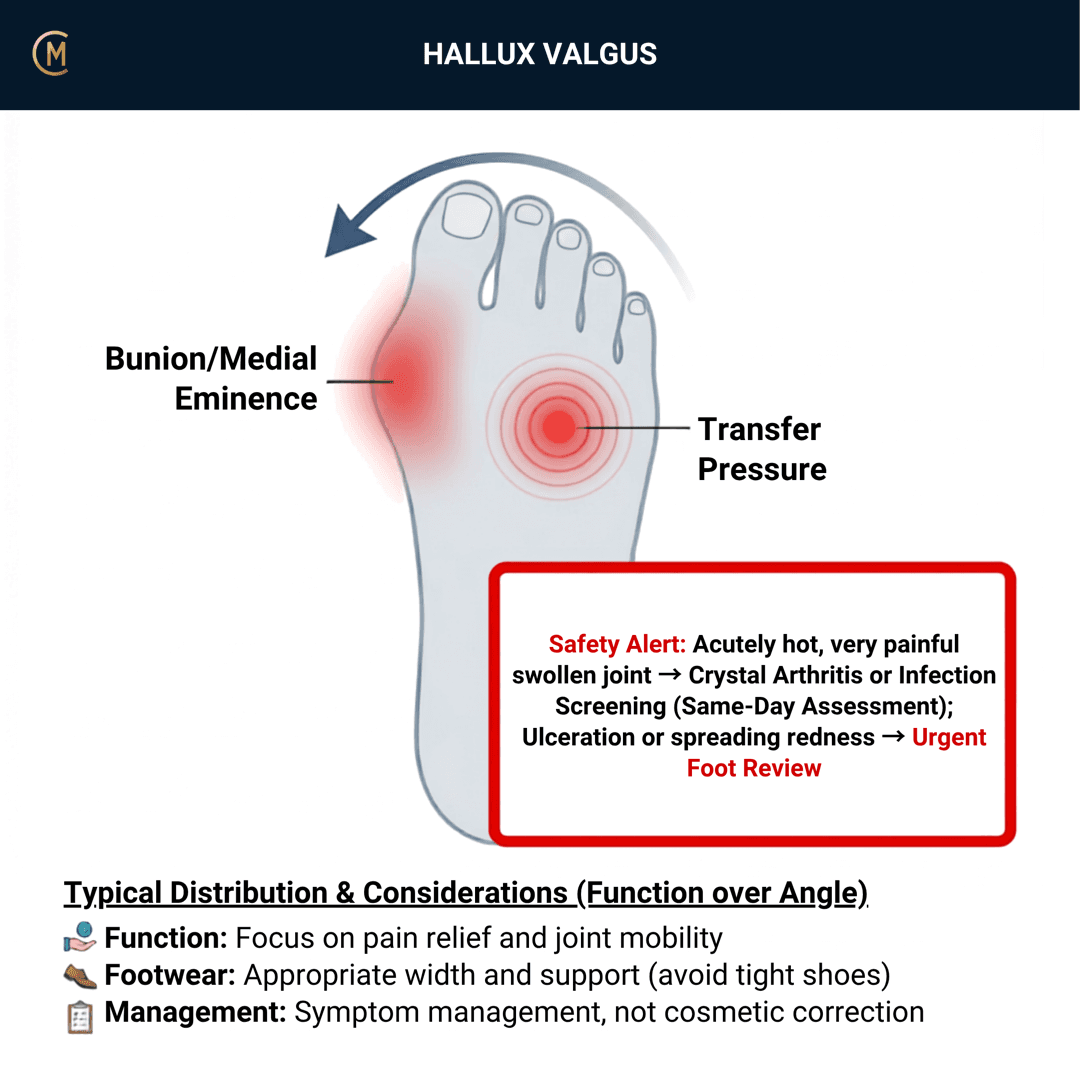
Who: Often a family history. Very narrow toe boxes and high heels in your 20s are associated with it (Matsuoka et al. 2026) [21] — whether shoes cause it or just irritate it isn't settled.
What: A three-dimensional first-ray deformity — lateral deviation of the hallux with a medial prominence.
How it behaves: Pain and swelling at the medial first MTP. Worse in narrow shoes and on prolonged walking. Eased by wide shoes and rest.
The one thing to take from this page:
Treat what limits comfort and function. Alignment is a finding, not the target — and saying so up front is what keeps the patient with you.
What conservative care actually moves
| Moves well | Moves modestly |
|---|---|
| Pain | Alignment |
| Function and footwear tolerance | Hallux valgus angle |
| Pressure distribution | — |
Non-surgical care can improve pain and some alignment measures, with realistic expectations required, and intervention matched to tolerance and goals [1]. Orthoses may help, and design, wear time, comfort and adherence strongly shape the result [2].
Promise the pain and the function. Don't promise the angle.
⚠️ No Australian guideline exists. Anchored to a NICE-based management update [3] and the Cochrane review of surgery [4].
2 · SE — THE SUBJECTIVE PATTERN (the 70%)
Five stages, in your course's order.
MAIN PROBLEM
"The bump rubs in every shoe I own."
"It aches after I've been on my feet all day."
"My toe's pushing into the second one now."
Note which of those three it is. Rubbing, aching, and deformity progression are different complaints with different treatments.
BODY CHART
- Mark the medial eminence — and separately, the dorsal joint line (that's the hallux rigidus question) and the plantar first MTP (sesamoids).
- Mark callus and skin irritation, including under the second and third metatarsal heads. Transfer load is part of this pattern.
- Note second toe position — drift, overriding, or a hammer deformity.
BEHAVIOUR
| Fits hallux valgus | Points elsewhere | |
|---|---|---|
| Aggs | Narrow shoes, prolonged walking | Push-off, hills, sprinting → hallux rigidus |
| Eases | Wide shoes, rest, going barefoot | Stiff-soled or rocker shoes → hallux rigidus |
| Severity | VAS 0–10 at best / at worst / right now | — |
| Pain site | Medial prominence | Dorsal, with jamming → hallux rigidus. Plantar → sesamoiditis |
| Onset | Gradual, progressive | Acute, red, hot → gout |
HISTORY
- Footwear, in detail — work, exercise, and what they'd wear if pain weren't a factor.
- Family history. Common, and worth naming because it reframes blame.
- Rate of progression, and whether the second toe has started to change.
- What matters to them. Comfort in shoes? Walking distance? Running? The goal decides the plan.
SPECIAL / SCREENING QUESTIONS
- Acute red hot swollen joint — gout, and it is ruled out before loading.
- Morning stiffness >30 min (In), multiple joints, systemic features — inflammatory arthropathy.
- Numbness, burning into the toes — neuroma or nerve.
- Diabetes or neuropathy — changes the risk of a pressure lesion entirely.
Assessing this region? Download the Ankle & Foot assessment template →
3 · HYPOTHESIS RANKING
| Competing pattern | The one discriminating feature |
|---|---|
| Hallux rigidus (1st MTP OA) | Dorsal pain and stiffness with reduced dorsiflexion, often under 40°, rather than medial eminence pain and lateral toe deviation. |
| Gout | Acute red, hot, swollen first MTP. Rule it out before loading anything. |
| Sesamoiditis | Plantar rather than medial pain, worse on push-off. |
And the ones that come with it
Transfer metatarsalgia and lesser toe deformity. Hallux valgus alters medial forefoot loading and shifts pressure centrally (Wong et al. 2025), which is why the second and third metatarsal heads start to hurt and the second toe starts to change. Treating only the bunion in a foot that has already transferred its load is treating half the problem.
4 · RED FLAGS — DON'T MISS THIS
This section is free, on every pattern, forever. Safety is never gated.
| Finding | What it suggests | What you do |
|---|---|---|
| Acute red, hot, swollen 1st MTP | Gout, or septic arthritis | Same-day medical review. Do not load it |
| Fever, systemically unwell with a hot joint | Septic arthritis | 🚑 Emergency |
| Hot, swollen first MTP — check passive range | Painful loss of active and passive range points into the joint; preserved passive range points periarticular (bursitis, tendinitis) | Hot is same-day medical review either way — septic arthritis is the one that can't wait (Swisher et al. 2025) [22] |
| Morning stiffness >30 min (In), multiple joints, systemic features | Inflammatory arthropathy | GP referral |
| Skin breakdown or ulceration over the eminence | Pressure lesion | Offload urgently; medical review if diabetic |
| Diabetes or neuropathy with any callus or skin change | Neuropathic ulcer risk | 🚑 See the infection page |
| Rapidly progressive deformity, or sudden change | Structural failure or inflammatory | Medical or orthopaedic referral |
| Focal bony tenderness with a load spike | Stress fracture | Offload and image |
The rule: a gradually deforming, shoe-sensitive, non-inflamed joint is yours. Hot, red, systemically unwell, ulcerated, or neuropathic is not.
Cross-links: Hallux rigidus · Metatarsalgia · Infection / osteomyelitis / ulcer
5 · OE — THE OBJECTIVE (the 30%)
Members
Sections 5 to 7 are for members
The objective exam, management and pearls, plus the six-minute lesson and the debrief. Free with an account.
Sign in or join free6 · MX — MANAGEMENT ESSENTIALS
Members
Sections 5 to 7 are for members
The objective exam, management and pearls, plus the six-minute lesson and the debrief. Free with an account.
Sign in or join free7 · CLINICAL PEARLS + RETRIEVAL CHECK
Members
Sections 5 to 7 are for members
The objective exam, management and pearls, plus the six-minute lesson and the debrief. Free with an account.
Sign in or join freeMembers
The 4-minute lesson is for members
Twelve slides on this pattern: what you'll hear, what to examine, what to do. Free with an account.
Sign in or join freeGuideline anchor
No Australian guideline covers hallux valgus.
More
Anchored to the NICE-based management update (Imran et al. 2025, PMID 41393558) for the pathway, the systematic review and meta-analysis of non-surgical interventions (Hurn et al. 2022, PMID 33768721) for conservative care, and the Cochrane review of surgery (Dias et al. 2024, PMID 39051477) for the operative side.
The NICE-based anchor is a UK pathway summary, not an Australian one, and the Cochrane review is a synthesis rather than a guideline. Neither is written for a physiotherapist deciding how hard to push an alignment device. The conservative reasoning on this page comes from the primary evidence and is labelled as such.
Members
The evidence summary is for members
Verified diagnostic accuracy, where the evidence stands and what it doesn't settle. Free with an account.
Sign in or join freeSources · 20
ShowHide
Every source on this page resolves and title-verifies against PubMed. Newest first.
- 2022Hurn et al. (2022). Effectiveness of Nonsurgical Interventions for Hallux Valgus: A Systematic Review and Meta-Analysis. Arthritis care & research, 74(10), 1676-1688. https://doi.org/10.1002/acr.24603
- 2021Kwan et al. (2021). Hallux valgus orthosis characteristics and effectiveness: a systematic review with meta-analysis. BMJ open, 11(8), e047273. https://doi.org/10.1136/bmjopen-2020-047273
- 2025Imran et al. (2025). Hallux Valgus Management: An Update Based on National Institute for Health and Care Excellence (NICE) Guidelines. Cureus, 17(11), e96642. https://doi.org/10.7759/cureus.96642
- 2024Dias et al. (2024). Surgical interventions for treating hallux valgus and bunions. The Cochrane database of systematic reviews, 7(7), CD013726. https://doi.org/10.1002/14651858.CD013726.pub2
- 2013Nix et al. (2013). Gait parameters associated with hallux valgus: a systematic review. Journal of foot and ankle research, 6(1), 9. https://doi.org/10.1186/1757-1146-6-9
- 2015Kim et al. (2015). Effect of toe-spread-out exercise on hallux valgus angle and cross-sectional area of abductor hallucis muscle in subjects with hallux valgus. Journal of physical therapy science, 27(4), 1019-22. https://doi.org/10.1589/jpts.27.1019
- 2015Mortka & Lisiński (2015). Hallux valgus-a case for a physiotherapist or only for a surgeon? Literature review. Journal of physical therapy science, 27(10), 3303-7. https://doi.org/10.1589/jpts.27.3303
- 2016Fraissler et al. (2016). Treatment of hallux valgus deformity. EFORT open reviews, 1(8), 295-302. https://doi.org/10.1302/2058-5241.1.000005
- 2018Nishimura et al. (2018). Does hallux valgus impair physical function?. BMC musculoskeletal disorders, 19(1), 174. https://doi.org/10.1186/s12891-018-2100-0
- 2021Ying et al. (2021). Adjusted Indirect and Mixed Comparisons of Conservative Treatments for Hallux Valgus: A Systematic Review and Network Meta-Analysis. International journal of environmental research and public health, 18(7). https://doi.org/10.3390/ijerph18073841
- 2021Ezzatvar et al. (2021). Prevalence and Predisposing Factors for Recurrence after Hallux Valgus Surgery: A Systematic Review and Meta-Analysis. Journal of clinical medicine, 10(24). https://doi.org/10.3390/jcm10245753
- 2023Oztarsu & Oksuz (2023). Comparison of the effects of progressive supervised and home program exercise therapy in mild-moderate hallux valgus. Journal of comparative effectiveness research, 12(3), e220091. https://doi.org/10.2217/cer-2022-0091
- 2024Khan & Patil (2024). The Effect of Therapeutic Approaches on Hallux Valgus Deformity. Cureus, 16(4), e58750. https://doi.org/10.7759/cureus.58750
- 2024Krześniak & Truszczyńska-Baszak (2024). Toe Separators as a Therapeutic Tool in Physiotherapy-A Systematic Review. Journal of clinical medicine, 13(24). https://doi.org/10.3390/jcm13247771
- 2025Bajraszewski et al. (2025). Footwear Toe-Box Shape and Medial Forefoot Pressures in Women With Hallux Valgus. Journal of foot and ankle research, 18(2), e70041. https://doi.org/10.1002/jfa2.70041
- 2025Jankowicz-Szymańska et al. (2025). The impact of corrective exercises, kinesiology taping, and mechanical correction on pain and foot shape in women with hallux valgus. Frontiers in physiology, 16, 1473278. https://doi.org/10.3389/fphys.2025.1473278
- 2025Ettinger et al. (2025). Hallux Valgus: Prevalence and Treatment Options. Deutsches Arzteblatt international, 122(11), 308-314. https://doi.org/10.3238/arztebl.m2025.0068
- 2025Cho et al. (2025). Current Concepts of Radiographic Evaluation and Surgical Treatment for Hallux Valgus Deformity. Journal of clinical medicine, 14(14). https://doi.org/10.3390/jcm14145072
- 2025Wong et al. (2025). Does Hallux Valgus Impair Medial Forefoot Loading? A Meta-Analysis of Plantar Pressure Distribution. Journal of foot and ankle research, 18(3), e70073. https://doi.org/10.1002/jfa2.70073
- 2025Gumuskaya et al. (2025). Preoperative and Postoperative Physical and Mechanical Rehabilitation Interventions in Hallux Valgus: A Systematic Review. Journal of foot and ankle research, 18(3), e70083. https://doi.org/10.1002/jfa2.70083
Mapped to this pattern
Generic measures that also apply
- Borg RPE
Borg Rating of Perceived Exertion Scale (6-20)
perceived exertion · 1 items · 1 min
- GROC
Global Rating of Change Scale
perceived change since baseline · 1 items · 1 min
- NPRS
Numeric Pain Rating Scale
pain intensity · 1 items · 1 min
- PGIC
Patient Global Impression of Change
perceived change since baseline · 1 items · 1 min
- PSFS
Patient-Specific Functional Scale
patient-generated function · 3 items · 2 min
- SANE
Single Assessment Numeric Evaluation
patient-rated function as a percentage of normal · 1 items · 1 min
- VAS
Visual Analogue Scale
pain intensity · 1 items · 1 min
- Borg CR10
Borg Category Ratio 10 Scale
perceived exertion or symptom intensity, ratio scale · 1 items · 1 min
- GAS
Goal Attainment Scaling
individualised goal achievement · 10 min
Did this page do its job?
CliniStudy is in beta. One tap is enough — it decides what gets fixed first.