
1 · SNAPSHOT
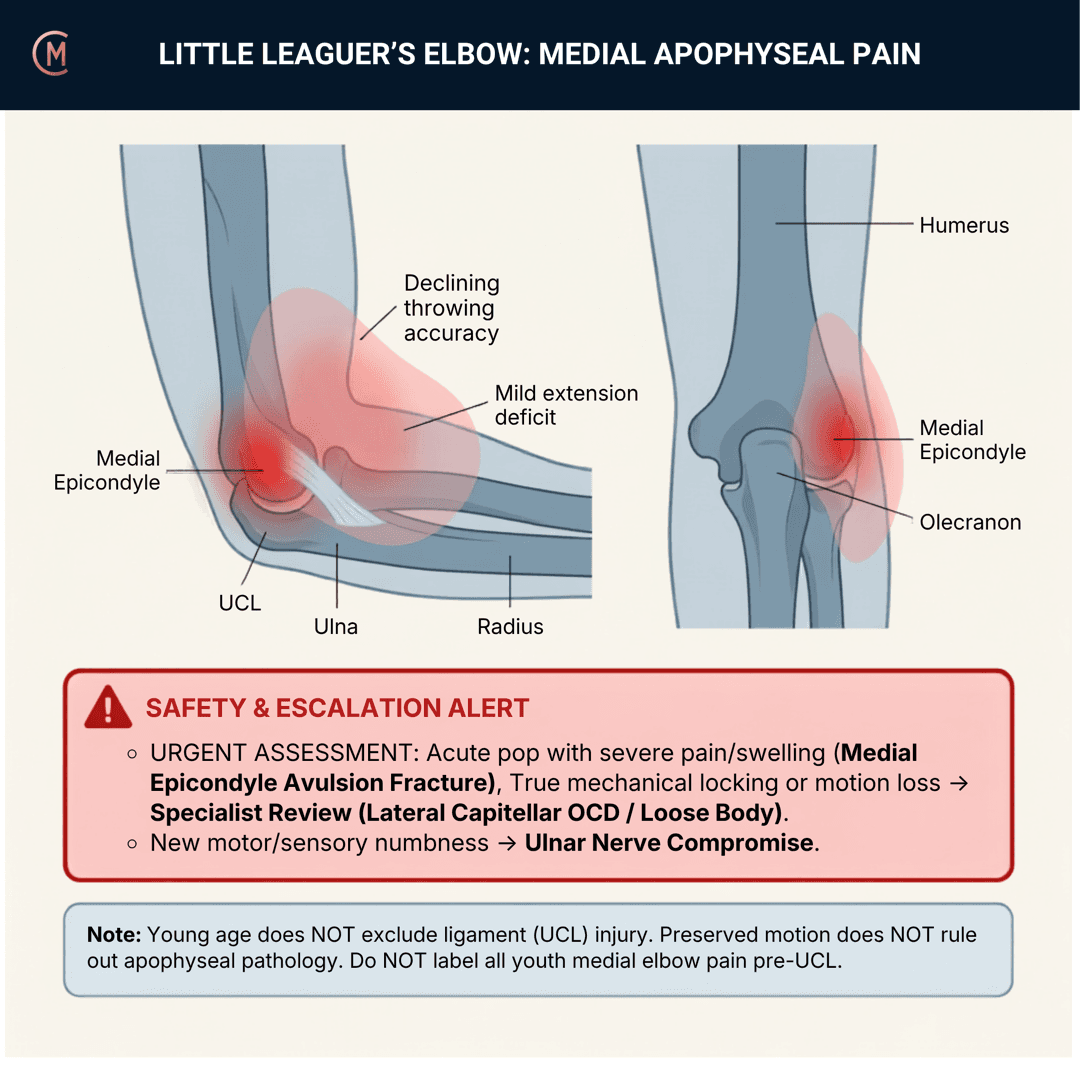
Who: Skeletally immature throwers. Baseball pitchers and catchers above all; the same logic applies to cricket, javelin and any repeated overhead valgus load.
What: Traction overload of the medial epicondyle apophysis.
How it behaves: Gradual medial elbow pain through late cocking and acceleration. A "pulling" or "tight" ache. Worse with pitching volume. No single traumatic event.
The one thing to take from this page:
Same load, same sport, same position — different failure point. In the immature elbow the apophysis is the weak link; in the mature elbow it's the ligament. Age decides which page you're on.
The safety split
| Uncomplicated — yours | Escalate |
|---|---|
| Gradual onset, no trauma | Acute pop, sudden severe pain |
| Focal apophyseal tenderness | Medial epicondyle avulsion |
| Full or near-full range | Loss of range |
| No neurological symptoms | Ulnar nerve symptoms |
| Improving on deload | Lateral elbow pain → osteochondritis dissecans |
⚠️ No Australian guideline exists — and the pitch-count numbers you'll hear are American governing-body rules, not clinical thresholds. The principle transfers: count the load, mandate rest days, don't play year-round. The specific number should come from the local competition, not from a page.
2 · SE — THE SUBJECTIVE PATTERN (the 70%)
Five stages, in your course's order. The workload history is the diagnosis and the treatment, and you are usually taking it from a child, a parent and — indirectly — a coach.
MAIN PROBLEM
"My elbow pulls when I throw."
"He's lost velocity and he's not getting it over the plate."
"It only hurts when he pitches."
Velocity loss and loss of control are symptoms. They often arrive before the child says the word "pain".
BODY CHART
- Mark the medial epicondyle apophysis — focal, not the whole medial elbow.
- Mark the lateral side too. Lateral pain is the osteochondritis dissecans question and it changes everything.
- Mark any 4th and 5th digit symptoms — the ulnar nerve screen.
BEHAVIOUR
| Fits apophysitis | Points elsewhere | |
|---|---|---|
| Aggs | Late cocking to acceleration, pitching volume, fatigue | Gripping rather than throwing → flexor tendinopathy |
| Severity | VAS 0–10 at best / at worst / right now | — |
| Onset | Gradual | Acute pop → avulsion |
| Range | Full or near-full | Loss of range → escalate |
| Symptoms | Load-related pain | Numbness in 4th/5th digits → cubital tunnel |
HISTORY — the workload audit
Ask all of it. This is the assessment.
- Pitch counts, innings, rest days.
- Multiple teams, overlapping seasons, showcases, year-round throwing.
- Velocity change, control change, fatigue during outings.
- Was he pitching through pain? Ask the child separately if you can.
- Recent workload spike.
SPECIAL / SCREENING QUESTIONS
- Any single traumatic pop? Avulsion.
- Loss of extension or flexion? Escalate.
- Lateral elbow pain, catching, locking? Osteochondritis dissecans.
- Numbness or tingling in the little and ring fingers?
- And note: youth players can develop elbow injury even without prior pain (Matsuura et al. 2013), so absence of a pain history is not reassurance about load.
Assessing this region? Download the Elbow assessment template →
3 · HYPOTHESIS RANKING
| Competing pattern | The one discriminating feature |
|---|---|
| Ulnar collateral ligament injury | Skeletally mature thrower. This one is apophyseal — tender medial epicondyle apophysis, widening on radiograph. |
| Medial elbow flexor tendinopathy | Tendon rather than apophysis; gradual with gripping rather than with throwing volume. |
| Cubital tunnel syndrome | Numbness and tingling in the 4th and 5th digits rather than load-related medial pain. |
The two that outrank the table
Medial epicondyle avulsion — a severe variant of this same problem. Acute worsening, a pop, or functional loss needs imaging [1].
Osteochondritis dissecans of the capitellum — lateral elbow pain, catching, locking, loss of extension. Different side, different consequence, and it is why you palpate laterally in a medial elbow presentation.
And the one that changes how seriously you take persistence
Chronic, non-healed medial epicondylar traction apophysitis has been associated with later ulnar collateral ligament insufficiency [2]. So persistent symptoms are not growing pains — they are a reason to keep the athlete deloaded and reassessed.
4 · RED FLAGS — DON'T MISS THIS
This section is free, on every pattern, forever. Safety is never gated.
| Finding | What it suggests | What you do |
|---|---|---|
| Acute pop with severe pain | Medial epicondyle avulsion | Image. Orthopaedic review |
| Loss of elbow range | Avulsion, loose body, or OCD | Image |
| Inability to throw at all | Higher-grade injury | Image |
| Lateral elbow pain, catching or locking | Osteochondritis dissecans of the capitellum | Image. Orthopaedic review |
| Elbow pain at rest | Capitellar OCD — rest pain predicted it in screened adolescent throwers | Palpate and compress laterally; image if it's there (Yang et al. 2018) [20] |
| Ulnar nerve symptoms | Nerve involvement | Escalate |
| Visible swelling or deformity | Structural | Image |
| Valgus instability | Ligamentous or avulsion injury | Orthopaedic review |
| Persistent symptoms despite deload | Non-healing apophysitis | Image, and keep them off throwing |
The rule: gradual load-related medial pain with full range in a skeletally immature thrower is yours. Acute, stiff, lateral, neurological or unstable is not.
Cross-links: Little leaguer's shoulder · Lateral elbow tendinopathy · Cubital tunnel syndrome
5 · OE — THE OBJECTIVE (the 30%)
Members
Sections 5 to 7 are for members
The objective exam, management and pearls, plus the six-minute lesson and the debrief. Free with an account.
Sign in or join free6 · MX — MANAGEMENT ESSENTIALS
Members
Sections 5 to 7 are for members
The objective exam, management and pearls, plus the six-minute lesson and the debrief. Free with an account.
Sign in or join free7 · CLINICAL PEARLS + RETRIEVAL CHECK
Members
Sections 5 to 7 are for members
The objective exam, management and pearls, plus the six-minute lesson and the debrief. Free with an account.
Sign in or join freeMembers
The 5-minute lesson is for members
Twelve slides on this pattern: what you'll hear, what to examine, what to do. Free with an account.
Sign in or join freeGuideline anchor
No Australian guideline covers youth throwing elbow injury.
More
Anchored to the clinical review of adolescent overhead elbow injuries (Looney et al. 2021, PMID 33996078) for the differential, the systematic review of risk factors in adolescent baseball (Norton et al. 2019, PMID 29630388) for prevention, and the pitch-count limitation cohort (Matsuura et al. 2021, PMID 33796588) for the workload intervention that has actual outcome data behind it.
None of these is an Australian document and none is a formal guideline. The pitch-count rules that exist are American youth baseball governing-body rules, not clinical guidelines, and they do not transfer directly to Australian club structures or to cricket. The principle — count the load, mandate rest days, don't play year-round — does.
Members
The evidence summary is for members
Verified diagnostic accuracy, where the evidence stands and what it doesn't settle. Free with an account.
Sign in or join freeSources · 19
ShowHide
Every source on this page resolves and title-verifies against PubMed. Newest first.
- 2025Zheng et al. (2025). Medial Epicondylar Apophyseal Avulsion Fractures in Youth Throwers: A Severe Variant of Little League Elbow. Orthopaedic journal of sports medicine, 13(9), 23259671251365974. https://doi.org/10.1177/23259671251365974
- 2022Otoshi et al. (2022). The influence of chronic medial epicondylar apophysitis on medial ulnar collateral ligament insufficiency-: a retrospective cohort study. JSES international, 6(3), 539-544. https://doi.org/10.1016/j.jseint.2021.12.014
- 2021Shitara et al. (2021). Asymptomatic Medial Elbow Ultrasound Abnormality in Youth Baseball Players Is an Independent Risk Factor for Elbow Injury: A Prospective Cohort Study. Orthopaedic journal of sports medicine, 9(4), 2325967120986791. https://doi.org/10.1177/2325967120986791
- 2006Olsen SJ 2nd et al. (2006). Risk factors for shoulder and elbow injuries in adolescent baseball pitchers. The American journal of sports medicine, 34(6), 905-12. https://doi.org/10.1177/0363546505284188
- 2021Matsuura et al. (2021). Limiting the Pitch Count in Youth Baseball Pitchers Decreases Elbow Pain. Orthopaedic journal of sports medicine, 9(3), 2325967121989108. https://doi.org/10.1177/2325967121989108
- 2002Lyman et al. (2002). Effect of pitch type, pitch count, and pitching mechanics on risk of elbow and shoulder pain in youth baseball pitchers. The American journal of sports medicine, 30(4), 463-8. https://doi.org/10.1177/03635465020300040201
- 2010Harada et al. (2010). Risk factors for elbow injuries among young baseball players. Journal of shoulder and elbow surgery, 19(4), 502-7. https://doi.org/10.1016/j.jse.2009.10.022
- 2012Fleisig & Andrews (2012). Prevention of elbow injuries in youth baseball pitchers. Sports health, 4(5), 419-24. https://doi.org/10.1177/1941738112454828
- 2013Gregory & Nyland (2013). Medial elbow injury in young throwing athletes. Muscles, ligaments and tendons journal, 3(2), 91-100. https://doi.org/10.11138/mltj/2013.3.2.91
- 2013Matsuura et al. (2013). Elbow Injuries in Youth Baseball Players Without Prior Elbow Pain: A 1-Year Prospective Study. Orthopaedic journal of sports medicine, 1(5), 2325967113509948. https://doi.org/10.1177/2325967113509948
- 2019Norton et al. (2019). Risk Factors for Elbow and Shoulder Injuries in Adolescent Baseball Players: A Systematic Review. The American journal of sports medicine, 47(4), 982-990. https://doi.org/10.1177/0363546518760573
- 2021Looney et al. (2021). Evaluation and management of elbow injuries in the adolescent overhead athlete. SAGE open medicine, 9, 20503121211003362. https://doi.org/10.1177/20503121211003362
- 2021Tajika et al. (2021). Risk Factors for Throwing-Related Shoulder and Elbow Pain in Adolescent Baseball Players: A Prospective Study of Physical and Developmental Factors. Orthopaedic journal of sports medicine, 9(9), 23259671211017129. https://doi.org/10.1177/23259671211017129
- 2021Watanabe et al. (2021). Increased medial laxity of the elbow in preadolescent baseball players with or without medial elbow apophysitis. JSES international, 5(6), 1119-1124. https://doi.org/10.1016/j.jseint.2021.07.010
- 2021Mine et al. (2021). Risk Factors of Shoulder and Elbow Injuries in Baseball: A Scoping Review of 3 Types of Evidence. Orthopaedic journal of sports medicine, 9(12), 23259671211064645. https://doi.org/10.1177/23259671211064645
- 2024Koseki et al. (2024). Characteristics and Clinical Assessment of Elbow Pain in Youth Baseball Players. Sports (Basel, Switzerland), 12(6). https://doi.org/10.3390/sports12060161
- 2024Sgroi et al. (2024). Throwing Injuries and Prevention Strategies in Youth Baseball. HSS journal : the musculoskeletal journal of Hospital for Special Surgery, 20(3), 341-345. https://doi.org/10.1177/15563316241249139
- 2026Kriz et al. (2026). Do Pitching Restriction Policies Reduce Shoulder and Elbow Injuries in High School Baseball Players?. Orthopaedic journal of sports medicine, 14(2), 23259671251412404. https://doi.org/10.1177/23259671251412404
- 2026Saito et al. (2026). Age-Related Medial Elbow Laxity in Youth Baseball Players: Ultrasonographic Evaluation. Orthopaedic journal of sports medicine, 14(2), 23259671261420424. https://doi.org/10.1177/23259671261420424
Mapped to this pattern
Generic measures that also apply
- Borg RPE
Borg Rating of Perceived Exertion Scale (6-20)
perceived exertion · 1 items · 1 min
- GROC
Global Rating of Change Scale
perceived change since baseline · 1 items · 1 min
- NPRS
Numeric Pain Rating Scale
pain intensity · 1 items · 1 min
- PGIC
Patient Global Impression of Change
perceived change since baseline · 1 items · 1 min
- PSFS
Patient-Specific Functional Scale
patient-generated function · 3 items · 2 min
- SANE
Single Assessment Numeric Evaluation
patient-rated function as a percentage of normal · 1 items · 1 min
- VAS
Visual Analogue Scale
pain intensity · 1 items · 1 min
- Borg CR10
Borg Category Ratio 10 Scale
perceived exertion or symptom intensity, ratio scale · 1 items · 1 min
- GAS
Goal Attainment Scaling
individualised goal achievement · 10 min
Did this page do its job?
CliniStudy is in beta. One tap is enough — it decides what gets fixed first.