
1 · SNAPSHOT
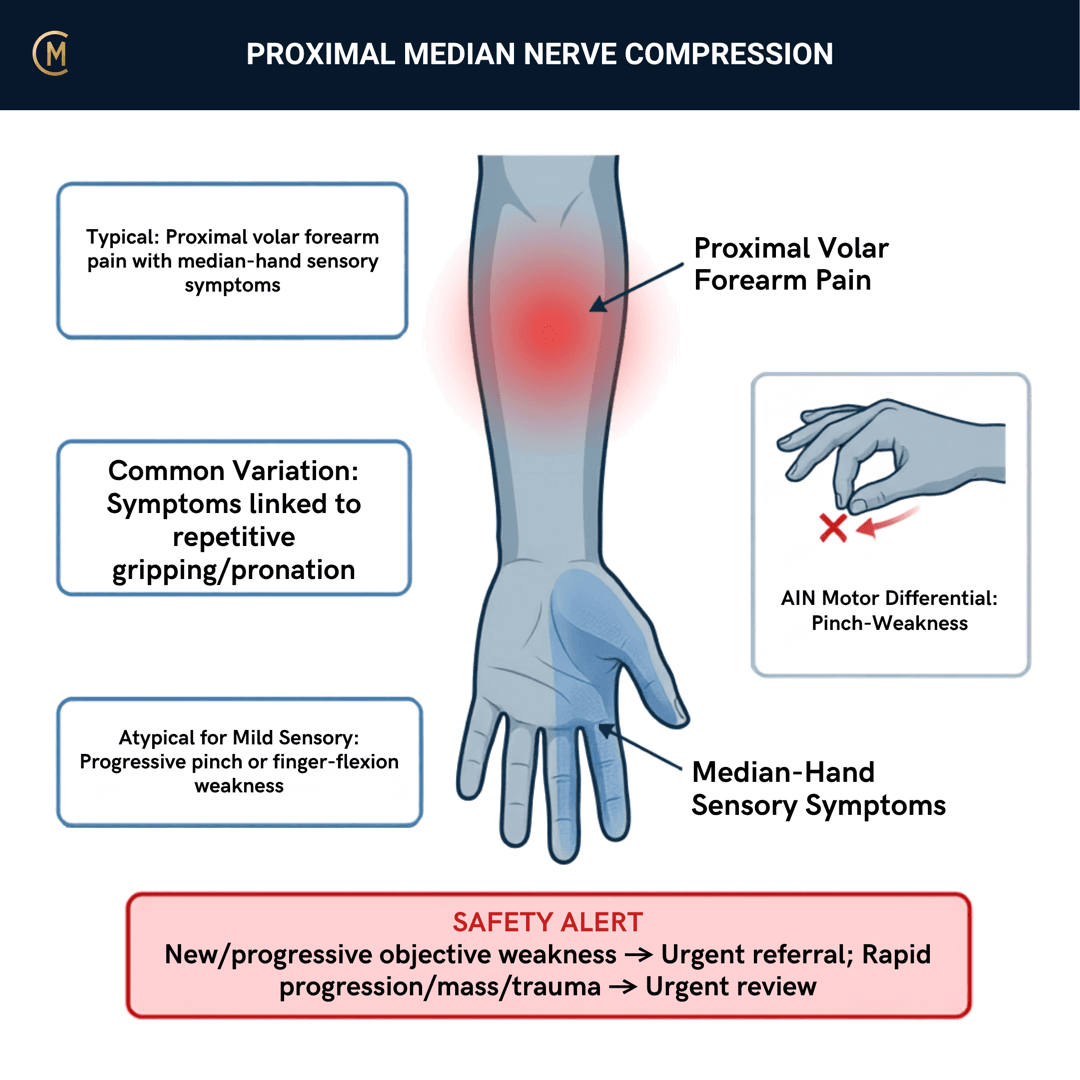
Who: Manual trades and lifters. Repetitive gripping and pronation-supination load.
What: Proximal median nerve entrapment in the forearm.
How it behaves: Forearm pain and median-distribution paraesthesia. Worse with gripping and pronation. No nocturnal symptoms, or far less than carpal tunnel. Eased by rest.
The one thing to take from this page:
Electrodiagnosis may be negative in pronator syndrome. So a normal nerve conduction study does not clear it — and this diagnosis is made on anatomy, history and local provocation.
That is the central message of the current concepts literature [1], and it is what separates a student who reasons from one who waits for a test.
Same nerve, four places
| Where | Its discriminator |
|---|---|
| Lacertus fibrosus | Pain on resisted elbow flexion and supination |
| Pronator teres | Proximal volar forearm tenderness, pain on resisted pronation |
| Superficialis arch | More distal forearm — distinguishable from pronator |
| Carpal tunnel | Nocturnal waking, relief on shaking out, positive Phalen's and wrist Tinel's |
And they can coexist. A released carpal tunnel that still hurts is a reason to look higher [2].
⚠️ No guideline exists. The literature here is reviews, small series and case reports — which is itself a statement about how often this gets recognised.
2 · SE — THE SUBJECTIVE PATTERN (the 70%)
Five stages, in your course's order. The location of the dominant tenderness is the diagnosis — and the night question is what rules the alternative out.
MAIN PROBLEM
"My forearm aches and my thumb side of the hand tingles."
"It's worse when I'm gripping or turning a screwdriver."
"No, it doesn't wake me."
That third answer is doing real work.
BODY CHART
- Map the median territory in the hand — and mark where the dominant pain actually is. Proximal volar forearm is this pattern; wrist and hand alone is carpal tunnel.
- Mark the pronator teres region and, separately, the lacertus just medial to the biceps tendon.
- Draw the neck too. C6–T1 is on the list.
BEHAVIOUR
| Fits pronator teres | Points elsewhere | |
|---|---|---|
| Aggs | Gripping, repetitive pronation, lifting, manual work | Wrist position and sustained flexion → CTS |
| Night | Absent or minor | Nocturnal waking, shaking out → CTS |
| Eases | Rest | — |
| Severity | VAS 0–10 at best / at worst / right now | — |
| Motor | Usually none early | Pure motor, no sensory change → AIN syndrome |
HISTORY
- Occupational and sport load — tools, torque, gripping volume, lifting, racquet or throwing exposure. This is the exposure and usually the treatment.
- Any previous carpal tunnel surgery, and whether it helped. Ask this explicitly.
- Previous investigations — and what the nerve study showed. A normal one does not close the question.
SPECIAL / SCREENING QUESTIONS
- Thumb, index or middle weakness; difficulty making an "OK" sign — the anterior interosseous screen.
- Thenar wasting, pinch weakness, dropping objects — motor involvement, which escalates the pathway.
- Neck symptoms — the radiculopathy and double-crush question.
- Diabetes or systemic neuropathy risk.
Assessing this region? Download the Elbow assessment template →
3 · HYPOTHESIS RANKING
| Competing pattern | The one discriminating feature |
|---|---|
| Carpal tunnel syndrome | Nocturnal symptoms with relief on shaking out; positive Phalen's and Tinel's at the wrist. Pronator teres has no night symptoms. |
| Cervical radiculopathy (C6–T1) | Neck and arm pain with dermatomal numbness and myotomal weakness. |
| Anterior interosseous syndrome | Motor-only weakness of flexor pollicis longus and flexor digitorum profundus, without sensory change. |
The two the table doesn't separate
Lacertus fibrosus compression — suspect it with pain on resisted elbow flexion and supination rather than resisted pronation. Superficialis-pronator compression sits more distally. Both are distinguishable from classic pronator teres syndrome, and the distinction matters because the surgical decision differs [3].
And the honest framing: proximal median compression is best thought of as a spectrum rather than pronator-versus-AIN, and localisation needs history, examination, electrodiagnosis and ultrasound together — it spans several zones from plexus to forearm ([4]; Rodner et al. 2013).
4 · RED FLAGS — DON'T MISS THIS
This section is free, on every pattern, forever. Safety is never gated.
| Finding | What it suggests | What you do |
|---|---|---|
| Thenar weakness or wasting | Established motor involvement | Surgical opinion |
| Flexor pollicis longus or flexor digitorum profundus weakness | AIN or proximal median motor involvement | Urgent referral |
| Marked or constant sensory loss | Advanced | Escalate |
| Traumatic onset with progressive deficit | Structural | Urgent referral |
| Suspected mass, cyst or structural lesion | Space-occupying | Imaging, then surgical opinion |
| Persistent symptoms after carpal tunnel release | Missed proximal compression | Reassess the level. Do not re-release |
| Bilateral or stocking distribution | Systemic neuropathy | Medical referral |
| Weakness with no sensory symptoms that won't stay in one nerve's territory — atrophy in several, becoming bilateral — bulbar signs (tongue fasciculations, speech or swallowing change), or no improvement after a decompression | ALS can mimic a compressive neuropathy early (Thomson et al. 2023) [16] | Neurodiagnostic testing and prompt neurologist referral — not a decompression |
| Failure to improve after a focused 6–8 week block | Wrong level, or needs investigation | EDX or ultrasound, then referral |
The rule: sensory irritability that tracks gripping and pronation load is yours. Objective motor deficit, atrophy, traumatic progression or a suspected lesion is not.
Cross-links: Peripheral nerve entrapments · Cubital tunnel syndrome · Lateral elbow tendinopathy
5 · OE — THE OBJECTIVE (the 30%)
Members
Sections 5 to 7 are for members
The objective exam, management and pearls, plus the six-minute lesson and the debrief. Free with an account.
Sign in or join free6 · MX — MANAGEMENT ESSENTIALS
Members
Sections 5 to 7 are for members
The objective exam, management and pearls, plus the six-minute lesson and the debrief. Free with an account.
Sign in or join free7 · CLINICAL PEARLS + RETRIEVAL CHECK
Members
Sections 5 to 7 are for members
The objective exam, management and pearls, plus the six-minute lesson and the debrief. Free with an account.
Sign in or join freeMembers
The 4-minute lesson is for members
Twelve slides on this pattern: what you'll hear, what to examine, what to do. Free with an account.
Sign in or join freeGuideline anchor
No guideline exists for proximal median nerve entrapment, in Australia or anywhere.
More
Anchored to the current concepts review of proximal median nerve compression (Adler & Wolf 2020, PMID 32893044), the differential review separating pronator syndrome from carpal tunnel syndrome (Balcerzak et al. 2022, PMID 36292122), and the evidence-based occupational review (Carter & Weiss 2015, PMID 26231964) for the conservative trial.
No guideline exists, and the condition is under-recognised enough that its literature is mostly reviews, small series and case reports. The strongest single message in that literature — that electrodiagnosis may be negative — is on the page rather than buried, because it is what changes a student's reasoning.
Members
The evidence summary is for members
Verified diagnostic accuracy, where the evidence stands and what it doesn't settle. Free with an account.
Sign in or join freeSources · 15
ShowHide
Every source on this page resolves and title-verifies against PubMed. Newest first.
- 2020Adler & Wolf (2020). Proximal Median Nerve Compression: Pronator Syndrome. The Journal of hand surgery, 45(12), 1157-1165. https://doi.org/10.1016/j.jhsa.2020.07.006
- 2021El-Haj et al. (2021). Median Nerve Compression in the Forearm: A Clinical Diagnosis. Hand (New York, N.Y.), 16(5), 586-591. https://doi.org/10.1177/1558944719874137
- 2021Tang (2021). Median nerve compression: lacertus syndrome versus superficialis-pronator syndrome. The Journal of hand surgery, European volume, 46(9), 1017-1022. https://doi.org/10.1177/17531934211024092
- 2024Shields et al. (2024). Proximal median nerve neuropathy: electrodiagnostic and ultrasound findings in 62 patients. Frontiers in neurology, 15, 1468813. https://doi.org/10.3389/fneur.2024.1468813
- 2023Hu et al. (2023). [Value of High-Frequency Ultrasound in the Diagnosis of Pronator Teres Syndrome]. Zhongguo yi xue ke xue yuan xue bao. Acta Academiae Medicinae Sinicae, 45(3), 436-439. https://doi.org/10.3881/j.issn.1000-503X.15472
- 2015Carter & Weiss (2015). Diagnosis and Treatment of Work-Related Proximal Median and Radial Nerve Entrapment. Physical medicine and rehabilitation clinics of North America, 26(3), 539-49. https://doi.org/10.1016/j.pmr.2015.04.001
- 2021Binder et al. (2021). Outcome of Surgical Treated Isolated Pronator Teres Syndromes-A Retrospective Cohort Study and Complete Review of the Literature. International journal of environmental research and public health, 19(1). https://doi.org/10.3390/ijerph19010080
- 2004Lee & LaStayo (2004). Pronator syndrome and other nerve compressions that mimic carpal tunnel syndrome. The Journal of orthopaedic and sports physical therapy, 34(10), 601-9. https://doi.org/10.2519/jospt.2004.34.10.601
- 2013Rodner et al. (2013). Pronator syndrome and anterior interosseous nerve syndrome. The Journal of the American Academy of Orthopaedic Surgeons, 21(5), 268-75. https://doi.org/10.5435/JAAOS-21-05-268
- 2014Lee et al. (2014). Early surgical treatment of pronator teres syndrome. Journal of Korean Neurosurgical Society, 55(5), 296-9. https://doi.org/10.3340/jkns.2014.55.5.296
- 2022Balcerzak et al. (2022). How to Differentiate Pronator Syndrome from Carpal Tunnel Syndrome: A Comprehensive Clinical Comparison. Diagnostics (Basel, Switzerland), 12(10). https://doi.org/10.3390/diagnostics12102433
- 2023Shojaie et al. (2023). Ultrasound-guided median nerve hydrodissection of pronator teres syndrome: a case report and a literature review. Journal of ultrasonography, 23(94), e165-e169. https://doi.org/10.15557/jou.2023.0026
- 2025Binsaleem (2025). Median nerve entrapment neuropathy: a review on the pronator syndrome. JSES reviews, reports, and techniques, 5(1), 70-78. https://doi.org/10.1016/j.xrrt.2024.10.001
- 2025Podlasińska et al. (2025). The Pronator Teres Muscle Revisited: Morphological Classification, Neurovascular Entrapment, and Surgical Implications. Journal of clinical medicine, 14(21). https://doi.org/10.3390/jcm14217474
- 2025Bartoletti et al. (2025). Peripheral Nerve Syndromes at the Elbow: A Review of Current Treatments. The archives of bone and joint surgery, 13(12), 800-806. https://doi.org/10.22038/ABJS.2025.87645.3996
Generic measures that also apply
- Borg RPE
Borg Rating of Perceived Exertion Scale (6-20)
perceived exertion · 1 items · 1 min
- DASH
Disabilities of the Arm, Shoulder and Hand
upper limb disability · 30 items · 8 min
- GROC
Global Rating of Change Scale
perceived change since baseline · 1 items · 1 min
- NPRS
Numeric Pain Rating Scale
pain intensity · 1 items · 1 min
- PGIC
Patient Global Impression of Change
perceived change since baseline · 1 items · 1 min
- PSFS
Patient-Specific Functional Scale
patient-generated function · 3 items · 2 min
- QuickDASH
QuickDASH
upper limb disability, short form · 11 items · 4 min
- SANE
Single Assessment Numeric Evaluation
patient-rated function as a percentage of normal · 1 items · 1 min
- UEFI
Upper Extremity Functional Index
upper limb function · 20 items · 5 min
- VAS
Visual Analogue Scale
pain intensity · 1 items · 1 min
- Borg CR10
Borg Category Ratio 10 Scale
perceived exertion or symptom intensity, ratio scale · 1 items · 1 min
- GAS
Goal Attainment Scaling
individualised goal achievement · 10 min
Did this page do its job?
CliniStudy is in beta. One tap is enough — it decides what gets fixed first.