
1 · SNAPSHOT
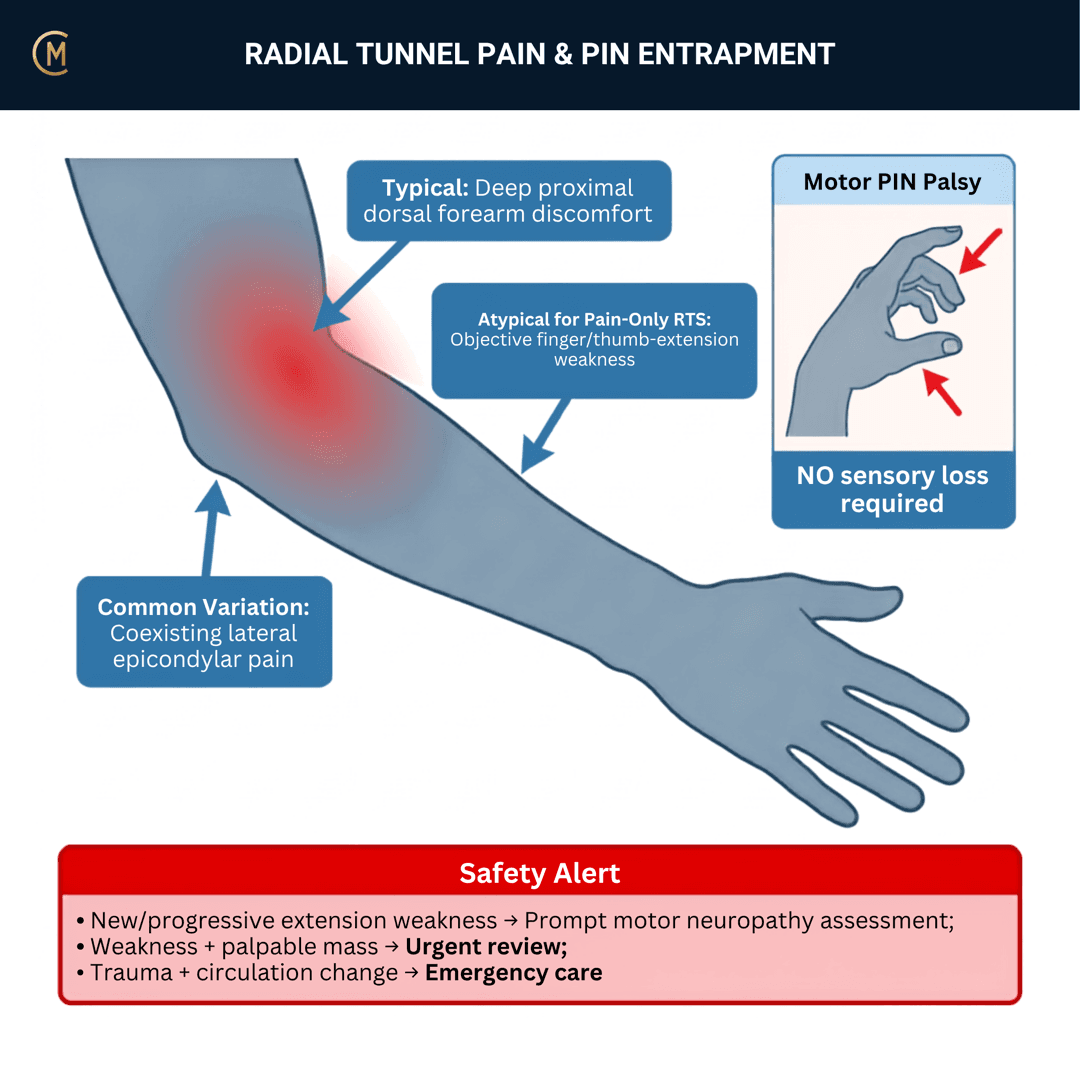
A contested diagnosis.
Illness script in one line: deep, dull, poorly localised pain in the proximal dorsal forearm rather than at the epicondyle, worse with resisted supination and repetitive forearm rotation, often in someone who has already been treated for tennis elbow and didn't respond.
Caseload frequency: uncommon, and over-diagnosed in some settings while being missed in others. Read further: epidemiology and overlap with lateral epicondylitis [1], throwing athletes [2].
Same nerve, same tunnel — and weakness decides which problem you're looking at
Radial tunnel syndrome and PIN entrapment are separate problems. Most textbooks conflate them. The distinction is the one that matters.
The posterior interosseous nerve is the deep, motor branch of the radial nerve, and it runs through the radial tunnel under the arcade of Frohse. Read further: anatomy of the radial nerve and the arcade of Frohse [3]. Two things can go wrong in the same tunnel:
| Radial tunnel syndrome | PIN entrapment / palsy | |
|---|---|---|
| The complaint | Pain. Deep, aching, proximal dorsal forearm | Weakness. Finger and thumb extension |
| Weakness | None, or minimal — pain more than weakness | Present, and it's the whole point |
| Sensation | Normal | Normal — PIN is a motor branch. |
| What you do | Load management, nerve mobility, a diagnosis of exclusion | Find out why. Section 4 |
The single question that sorts them: can they extend their fingers and thumb against gravity and resistance?
The split: pain (more than weakness) with resisted supination and middle finger extension for radial tunnel; weak finger/thumb extension in more advanced cases for PIN. That is more precise than most of what's published.
2 · SE — THE SUBJECTIVE PATTERN (the 70%)
Main problem
"A deep ache in my forearm that nothing has touched." Deep, dull pain in lateral forearm — often misdiagnosed as tennis elbow.
Often described as "tennis elbow that doesn't respond to treatment." That sentence is the referral pathway for this condition.
Body chart
Proximal dorsal forearm, distal to the epicondyle, poorly localised. Pain radiates distally (not localised to epicondyle).
Ask them to point. A finger on the epicondyle is lateral elbow tendinopathy. A hand vaguely over the proximal dorsal forearm, three to five centimetres down, is this page.
And ask about numbness. There shouldn't be any. Normal sensation (motor > sensory).
Behaviour
Worse with resisted supination or finger extension. Minimal relief with rest; aggravated by repetitive forearm activity.
"Minimal relief with rest" is the discriminator students under-use. A tendinopathy usually settles overnight and hurts again with load. A nerve that's being compressed in a tunnel often aches at rest and at night: pain may persist at rest if irritable.
Aggs: screwdrivers, wringing, repetitive rotation, racquet strokes, throwing, tool use, sustained gripping with the forearm pronated.
Eases: not much, which is the point.
24-hr pattern: minimal relief with rest. A tendinopathy settles overnight and hurts again with load; this one doesn't.
Night: aches at rest and at night when irritable — the discriminator from a tendinopathy.
Severity: VAS 0–10 at best / at worst / right now.
History
Weeks to months, often with a course of tennis elbow treatment behind it that did nothing. Ask what was tried and for how long — a genuine eight-week loading programme that produced nothing is meaningful information.
Ask about weakness, specifically and in function: dropping things, difficulty opening the hand, difficulty lifting the fingers off a table. That question is section 4.
Special / screening questions
- Any weakness of finger or thumb extension? The question that changes the page.
- Any lump or swelling in the proximal forearm? Section 4.
- Rheumatoid arthritis, or known inflammatory joint disease? Section 4.
- Occupational and sporting rotation load. Trades, hairdressing, racquet, throwing. Read further: a collegiate shot, hammer and discus thrower (Richmond et al. 2025).
- Any previous elbow surgery or trauma?
Assessing this region? Download the Elbow assessment template →
3 · HYPOTHESIS RANKING
| Pattern | The one discriminating feature |
|---|---|
| Lateral elbow tendinopathy | Point tenderness directly over the lateral epicondyle / ECRB origin, pain with Cozen's and Mill's, full ROM and normal neuro exam, no distal forearm tenderness. Far more common — and it can coexist (Zhang et al. 2023). |
| Radial tunnel syndrome | Vague deep ache 3–5 cm distal to the epicondyle, pain more than weakness with resisted supination and middle finger extension, epicondyle non-tender or only mildly so, pain may persist at rest. |
| PIN entrapment / palsy | Weakness of finger and thumb extension, with sensation intact. Section 4 — a cause has to be looked for. |
| Cervical radiculopathy (C6/C7) | Neck movement changes it, dermatomal distribution, reflex and myotomal findings. |
| Posterolateral rotatory instability | A history of dislocation or lateral-side surgery, apprehension on push-up from a chair. |
| A mass lesion in the radial tunnel | Progressive weakness, a palpable lump, or symptoms that don't fit a load story. Read further: PIN lesion due to lipoma [4]. Section 4. |
The discriminator that does most of the work: where the finger points, and whether the fingers extend.
And the honest note: these are not clean alternatives. The overlap of radial tunnel syndrome with lateral epicondylitis has been studied (Zhang et al. 2023) and neuromuscular ultrasound has been examined for their differential diagnosis [5] — which tells you how often the question comes up.
4 · RED FLAGS — DON'T MISS THIS
Free forever. Never gated.
Possible weakness of the wrist or finger extensors is where this stops being a load problem.
1. Weakness means look for a cause
A patient who cannot extend their fingers and thumb properly does not have a more severe radial tunnel syndrome. They have a PIN palsy, and something is causing it.
Two causes a physiotherapist is well placed to think of:
- A mass in the tunnel. Read further: posterior interosseous nerve lesion due to lipoma [4]. Feel the proximal forearm. A lump there in someone with progressive extensor weakness is not a coincidence. Weakness with a mass, or weakness progressing fast → urgent review.
- Rheumatoid arthritis. Read further: posterior interosseous nerve palsy in rheumatoid arthritis [6]. Elbow synovitis can compress the nerve — so ask about inflammatory joint disease, and don't attribute a hand that won't open to "weak extensors".
What to test, and how to read it: finger extension at the MCP joints against gravity and resistance, thumb extension, and wrist extension — and note whether the wrist deviates radially when they extend it, because extensor carpi radialis longus is supplied above the tunnel and is spared, so a PIN palsy gives a wrist that extends but drifts radially.
Action: refer for medical assessment and imaging. Name the weakness and the pattern in the letter. Check it with your educator.
2. Sensory loss doesn't belong here
Sensation intact (PIN is motor branch). Numbness over the dorsal hand or the anatomical snuffbox points at the superficial radial nerve, a more proximal radial nerve problem, or a cervical cause — not at this page.
A true wrist drop with sensory change is a high radial nerve problem. Read further: high radial nerve entrapment neuropathy [7]. That's a different level, and a different urgency. Trauma with major loss of function or a change in circulation → emergency assessment.
3. Progressive, non-responsive, or not fitting a load story
Already a referral trigger: refer for imaging/surgical opinion if progressive, non-responsive, or developing weakness. That line is doing red-flag work and deserves to be read as one.
Add: symptoms with no load relationship at all, night pain that dominates, or systemic features — that is not a tunnel and not a tendon.
5 · OE — THE OBJECTIVE (the 30%)
Members
Sections 5 to 7 are for members
The objective exam, management and pearls, plus the six-minute lesson and the debrief. Free with an account.
Sign in or join free6 · MX — MANAGEMENT ESSENTIALS
Members
Sections 5 to 7 are for members
The objective exam, management and pearls, plus the six-minute lesson and the debrief. Free with an account.
Sign in or join free7 · CLINICAL PEARLS + RETRIEVAL CHECK
Members
Sections 5 to 7 are for members
The objective exam, management and pearls, plus the six-minute lesson and the debrief. Free with an account.
Sign in or join freeMembers
The 4-minute lesson is for members
Twelve slides on this pattern: what you'll hear, what to examine, what to do. Free with an account.
Sign in or join freeGuideline anchor
No Australian guideline, no clinical practice guideline of any kind — and, unusually, no agreed diagnostic criteria either.
More
The diagnostic anchor is a systematic review of published clinical criteria for establishing the diagnosis of radial tunnel syndrome (Hones et al. 2024, PMID 38782802), with a JAAOS review and best-evidence summary (Wolf et al. 2023, PMID 37276490) and an orthopaedic review that calls it a diagnostic and treatment dilemma in its own title (Engin et al. 2023, PMID 36861868). The differential anchor is a study of the epidemiology of radial tunnel syndrome and its overlap with lateral epicondylitis in the Journal of Hand Surgery (Zhang et al. 2023, PMID 37923487). The conservative-outcome anchor is a study of clinical characteristics and results after conservative treatment or interfascicular neurolysis (Kato et al. 2026, PMID 41796461).
None of these is a clinical practice guideline. The most important of them is a systematic review of the diagnostic criteria other people have published — which exists because the criteria do not agree.
Members
The evidence summary is for members
Verified diagnostic accuracy, where the evidence stands and what it doesn't settle. Free with an account.
Sign in or join freeSources · 20
ShowHide
Every source on this page resolves and title-verifies against PubMed. Newest first.
- 2023Zhang et al. (2023). The Epidemiology of Radial Tunnel Syndrome and Its Overlap With Lateral Epicondylitis. The Journal of hand surgery, 48(11), 1172.e1-1172.e7. https://doi.org/10.1016/j.jhsa.2023.03.007
- 2025Richmond & Schroeder (2025). Radial Tunnel Syndrome in a Female Collegiate Shot, Hammer, and Discus Thrower. American journal of physical medicine & rehabilitation, 104(2), e23-e24. https://doi.org/10.1097/PHM.0000000000002606
- 2025Lepich et al. (2025). Anatomical analysis of the radial nerve and arcade of Frohse in the cubital fossa using human cadavers. Folia morphologica, 84(1), 71-75. https://doi.org/10.5603/fm.100891
- 2024Rojc & Golob (2024). Posterior interosseous nerve lesion due to lipoma. Review of the literature and rare case presentation. Radiology and oncology, 58(4), 480-485. https://doi.org/10.2478/raon-2024-0041
- 2024Kerasnoudis et al. (2024). Neuromuscular ultrasound for the differential diagnosis of radial tunnel syndrome and lateral epicondylitis. Journal of neuroimaging : official journal of the American Society of Neuroimaging, 34(6), 799-803. https://doi.org/10.1111/jon.13244
- 2025Kowalski et al. (2025). Posterior Interosseous Nerve Palsy in Rheumatoid Arthritis: A Systematic Review. Hand (New York, N.Y.), 20(7), 1004-1011. https://doi.org/10.1177/15589447241260766
- 2025Tada et al. (2025). High radial nerve entrapment neuropathy: an anatomical cadaver study and case report. Journal of shoulder and elbow surgery, 34(12), e1283-e1292. https://doi.org/10.1016/j.jse.2025.02.060
- 2024Hones et al. (2024). Establishing the diagnosis of radial tunnel syndrome: a systematic review of published clinical series. European journal of orthopaedic surgery & traumatology : orthopedie traumatologie, 34(6), 2813-2821. https://doi.org/10.1007/s00590-024-04003-8
- 2023Wolf et al. (2023). Radial Tunnel Syndrome: Review and Best Evidence. The Journal of the American Academy of Orthopaedic Surgeons, 31(15), 813-819. https://doi.org/10.5435/JAAOS-D-23-00314
- 2023Engin et al. (2023). Orthopedic Management of Radial Tunnel Syndrome: A Diagnostic and Treatment Dilemma. The Eurasian journal of medicine, 55(1), 59-63. https://doi.org/10.5152/eurasianjmed.2023.22274
- 2024Patterson et al. (2024). Posterior Interosseous Nerve Compression in the Forearm, AKA Radial Tunnel Syndrome: A Clinical Diagnosis. Hand (New York, N.Y.), 19(2), 228-235. https://doi.org/10.1177/15589447221122822
- 2024Hagert (2024). Commentary on "Posterior Interosseous Nerve Compression in the Forearm, AKA Radial Tunnel Syndrome: A Clinical Diagnosis" by Patterson et al. Hand (New York, N.Y.), 19(6), 1019-1020. https://doi.org/10.1177/15589447231207979
- 2025Smock et al. (2025). Diagnostic neuromuscular ultrasound of radial tunnel syndrome with the presence of a distal pseudoneuroma. Clinical neurophysiology : official journal of the International Federation of Clinical Neurophysiology, 177, 2110820. https://doi.org/10.1016/j.clinph.2025.2110820
- 2025Micheroli et al. (2025). Ultrasound imaging-based diagnosis of deep branch radial nerve entrapment. Journal of medical ultrasonics (2001), 52(3), 331-333. https://doi.org/10.1007/s10396-025-01530-7
- 2026Keles et al. (2026). Ultrasonographic and Electrophysiologic Assessment of Radial Tunnel Syndrome in Patients With Treatment-Resistant Lateral Epicondylitis: Insights into Diagnostic Utility and Clinical Implications. American journal of physical medicine & rehabilitation, 105(4), 330-337. https://doi.org/10.1097/PHM.0000000000002877
- 2026Kato et al. (2026). Clinical characteristics and results after conservative treatment or interfascicular neurolysis of 58 limbs with spontaneous posterior interosseous nerve palsy: A prospective Japanese multicenter study. Journal of orthopaedic science : official journal of the Japanese Orthopaedic Association, 31(5), 1036-1044. https://doi.org/10.1016/j.jos.2026.02.010
- 2023Qin et al. (2023). Treatment of posterior interosseous nerve entrapment syndrome with ultrasound-guided hydrodissection: A case report. World journal of clinical cases, 11(27), 6624-6630. https://doi.org/10.12998/wjcc.v11.i27.6624
- 2023Zeng & Chen (2023). Ultrasound-Guided Needle Release Combined with Corticosteroid Injection for the Treatment of Supinator Syndrome. Journal of visualized experiments : JoVE(195). https://doi.org/10.3791/65256
- 2026Raymond et al. (2026). Clinical Outcomes of Operative Management for Radial Tunnel Syndrome According to Surgical Approach: A Systematic Review. Hand (New York, N.Y.), 21(2), 176-185. https://doi.org/10.1177/15589447251315761
- 2024Abate et al. (2024). Current concepts of surgical approach for radial nerve entrapment around the elbow. Journal of ISAKOS : joint disorders & orthopaedic sports medicine, 9(3), 476-481. https://doi.org/10.1016/j.jisako.2024.03.001
Mapped to this pattern
Generic measures that also apply
- Borg RPE
Borg Rating of Perceived Exertion Scale (6-20)
perceived exertion · 1 items · 1 min
- DASH
Disabilities of the Arm, Shoulder and Hand
upper limb disability · 30 items · 8 min
- GROC
Global Rating of Change Scale
perceived change since baseline · 1 items · 1 min
- NPRS
Numeric Pain Rating Scale
pain intensity · 1 items · 1 min
- PGIC
Patient Global Impression of Change
perceived change since baseline · 1 items · 1 min
- PSFS
Patient-Specific Functional Scale
patient-generated function · 3 items · 2 min
- QuickDASH
QuickDASH
upper limb disability, short form · 11 items · 4 min
- SANE
Single Assessment Numeric Evaluation
patient-rated function as a percentage of normal · 1 items · 1 min
- UEFI
Upper Extremity Functional Index
upper limb function · 20 items · 5 min
- VAS
Visual Analogue Scale
pain intensity · 1 items · 1 min
- Borg CR10
Borg Category Ratio 10 Scale
perceived exertion or symptom intensity, ratio scale · 1 items · 1 min
- GAS
Goal Attainment Scaling
individualised goal achievement · 10 min
Did this page do its job?
CliniStudy is in beta. One tap is enough — it decides what gets fixed first.