
1 · SNAPSHOT
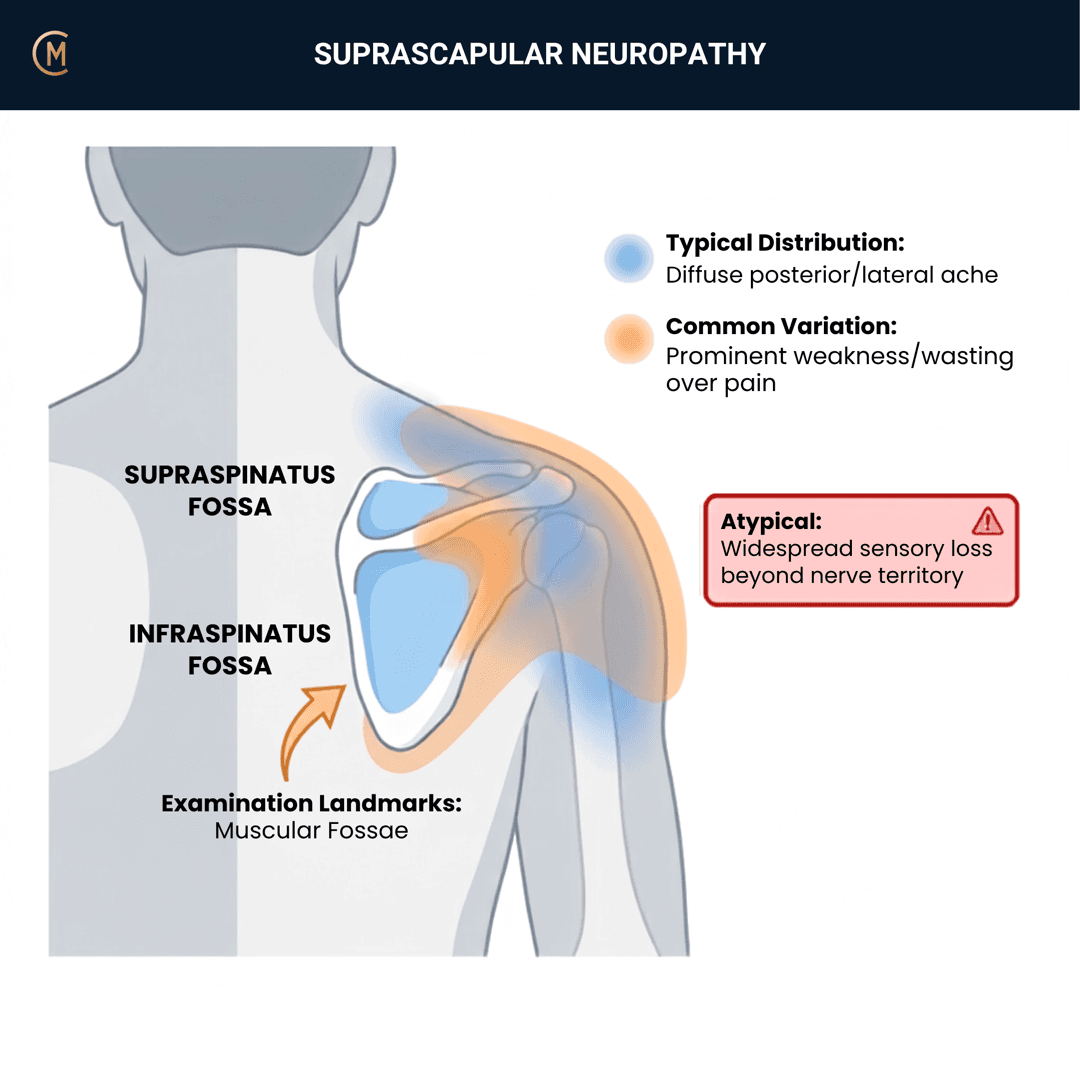
Who: Overhead athletes above all. Volleyball, baseball, overhead lifting, and anyone with high repetitive overhead volume.
What: Compression or traction of the suprascapular nerve, at one of two sites.
How it behaves: Deep, dull posterior/lateral shoulder ache. Weakness in overhead or external-rotation tasks. Eased by rest, worse with repetitive load. Often the athlete notices performance loss before pain.
The one thing to take from this page:
Work out where along the nerve it is, because where tells you what to look for. Both muscles weak points at the suprascapular notch. Infraspinatus alone points at the spinoglenoid notch — and that means go looking for a cyst.
Two sites, two patterns
| Lesion site | What is weak | What you should then look for |
|---|---|---|
| Suprascapular notch | Supraspinatus + infraspinatus | Anatomy, ligament, load, traction |
| Spinoglenoid notch | Infraspinatus predominantly | A paralabral / spinoglenoid cyst — and the labral tear behind it |
⚠️ There is no guideline here — not Australian, not international. This literature is reviews, case series and surgical cohorts. Everything on this page is a reasoned position from review-level evidence, not a recommendation with trial data behind it.
2 · SE — THE SUBJECTIVE PATTERN (the 70%)
Five stages, in your course's order. The give-away is a weakness story in someone whose neck screen is clean.
MAIN PROBLEM
"My serve has gone."
"There's a deep ache in the back of my shoulder."
"I can't hold the weight out to the side anymore."
Listen for performance loss as the presenting complaint. In overhead athletes it often arrives before the pain does.
BODY CHART
- Deep, dull, posterior and lateral shoulder. Poorly localised — patients often cup the back of the shoulder rather than point.
- Not dermatomal. Not below the elbow.
- Mark where they say the weakness is, not just the pain — it is the more useful mark on this page.
BEHAVIOUR
| Fits neuropathy | Points elsewhere | |
|---|---|---|
| Aggs | Repetitive overhead load, serving, throwing, pressing | Reaching in daily life only → think RCRSP |
| Eases | Rest | Nothing helps → reconsider |
| Symptom | Weakness and fatigue as much as pain | Pain-dominant with near-normal strength → RCRSP |
| Onset | Gradual, load-related | Severe acute pain then weakness days later → Parsonage-Turner |
| Distal | Nothing below the elbow | Dermatomal arm pain → cervical |
HISTORY
- Sport and position. Volleyball attacker, baseball pitcher, overhead lifter — the classic three.
- Training volume and recent change.
- Has anyone noticed a change in the shape of the shoulder? Ask the partner or the coach. Wasting is often seen before it is felt.
- Previous shoulder dislocation or labral injury. Relevant, because of the cyst.
- Previous large cuff tear. A massive retracted tear can tension this nerve.
SPECIAL / SCREENING QUESTIONS
- Severe pain for a few days, then weakness as the pain settled? That is neuralgic amyotrophy until proven otherwise, not this.
- Progressive weakness? Progressive wasting?
- Any systemic symptoms, unexplained weight loss, past cancer?
- Any numbness? This nerve is motor to those muscles — widespread sensory change points somewhere else.
Assessing this region? Download the Shoulder assessment template →
3 · HYPOTHESIS RANKING
| Competing pattern | The one discriminating feature |
|---|---|
| RC-related shoulder pain / SAPS | Pain-dominant with near-normal strength. This one gives weakness and wasting of supraspinatus and/or infraspinatus. |
| Cervical radiculopathy | Dermatomal arm pain and a positive cervical screen. Here the cervical screen is clean. |
| Massive rotator cuff tear | Structural loss of active elevation rather than isolated ER weakness with a tender suprascapular notch. |
| Parsonage-Turner syndrome | Severe acute pain first, then weakness as the pain settles. A different onset story entirely. |
| Posterior instability / labral pathology | Apprehension, clunking, a positional story — though it may sit alongside this one via the cyst. |
The two that outrank the table
A mass lesion or a space-occupying cyst. Progressive weakness or progressive wasting is not something you keep rehabilitating. It is a reason to image.
Neuralgic amyotrophy (Parsonage-Turner). Severe pain for days, then weakness appearing as the pain fades. Different condition, different pathway.
And the one that isn't a competitor at all
A massive retracted cuff tear can tension or irritate this nerve [1]. So consider neuropathy when weakness or atrophy is out of proportion to the cuff findings you can see — the two coexist rather than compete.
4 · RED FLAGS — DON'T MISS THIS
This section is free, on every pattern, forever. Safety is never gated.
| Finding | What it suggests | What you do |
|---|---|---|
| Progressive weakness | Ongoing compression, mass lesion | Image. Escalate |
| Progressive or marked wasting | Established denervation | Image. Escalate |
| Weakness with no plausible load history | Mass lesion, systemic neuropathy | Medical review |
| Severe pain for days, then weakness — especially after an infection, vaccination, surgery or childbirth, or with new breathlessness | Neuralgic amyotrophy; nerves outside the plexus, including the phrenic, are commonly involved (Meiling et al. 2024) [21] | Medical review |
| Weakness spreading beyond supra/infraspinatus | Brachial plexus or cervical cause | Medical review |
| Night pain unrelated to position, weight loss, past cancer | Malignancy | Medical review |
| Sensory loss in a dermatomal pattern | Cervical radiculopathy | Reassess the whole picture |
| A palpable mass | Space-occupying lesion | Image |
The rule: load-related posterior ache with weakness that improves as you unload and rebuild is yours. Weakness that is progressing, spreading, or has no load story behind it is not.
Cross-links: Rotator cuff–related shoulder pain · Subacromial impingement / SAPS · Little leaguer's shoulder · Peripheral nerve entrapments
5 · OE — THE OBJECTIVE (the 30%)
Members
Sections 5 to 7 are for members
The objective exam, management and pearls, plus the six-minute lesson and the debrief. Free with an account.
Sign in or join free6 · MX — MANAGEMENT ESSENTIALS
Members
Sections 5 to 7 are for members
The objective exam, management and pearls, plus the six-minute lesson and the debrief. Free with an account.
Sign in or join free7 · CLINICAL PEARLS + RETRIEVAL CHECK
Members
Sections 5 to 7 are for members
The objective exam, management and pearls, plus the six-minute lesson and the debrief. Free with an account.
Sign in or join freeMembers
The 5-minute lesson is for members
Twelve slides on this pattern: what you'll hear, what to examine, what to do. Free with an account.
Sign in or join freeGuideline anchor
No Australian guideline covers suprascapular neuropathy, and no guideline of any nationality does — the whole evidence base is reviews, case series and surgical cohorts.
More
Anchored to the current concept review (Bozzi et al. 2020, PMID 32707860) for the anatomy-to-presentation mapping, the clinical review (Boykin et al. 2010, PMID 20926731) for the diagnostic workup and differential, and the treatment review (Leider et al. 2021, PMID 34745481) for the conservative-versus-decompression decision.
There is no guideline here at all — not Australian, not international. The literature is predominantly lower-level evidence, and the systematic reviews on this page are reviews of surgical case series, not of controlled comparisons. Treat every management statement as a reasoned position from review-level evidence, not as a recommendation with trial data behind it.
Members
The evidence summary is for members
Verified diagnostic accuracy, where the evidence stands and what it doesn't settle. Free with an account.
Sign in or join freeSources · 20
ShowHide
Every source on this page resolves and title-verifies against PubMed. Newest first.
- 2012Shi et al. (2012). Suprascapular nerve: is it important in cuff pathology?. Advances in orthopedics, 2012, 516985. https://doi.org/10.1155/2012/516985
- 1994Holzgraefe et al. (1994). Prevalence of latent and manifest suprascapular neuropathy in high-performance volleyball players. British journal of sports medicine, 28(3), 177-9. https://doi.org/10.1136/bjsm.28.3.177
- 1998Ferretti et al. (1998). Injury of the suprascapular nerve at the spinoglenoid notch. The natural history of infraspinatus atrophy in volleyball players. The American journal of sports medicine, 26(6), 759-63. https://doi.org/10.1177/03635465980260060401
- 2020Bozzi et al. (2020). Suprascapular Neuropathy around the Shoulder: A Current Concept Review. Journal of clinical medicine, 9(8). https://doi.org/10.3390/jcm9082331
- 2015Ahlawat et al. (2015). Spectrum of suprascapular nerve lesions: normal and abnormal neuromuscular imaging appearances on 3-T MR neurography. AJR. American journal of roentgenology, 204(3), 589-601. https://doi.org/10.2214/AJR.14.12974
- 2017Kostretzis et al. (2017). Suprascapular Nerve Pathology: A Review of the Literature. The open orthopaedics journal, 11, 140-153. https://doi.org/10.2174/1874325001711010140
- 1998Sandow & Ilic (1998). Suprascapular nerve rotator cuff compression syndrome in volleyball players. Journal of shoulder and elbow surgery, 7(5), 516-21. https://doi.org/10.1016/s1058-2746(98)90205-1
- 1996Kugler et al. (1996). Muscular imbalance and shoulder pain in volleyball attackers. British journal of sports medicine, 30(3), 256-9. https://doi.org/10.1136/bjsm.30.3.256
- 2023Kim et al. (2023). Clinical Outcomes Following Arthroscopic Decompression and Repair versus Repair Alone in Patients with a Concomitant Spinoglenoid Cyst and SLAP Lesion: A Systematic Review. Diagnostics (Basel, Switzerland), 13(14). https://doi.org/10.3390/diagnostics13142364
- 2025Meng et al. (2025). Arthroscopic management of spinoglenoid notch cysts: with and without labral lesions. BMC musculoskeletal disorders, 26(1), 796. https://doi.org/10.1186/s12891-025-09074-0
- 2018Memon et al. (2018). Arthroscopic management of suprascapular neuropathy of the shoulder improves pain and functional outcomes with minimal complication rates. Knee surgery, sports traumatology, arthroscopy : official journal of the ESSKA, 26(1), 240-266. https://doi.org/10.1007/s00167-017-4694-4
- 2018Momaya et al. (2018). Clinical outcomes of suprascapular nerve decompression: a systematic review. Journal of shoulder and elbow surgery, 27(1), 172-180. https://doi.org/10.1016/j.jse.2017.09.025
- 2024Sandler et al. (2024). High rates of return to sport after suprascapular nerve decompression: an updated systematic review. JSES reviews, reports, and techniques, 4(4), 654-661. https://doi.org/10.1016/j.xrrt.2024.05.007
- 2021Leider et al. (2021). Treatment of suprascapular nerve entrapment syndrome. Orthopedic reviews, 13(2), 25554. https://doi.org/10.52965/001c.25554
- 2014Hill et al. (2014). Evaluation, treatment, and outcomes of suprascapular neuropathy: a 5-year review. PM & R : the journal of injury, function, and rehabilitation, 6(9), 774-80. https://doi.org/10.1016/j.pmrj.2014.02.003
- 1999Cummins et al. (1999). Suprascapular nerve entrapment at the spinoglenoid notch in a professional baseball pitcher. The American journal of sports medicine, 27(6), 810-2. https://doi.org/10.1177/03635465990270062101
- 2004Safran (2004). Nerve injury about the shoulder in athletes, part 1: suprascapular nerve and axillary nerve. The American journal of sports medicine, 32(3), 803-19. https://doi.org/10.1177/0363546504264582
- 2010Boykin et al. (2010). Suprascapular neuropathy. The Journal of bone and joint surgery. American volume, 92(13), 2348-64. https://doi.org/10.2106/JBJS.I.01743
- 2012Moen et al. (2012). Suprascapular neuropathy: what does the literature show?. Journal of shoulder and elbow surgery, 21(6), 835-46. https://doi.org/10.1016/j.jse.2011.11.033
- 2025Ayik et al. (2025). Dark side of the shoulder: suprascapular and axillary nerve compressions. International orthopaedics, 49(5), 1153-1165. https://doi.org/10.1007/s00264-025-06465-9
Mapped to this pattern
Generic measures that also apply
- Borg RPE
Borg Rating of Perceived Exertion Scale (6-20)
perceived exertion · 1 items · 1 min
- GROC
Global Rating of Change Scale
perceived change since baseline · 1 items · 1 min
- NPRS
Numeric Pain Rating Scale
pain intensity · 1 items · 1 min
- PGIC
Patient Global Impression of Change
perceived change since baseline · 1 items · 1 min
- PSFS
Patient-Specific Functional Scale
patient-generated function · 3 items · 2 min
- SANE
Single Assessment Numeric Evaluation
patient-rated function as a percentage of normal · 1 items · 1 min
- VAS
Visual Analogue Scale
pain intensity · 1 items · 1 min
- Borg CR10
Borg Category Ratio 10 Scale
perceived exertion or symptom intensity, ratio scale · 1 items · 1 min
- GAS
Goal Attainment Scaling
individualised goal achievement · 10 min
Did this page do its job?
CliniStudy is in beta. One tap is enough — it decides what gets fixed first.