
1 · SNAPSHOT
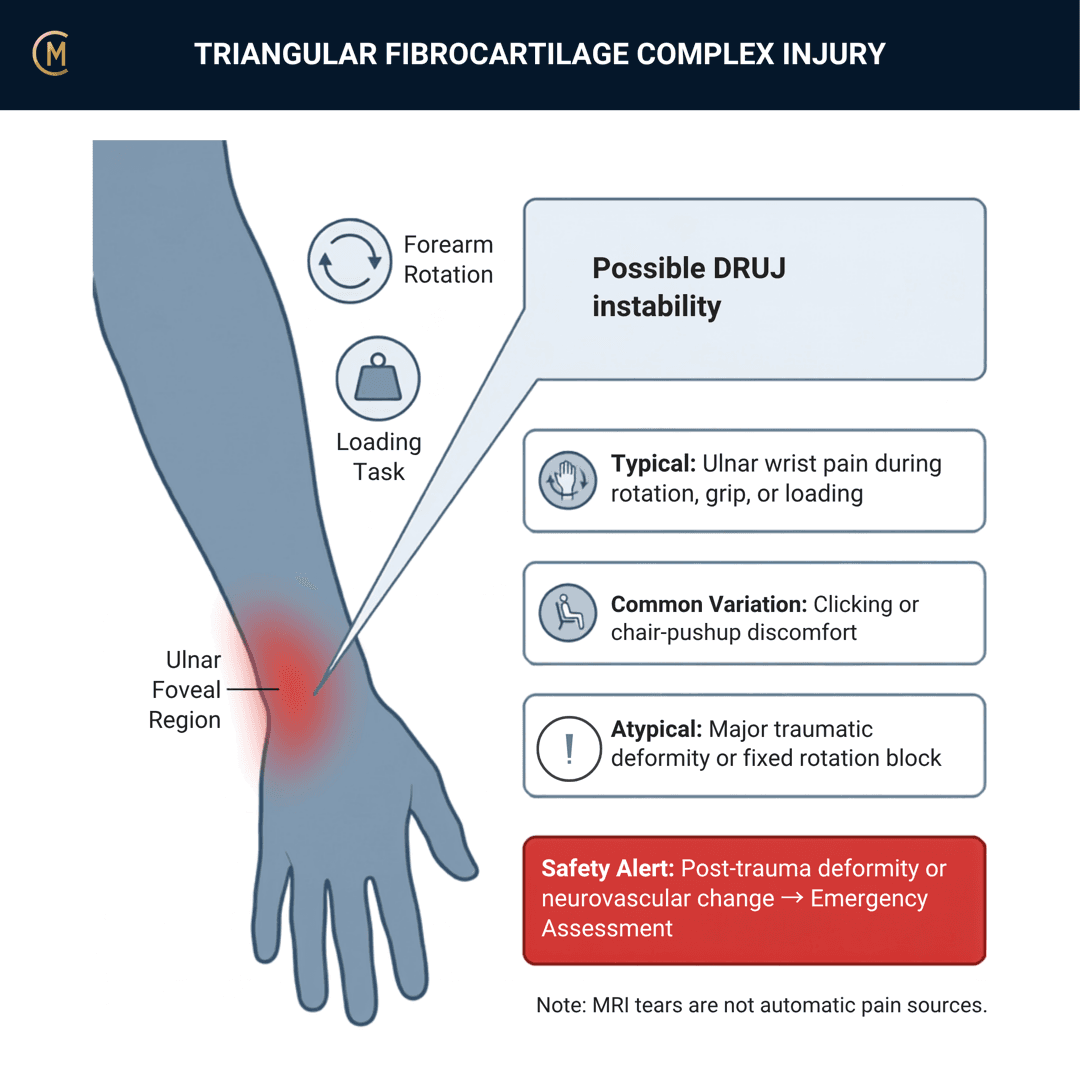
The commonest label on the ulnar side of the wrist, and the one most often applied to a scan rather than a patient.
Illness script in one line: ulnar-sided wrist pain after a rotation or axial load — pushing off a chair, a fall on an extended wrist, a racquet — with clicking or catching on pronation and supination and pain on weight-bearing through the hand.
Caseload frequency: common on any sporting or hand caseload. Read further: prevalence and management in racquet sport players [1].
Traumatic and degenerative TFCC are two different problems wearing the same name
This pattern is written for the traumatic one — the fall, the racquet, the gymnast — and for a student caseload that is the right choice. But you will meet the other one, and applying this pattern to it goes wrong.
TFCC lesions have a formal classification [2] and the split that matters to you is traumatic versus degenerative.
| Traumatic | Degenerative (ulnocarpal impaction) | |
|---|---|---|
| Story | A specific event. Push off a chair, a fall, a racquet, a fall on an extended wrist | Gradual. Months. No event they can name |
| Age | Younger, sporting | Older, or a wrist with a previous distal radius fracture |
| Provoked by | Rotation, ulnar deviation, weight-bearing | Grip and pronation — which is the same thing, and that's the trap |
| The underlying problem | A tear | Load. Read further: ulnocarpal impaction [3] |
| What you're doing | Protect, then progressively reload | Reduce the load through that column, then rebuild |
One anatomical fact makes this usable: ulnar variance changes with grip and forearm rotation, which is why the pronated grip view matters when a radiologist is assessing it [4]. A wrist that looks ulnar-neutral at rest can be ulnar-positive under the exact load the patient complains about.
2 · SE — THE SUBJECTIVE PATTERN (the 70%)
Main problem
"It hurts on the little-finger side when I twist or push." Ulnar-sided wrist pain after rotation or axial load (e.g. push off chair, fall).
The two words to listen for are twist and push. If neither is in the story, question the label.
Body chart
Ulnar side, distal to the ulnar styloid, often pointed to with one finger. On examination: tenderness distal to ulnar styloid.
Get them to point with one finger before you palpate. The ulnar side of the wrist is a small postcode with several tenants — the TFCC, the DRUJ, the ECU, the pisotriquetral joint, the lunotriquetral interval, the hamate — and where they point narrows it faster than any test.
Behaviour
Clicking, catching, or instability with pronation–supination. Worse with weight-bearing on extended wrist. Eased by wrist support or avoiding rotation.
Aggs: pushing up out of a chair or off the floor, opening jars and doors, turning a key, a screwdriver, racquet strokes, press-ups, gymnastics weight-bearing, carrying with the wrist deviated.
Eases: a wrist support, avoiding rotation, not bearing weight through the hand.
Severity: VAS 0–10 at best / at worst / right now.
Ask about clicking carefully. A click that hurts and a click that is just noise are different things, and plenty of wrists click without a problem. What you want is: does the click reproduce their pain, and does it come with a sense of the wrist giving way.
The specific question worth adding: "does the door handle hurt?" Turning a handle is near-pure forearm rotation with a small grip load, and it is a clean, repeatable functional item for the whole episode of care.
History
Either a single event, or months of nothing in particular. This is where you sort traumatic from degenerative — go back to section 1.
Ask about a previous distal radius fracture. It changes the whole page — see section 4.
Special / screening questions
Common in racquet sports or gymnastics. Read further: prevalence and management in racquet sport players (Astavans et al. 2026).
- Sport and load history: racquet, gymnastics, CrossFit and calisthenics (weight-bearing on an extended wrist), rowing, golf, throwing.
- Occupational: anything with sustained rotation under load — trades, hairdressing, physiotherapy.
- Previous wrist fracture or surgery. Always ask.
Assessing this region? Download the Wrist & Hand assessment template →
3 · HYPOTHESIS RANKING
Read further: a systematic clinical approach to ulnar-sided wrist pain and its principles of treatment [5], a diagnostic evaluation approach.
| Pattern | The one discriminating feature |
|---|---|
| TFCC injury (traumatic) | A named event, plus pain on rotation and axial load, tenderness distal to the ulnar styloid, and a click that reproduces the pain. |
| Ulnocarpal impaction (degenerative) | Gradual, grip- and pronation-dominant, older or post-fracture. Read further: ulnocarpal impaction (Leibig et al. 2021). Same postcode, different problem. |
| DRUJ instability | A sense of the forearm giving way turning handles, and increased translation on ballottement. Read further: DRUJ instability reviews [6]. May coexist; not present in every TFCC presentation. |
| ECU tendinopathy or subluxation | A palpable snap over the ulnar groove on supination, pain on resisted ECU, tenderness along the sheath. Coexists more often than students expect — the incidence of ECU pathology in patients with TFCC injury has been reported [7]. It isn't either/or. |
| Hamatolunate impingement | Described as a differential of ulnar-sided wrist pain [8]. Tender more distal and dorsal, provoked by ulnar deviation. |
| Lunotriquetral or pisotriquetral pathology | Tenderness at a different point — the LT interval dorsally, or the pisiform volarly, which is exquisitely tender when you press it and reproduces their pain. |
The discriminator that does most of the work: where the one finger points, and whether there was an event.
4 · RED FLAGS — DON'T MISS THIS
Free forever. Never gated.
Two things belong here.
1. Frank DRUJ instability is a surgical conversation, not a rehab progression
Read further: distal radioulnar joint instability [6].
What it looks like: a clunk rather than a click; the ulnar head that visibly or palpably rides dorsally; a positive piano-key sign with obvious asymmetry against the other side; and a patient who describes the forearm giving way rather than the wrist hurting.
Why it's here: the standard management line — avoid heavy rotation or weight-bearing until pain-free — is the right instinct, and this is the situation where progressive rotation and loading actively makes things worse. Refer before you progress, not after it fails.
2. Ulnar-sided wrist pain after a distal radius fracture
Read further: DRUJ instability in distal radius fracture [9].
This is the one students walk past, because the fracture has a diagnosis, a treatment and a discharge, and the ulnar-sided pain afterwards gets filed as "stiffness". A distal radius fracture that heals with shortening changes ulnar variance permanently — which is the degenerative column of the table in section 1. Ask about a previous wrist fracture on every ulnar-sided wrist, and if the answer is yes, say so in the referral letter.
3. It isn't the TFCC
A fall with snuffbox tenderness is a scaphoid fracture — radial side, free-forever page, go there. A hot, swollen wrist with systemic features is not a mechanical problem. Sensory symptoms in the little and ring finger point at the ulnar nerve, not the TFCC.
5 · OE — THE OBJECTIVE (the 30%)
Members
Sections 5 to 7 are for members
The objective exam, management and pearls, plus the six-minute lesson and the debrief. Free with an account.
Sign in or join free6 · MX — MANAGEMENT ESSENTIALS
Members
Sections 5 to 7 are for members
The objective exam, management and pearls, plus the six-minute lesson and the debrief. Free with an account.
Sign in or join free7 · CLINICAL PEARLS + RETRIEVAL CHECK
Members
Sections 5 to 7 are for members
The objective exam, management and pearls, plus the six-minute lesson and the debrief. Free with an account.
Sign in or join freeMembers
The 4-minute lesson is for members
Twelve slides on this pattern: what you'll hear, what to examine, what to do. Free with an account.
Sign in or join freeGuideline anchor
No Australian guideline, and no clinical practice guideline of any kind for this condition — but there is an Australasian anchor.
More
Outcomes of operative and non-operative management of triangular fibrocartilage complex injury have been reported in the ANZ Journal of Surgery (Onggo et al. 2024, PMID 38308429). The physiotherapy anchor is a structured non-operative treatment programme for traumatic TFCC injury (Tse et al. 2023, PMID 37490953), with the natural history of non-operatively treated traumatic tears described (Choi et al. 2024, PMID 39619455) and outcomes of non-surgical treatment of ulnar-sided wrist pain reported (Teh et al. 2026, PMID 42687796). The diagnostic anchor is an analysis of the sensitivity and specificity of the ulnar fovea sign (Tay et al. 2007, PMID 17398352).
None of these is a clinical practice guideline. The ANZ paper is an outcomes comparison, the Hand Surgery and Rehabilitation paper describes one programme, and the natural history paper is observational. There is no guideline for this condition anywhere.
Members
The evidence summary is for members
Verified diagnostic accuracy, where the evidence stands and what it doesn't settle. Free with an account.
Sign in or join freeSources · 20
ShowHide
Every source on this page resolves and title-verifies against PubMed. Newest first.
- 2026Astavans et al. (2026). Triangular Fibrocartilage Complex Injuries in Racquet Sport Players: Prevalence, Management, and Outcomes. Hand (New York, N.Y.), 15589447261416993. https://doi.org/10.1177/15589447261416993
- 2024Nakamura (2024). Classifications of Triangular Fibrocartilage Complex Lesions. Journal of wrist surgery, 13(1), 1. https://doi.org/10.1055/s-0043-1778082
- 2021Leibig et al. (2021). Ulnocarpal Impaction. Hand clinics, 37(4), 553-562. https://doi.org/10.1016/j.hcl.2021.06.009
- 2000Tomaino (2000). The importance of the pronated grip x-ray view in evaluating ulnar variance. The Journal of hand surgery, 25(2), 352-7. https://doi.org/10.1053/jhsu.2000.jhsu25a0352
- 2025Satria et al. (2025). Ulnar-Sided Wrist Pain: Systematic Clinical Approach and Principles of Treatment. Orthopedic research and reviews, 17, 199-212. https://doi.org/10.2147/ORR.S506374
- 2025Maclean (2025). Distal Radioulnar Joint Instability. The journal of hand surgery Asian-Pacific volume, 30(5), 447-457. https://doi.org/10.1142/S2424835525400089
- 2025Jung et al. (2025). Incidence of extensor carpi ulnaris pathology in patients with triangular fibrocartilage complex foveal repairs. The Journal of hand surgery, European volume, 50(10), 1326-1332. https://doi.org/10.1177/17531934251335104
- 2024Nakamoto et al. (2024). Hamatolunate impingement, a differential diagnosis of ulnar-sided wrist pain. Journal of hand and microsurgery, 16(3), 100049. https://doi.org/10.1016/j.jham.2024.100049
- 2025Huang et al. (2025). Distal Radioulnar Joint Instability in Distal Radius Fracture. The journal of hand surgery Asian-Pacific volume, 30(6), 571-581. https://doi.org/10.1142/S2424835525400090
- 2007Tay et al. (2007). The "ulnar fovea sign" for defining ulnar wrist pain: an analysis of sensitivity and specificity. The Journal of hand surgery, 32(4), 438-44. https://doi.org/10.1016/j.jhsa.2007.01.022
- 2022Spies et al. (2022). Diagnostic accuracy of wrist MRI in comparison to wrist arthroscopy regarding TFCC lesions in clinical practice. Archives of orthopaedic and trauma surgery, 142(5), 879-885. https://doi.org/10.1007/s00402-021-04329-6
- 2024Zhao et al. (2024). Diagnostic value of MRI in traumatic triangular fibrocartilage complex injuries: a retrospective study. BMC musculoskeletal disorders, 25(1), 63. https://doi.org/10.1186/s12891-023-07140-z
- 2026Bouredoucen (2026). The triangular fibrocartilage complex (TFCC): updated anatomy, variants, and MRI diagnostic pitfalls. Skeletal radiology, 55(9), 2175-2193. https://doi.org/10.1007/s00256-026-05219-x
- 2025Graesser et al. (2025). Reliability of Wrist Arthroscopy in the Diagnosis and Treatment of Triangular Fibrocartilage Complex Tears. The Journal of hand surgery, 50(1), 2-9. https://doi.org/10.1016/j.jhsa.2024.07.002
- 2025van Wijk et al. (2025). Diagnostic wrist arthroscopy: findings in patients suspected of TFCC lesions. Archives of orthopaedic and trauma surgery, 145(1), 399. https://doi.org/10.1007/s00402-025-06002-8
- 2023Tse et al. (2023). A structured non-operative treatment program for traumatic triangular fibrocartilage complex tear: A quasi-experimental study. Hand surgery & rehabilitation, 42(6), 492-498. https://doi.org/10.1016/j.hansur.2023.07.009
- 2024Choi et al. (2024). The Natural History of Non-operatively Treated Traumatic Triangular Fibrocartilage Complex Tears: A Systematic Review. Journal of wrist surgery, 13(6), 550-558. https://doi.org/10.1055/s-0044-1786164
- 2026Teh et al. (2026). Outcomes of Nonsurgical Treatment of Ulnar-Sided Wrist Pain. The journal of hand surgery Asian-Pacific volume. https://doi.org/10.1142/S2424835526500451
- 2024Onggo et al. (2024). Triangular fibrocartilage complex injury: outcomes of operative and non-operative management. ANZ journal of surgery, 94(4), 719-723. https://doi.org/10.1111/ans.18891
- 2026Lee et al. (2026). Postoperative Immobilization After Foveal Triangular Fibrocartilage Complex Repair: A Systematic Review and Meta-Analysis of Comparative Studies. The Journal of hand surgery, 51(5), 512.e1-512.e11. https://doi.org/10.1016/j.jhsa.2026.01.029
Mapped to this pattern
Generic measures that also apply
- Borg RPE
Borg Rating of Perceived Exertion Scale (6-20)
perceived exertion · 1 items · 1 min
- DASH
Disabilities of the Arm, Shoulder and Hand
upper limb disability · 30 items · 8 min
- GROC
Global Rating of Change Scale
perceived change since baseline · 1 items · 1 min
- NPRS
Numeric Pain Rating Scale
pain intensity · 1 items · 1 min
- PGIC
Patient Global Impression of Change
perceived change since baseline · 1 items · 1 min
- PSFS
Patient-Specific Functional Scale
patient-generated function · 3 items · 2 min
- QuickDASH
QuickDASH
upper limb disability, short form · 11 items · 4 min
- SANE
Single Assessment Numeric Evaluation
patient-rated function as a percentage of normal · 1 items · 1 min
- UEFI
Upper Extremity Functional Index
upper limb function · 20 items · 5 min
- VAS
Visual Analogue Scale
pain intensity · 1 items · 1 min
- Borg CR10
Borg Category Ratio 10 Scale
perceived exertion or symptom intensity, ratio scale · 1 items · 1 min
- GAS
Goal Attainment Scaling
individualised goal achievement · 10 min
Did this page do its job?
CliniStudy is in beta. One tap is enough — it decides what gets fixed first.