
1 · SNAPSHOT
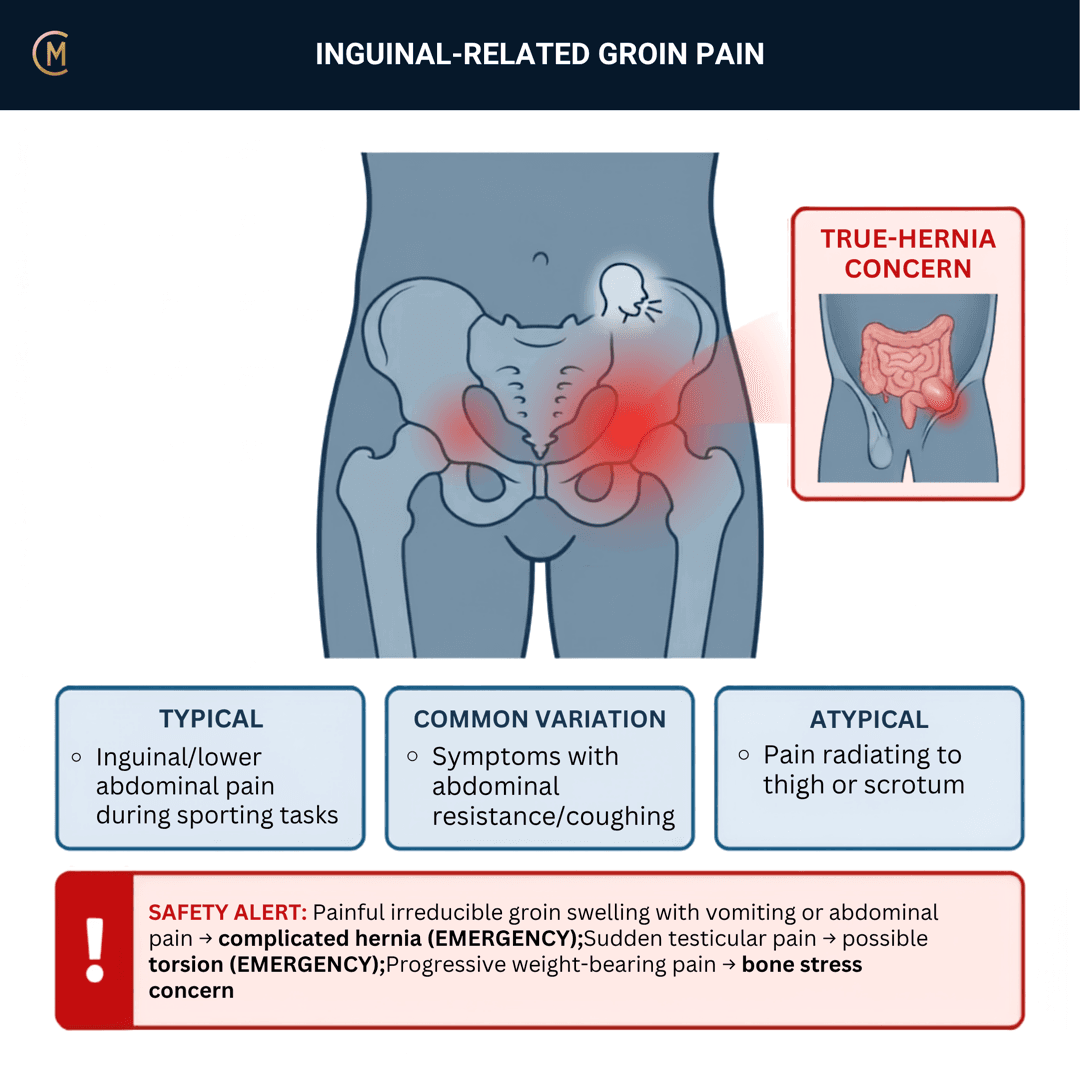
Who: Field and court athletes — soccer, AFL, rugby, hockey.
What: Inguinal-related groin pain, the fourth Doha entity.
How it behaves: Gradual lower abdominal, inguinal or groin pain with sprinting, cutting, kicking and sit-ups. Pain with coughing, sneezing, or getting out of bed. Eases with rest. Often long-standing, vague, and hard to localise.
The one thing to take from this page:
It is not a hernia. There is no defect to repair — it is a load-sharing problem across the pubic and inguinal region. The argument about the name is in the published literature, and the reason it matters is that "hernia" tells everyone there is something to fix surgically.
Not a hernia
| True inguinal hernia | Inguinal-related groin pain |
|---|---|
| A palpable bulge | No bulge |
| Cough impulse | Pain with cough — not a bulge with cough |
| A defect | No defect — obliques, transversus, rectus and adductors sharing load at the pubis |
| A surgical diagnosis | A load problem. Surgery is a late conversation |
⚠️ One randomised rehabilitation trial exists on this whole page, and a systematic review found high variation in terminology, surgical technique and preoperative diagnosis across the literature. Results are hard to pool. Do not quote them as consistent.
2 · SE — THE SUBJECTIVE PATTERN (the 70%)
Five stages, in your course's order. This is the vaguest of the four groin entities — expect the patient to struggle to localise it, and treat that vagueness as information.
MAIN PROBLEM
"It's deep, somewhere in my groin and lower belly."
"Sprinting and sit-ups both do it."
"Coughing catches me."
BODY CHART
- Lower abdominal, inguinal, and groin — often a hand rather than a finger.
- Mark the pubic tubercle and the inguinal canal.
- Mark the adductor origin and the symphysis too. They coexist constantly.
- Any lump or bulge? Mark it, then examine for it.
BEHAVIOUR
| Fits inguinal-related | Points elsewhere | |
|---|---|---|
| Aggs | Sprinting, cutting, kicking, sit-ups | Cutting with adductor tenderness only → adductor-related |
| Severity | VAS 0–10 at best / at worst / right now | — |
| Signature | Cough, sneeze, getting out of bed | Central symphyseal with sit-up → pubic-related |
| Onset | Gradual, long-standing | A bulge appearing → true hernia |
| Localisation | Vague, hard to pinpoint | Sharply localised → reconsider |
| Age | Adult athlete | Adolescent → unfused pubic physis, different diagnosis |
HISTORY
- How long? This one is usually months, sometimes seasons.
- Sprint, cut and kick volume; sit-up and core programme volume.
- Has anyone said "hernia"? Find out what they think is wrong with them — it shapes everything.
- Any previous groin surgery, including on the other side?
- Contralateral symptoms? Don't forget across-the-line contributions.
SPECIAL / SCREENING QUESTIONS
- Any lump or bulge, especially on coughing or straining?
- Testicular, scrotal or urinary symptoms?
- Can they weight-bear and hop? Night pain, RED-S profile?
- Skeletally mature? In an adolescent this is a different structure.
Assessing this region? Download the Hip & Groin assessment template →
3 · HYPOTHESIS RANKING
| Competing pattern | The one discriminating feature |
|---|---|
| Adductor-related groin pain | Tender adductor origin, squeeze positive, cough and sit-up negative. Coexists constantly. |
| Pubic-related groin pain | Central symphyseal tenderness, squeeze and sit-up positive. |
| Hip-related pain (FAI, labral) | FADIR, reduced IR in flexion — and athletic pubalgia imaging findings have been described in patients with FAI [1]. |
| Iliopsoas-related pain | Tender deep to the inguinal ligament, pain on resisted hip flexion. |
| Referred urological or abdominal pain | Not reproduced by musculoskeletal loading; testicular or urinary symptoms. |
The two that outrank the table
A true inguinal hernia. A palpable bulge or a cough impulse. That is a surgical diagnosis and it is not this one — clear it explicitly.
An adolescent with an unfused pubic physis. Read further: the unfused pubic physis in paediatric athletes [2]. Different structure. Do not apply the adult model.
And the reason this is called a potpourri
Inguinal-related groin pain has been described in the literature as "a pathological potpourri" [3]. That is the honest framing — several structures around one region, sharing load, with imaging that rarely settles anything.
4 · RED FLAGS — DON'T MISS THIS
This section is free, on every pattern, forever. Safety is never gated.
| Finding | What it suggests | What you do |
|---|---|---|
| A palpable bulge or cough impulse | True inguinal hernia | Surgical review. Do not rehabilitate it |
| A tender, irreducible lump | Incarcerated or strangulated hernia | EMERGENCY |
| Adolescent athlete, skeletally immature | Unfused pubic physis — a different diagnosis | Paediatric imaging and review |
| Sudden testicular pain | Testicular torsion | 🚑 Emergency, now |
| Other testicular or scrotal pain or swelling | Urological pathology | Urgent medical review |
| Urinary symptoms, fever, feeling unwell — or acute groin pain with fever | Infection, including infective osteitis pubis or pubic osteomyelitis | Medical review. A normal X-ray, CT or even a first MRI doesn't clear it — repeat the MRI if suspicion stays (Yanagita et al. 2023) [21] |
| Unable to weight-bear or hop | Pubic ramus or femoral neck stress fracture | Urgent imaging |
| RED-S profile — low energy availability, menstrual disturbance | Bone stress injury | Image and refer |
| Night pain, weight loss, cancer history | Malignancy | Medical review |
The rule: long-standing, load-related lower abdominal and inguinal pain with no bulge, in a skeletally mature athlete who can hop and is systemically well, is yours. A bulge, an adolescent, anything testicular, or an inability to weight-bear is not.
Cross-links: Adductor-related groin pain · Pubic-related groin pain · Iliopsoas-related pain · Femoroacetabular impingement
5 · OE — THE OBJECTIVE (the 30%)
Members
Sections 5 to 7 are for members
The objective exam, management and pearls, plus the six-minute lesson and the debrief. Free with an account.
Sign in or join free6 · MX — MANAGEMENT ESSENTIALS
Members
Sections 5 to 7 are for members
The objective exam, management and pearls, plus the six-minute lesson and the debrief. Free with an account.
Sign in or join free7 · CLINICAL PEARLS + RETRIEVAL CHECK
Members
Sections 5 to 7 are for members
The objective exam, management and pearls, plus the six-minute lesson and the debrief. Free with an account.
Sign in or join freeMembers
The 4-minute lesson is for members
Twelve slides on this pattern: what you'll hear, what to examine, what to do. Free with an account.
Sign in or join freeGuideline anchor
No treatment guideline exists.
More
Anchored to the Doha agreement (Weir et al. 2015, PMID 26031643), which makes inguinal-related groin pain the agreed term, and to the current understanding and assessment review from the same research group (Thorborg et al. 2025, PMID 41710221).
No guideline, no Australian document, and one randomised trial of rehabilitation on the whole page. A systematic review found high variation in terminology, surgical technique and preoperative diagnosis across this literature — so results are hard to pool and should not be quoted as though they were consistent.
Members
The evidence summary is for members
Verified diagnostic accuracy, where the evidence stands and what it doesn't settle. Free with an account.
Sign in or join freeSources · 20
ShowHide
Every source on this page resolves and title-verifies against PubMed. Newest first.
- 2020Varada et al. (2020). The prevalence of athletic pubalgia imaging findings on MRI in patients with femoroacetabular impingement. Skeletal radiology, 49(8), 1249-1258. https://doi.org/10.1007/s00256-020-03405-z
- 2024Bixby & d'Hemecourt (2024). Athletic pubalgia in pediatric athletes: implications of the unfused pubic physis on diagnosis and outcome. Pediatric radiology, 54(8), 1281-1283. https://doi.org/10.1007/s00247-024-05957-x
- 2022Vuckovic et al. (2022). Inguinal-related groin pain in athletes: a pathological potpourri. BMJ open sport & exercise medicine, 8(3), e001387. https://doi.org/10.1136/bmjsem-2022-001387
- 2023Heijboer et al. (2023). Clinical examination for athletes with inguinal-related groin pain: interexaminer reliability and prevalence of positive tests. BMJ open sport & exercise medicine, 9(1), e001498. https://doi.org/10.1136/bmjsem-2022-001498
- 2020Bou Antoun et al. (2020). High insertion of conjoint tendon is associated with inguinal-related groin pain: a MRI study. European radiology, 30(3), 1517-1524. https://doi.org/10.1007/s00330-019-06466-4
- 2019Abouelnaga & Aboelnour (2019). Effectiveness of Active Rehabilitation Program on Sports Hernia: Randomized Control Trial. Annals of rehabilitation medicine, 43(3), 305-313. https://doi.org/10.5535/arm.2019.43.3.305
- 2025Thorborg & Sheen (2025). Inguinal-Related Groin Pain and/or Disruption in Athletes: Current Understanding, Assessment and Management Strategies. Open access journal of sports medicine, 16, 510774. https://doi.org/10.2147/OAJSM.S510774
- 2025Dudai & Paajanen (2025). Narrative Review and Clinical Recommendations for Sportsman's Hernia and Athletic Pubalgia Based on 30 Years of Expert Experience. Journal of abdominal wall surgery : JAWS, 4, 15394. https://doi.org/10.3389/jaws.2025.15394
- 2020Gerhardt et al. (2020). Outcomes following surgical management of inguinal-related groin pain in athletes: a case series. Journal of hip preservation surgery, 7(1), 103-108. https://doi.org/10.1093/jhps/hnz068
- 2023Meuzelaar et al. (2023). Athletes treated for inguinal-related groin pain by endoscopic totally extraperitoneal (TEP) repair: long-term benefits of a prospective cohort. Hernia : the journal of hernias and abdominal wall surgery, 27(5), 1179-1186. https://doi.org/10.1007/s10029-023-02815-x
- 2020Drager et al. (2020). Athletic Pubalgia (Sports Hernia): Presentation and Treatment. Arthroscopy : the journal of arthroscopic & related surgery : official publication of the Arthroscopy Association of North America and the International Arthroscopy Association, 36(12), 2952-2953. https://doi.org/10.1016/j.arthro.2020.09.022
- 2024Rezaie et al. (2024). Outcomes and Proportions of Subsequent Contralateral Sports Hernia Repair Following Primary Unilateral Repair. The American journal of sports medicine, 52(3), 653-659. https://doi.org/10.1177/03635465231221496
- 2026Ayhan et al. (2026). Groin Pain Syndrome: Analysis of Surgical and Nonsurgical Outcomes Between Athletes and Nonathletes With "Sports Hernia" Using a Standardized Management Algorithm. Orthopaedic journal of sports medicine, 14(1), 23259671251405430. https://doi.org/10.1177/23259671251405430
- 2021Kraeutler et al. (2021). A Systematic Review Shows High Variation in Terminology, Surgical Techniques, Preoperative Diagnostic Measures, and Geographic Differences in the Treatment of Athletic Pubalgia/Sports Hernia/Core Muscle Injury/Inguinal Disruption. Arthroscopy : the journal of arthroscopic & related surgery : official publication of the Arthroscopy Association of North America and the International Arthroscopy Association, 37(7), 2377-2390.e2. https://doi.org/10.1016/j.arthro.2021.03.049
- 2023Neuville et al. (2023). Risk Factors for Athletic Pubalgia in Collegiate Football Student-Athletes: A Retrospective Cohort Study. Sports health, 15(5), 760-766. https://doi.org/10.1177/19417381221121127
- 2015Weir et al. (2015). Doha agreement meeting on terminology and definitions in groin pain in athletes. British journal of sports medicine, 49(12), 768-74. https://doi.org/10.1136/bjsports-2015-094869
- 2020Zuckerbraun et al. (2020). Groin Pain Syndrome Known as Sports Hernia: A Review. JAMA surgery, 155(4), 340-348. https://doi.org/10.1001/jamasurg.2019.5863
- 2020Zuckerbraun & Mauro (2020). Use of Sports Hernia to Describe Groin Pain in Athletes-Reply. JAMA surgery, 155(9), 895-896. https://doi.org/10.1001/jamasurg.2020.1767
- 2020Thorborg & Hölmich (2020). Use of Sports Hernia to Describe Groin Pain in Athletes. JAMA surgery, 155(9), 895. https://doi.org/10.1001/jamasurg.2020.1759
- 2021Dempsey et al. (2021). Nomenclature for groin pain in athletes. The British journal of radiology, 94(1126), 20201333. https://doi.org/10.1259/bjr.20201333
Mapped to this pattern
Generic measures that also apply
- Borg RPE
Borg Rating of Perceived Exertion Scale (6-20)
perceived exertion · 1 items · 1 min
- GROC
Global Rating of Change Scale
perceived change since baseline · 1 items · 1 min
- NPRS
Numeric Pain Rating Scale
pain intensity · 1 items · 1 min
- PGIC
Patient Global Impression of Change
perceived change since baseline · 1 items · 1 min
- PSFS
Patient-Specific Functional Scale
patient-generated function · 3 items · 2 min
- SANE
Single Assessment Numeric Evaluation
patient-rated function as a percentage of normal · 1 items · 1 min
- VAS
Visual Analogue Scale
pain intensity · 1 items · 1 min
- Borg CR10
Borg Category Ratio 10 Scale
perceived exertion or symptom intensity, ratio scale · 1 items · 1 min
- GAS
Goal Attainment Scaling
individualised goal achievement · 10 min
Did this page do its job?
CliniStudy is in beta. One tap is enough — it decides what gets fixed first.