
1 · SNAPSHOT
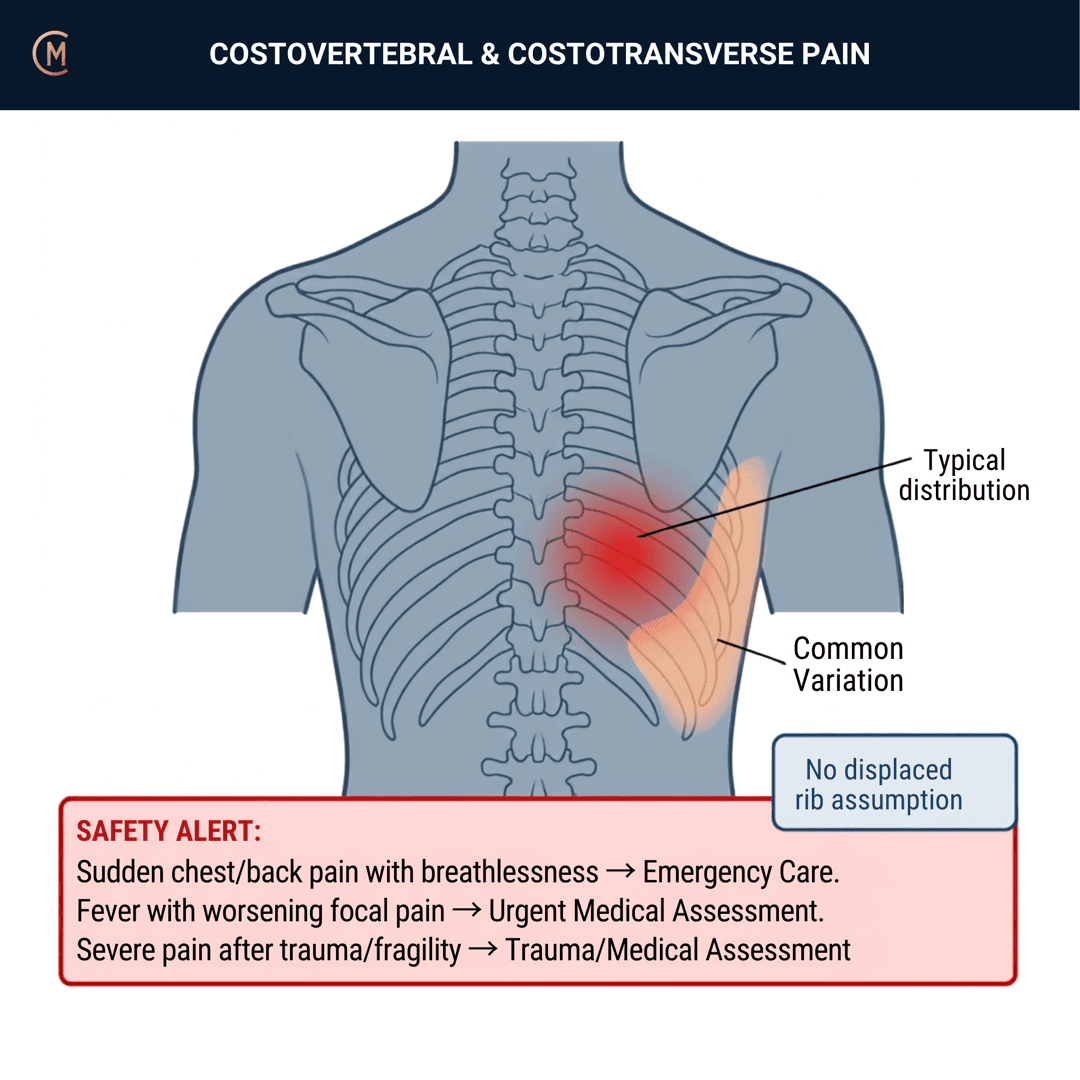
Who: Often after a sudden rotation or an awkward lift. Any age.
What: Costovertebral or costotransverse joint pain. Honestly: posterior thoracic pain with a rib-related provocation pattern.
How it behaves: Local thoracic pain with sharp, catching pain on breathing, coughing or sneezing. Referral wrapping along the rib. Aggs: deep breathing, trunk rotation, coughing, sneezing. Eases: unloading, shallow positions.
The one thing to take from this page:
The breath is the discriminator — it catches when they breathe, and it's reproduced by rib springing rather than a central PA. Beyond that, this and the PIV joint pattern overlap so much that your treatment barely changes. What does change your plan is an inflammatory time pattern, a trauma history, a fever, or a pain you can't reproduce.
Two benign patterns, one plan
| Thoracic PIV joint | Costovertebral / costotransverse | |
|---|---|---|
| Provoked by | Extension, ipsilateral rotation | The breath — deep inspiration, cough, sneeze |
| Reproduced by | Unilateral PA | Rib springing |
| Referral | Wraps round the rib cage | Wraps along the rib |
| Management | The same | The same |
What changes the plan: an inflammatory time pattern · trauma · fever or immunosuppression · pain you can't reproduce.
2 · SE — THE SUBJECTIVE PATTERN (the 70%)
Five stages, in your course's order.
MAIN PROBLEM
"It catches when I take a deep breath."
"I twisted to reach into the back seat and it grabbed."
"Sneezing is agony."
BODY CHART
- Posterior and paravertebral, at the rib angle. One or two fingers.
- Draw the wrap along the rib and note where it ends.
- Mark both sides. Alternating or bilateral rib-region pain is a different question — see the ranking.
- Any arm or leg symptoms? The answer should be no.
BEHAVIOUR
- Aggs: deep breathing, coughing, sneezing, trunk rotation, lying on it, deep laughing.
- Eases: unloading, shallow breathing (note it, don't endorse it), changing position.
- 24-hr pattern: the first deep breaths after a night lying on it, then any cough or sneeze at any hour.
- Night: lying on it is in the Aggs; changing position is in the Eases.
- Severity: VAS 0–10 at best / at worst / right now.
- Coding: M / In / P / Is.
- Irritability: resting symptoms + vigour of the provoking activity + time to settle. Often sharply irritable on the breath, low the rest of the time.
- The key: is it the BREATH or the MOVEMENT that catches it? Breath points here; movement points at the PIV joint. Usually it's both.
HISTORY
- Onset — sudden rotation, awkward lift, a coughing illness, or a blow?
- Any trauma at all? Rule out rib fracture. And traumatic costovertebral joint dislocation is described [1].
- Previous episodes.
- Any inflammatory history — psoriasis, uveitis, inflammatory bowel disease, family history?
- Any recent infection, immunosuppression, or tuberculosis exposure?
SPECIAL / SCREENING QUESTIONS
- Any breathlessness, exertional link, sweating, nausea?
- Any fever, night sweats, weight loss?
- Morning stiffness that eases with movement, over three months, under forty? — the axSpA question, and it is the one that gets left out.
- Any rash, especially in a band? — septic arthritis of this joint has been reported mimicking shingles.
Assessing this region? Download the Thoracic Spine assessment template →
3 · HYPOTHESIS RANKING
| Competing pattern | The one discriminating feature |
|---|---|
| Thoracic PIV joint dysfunction | Extension and ipsilateral rotation dominant, reproduced by unilateral PA. Overlaps heavily. Barely changes what you do. |
| Rib contusion or stress injury | Trauma or overuse history, focal bony tenderness on the rib itself. |
| Costochondritis | Anterior, at the junctions. Not reproduced from behind. |
| Intercostal muscle strain | Diffuse along the interspace, stretch- and contraction-provoked. |
| Thoracic discogenic pain | Flexion-loading dominant, band-like, ± neurology. |
| Pleuritic pain | Breathlessness with it, and no reproduction on springing or palpation. |
The one that gets left out — and it matters
Axial spondyloarthritis. Costovertebral and costotransverse joint involvement is a repeatedly described feature. Erosive costovertebral joint arthritis has been described in ankylosing spondylitis [2][3]. Read further: involvement in radiographic and axial spondyloarthritis [4][5][6], costotransverse ankylosis alongside syndesmophytes [7]. That it happens is enough.
A young adult with rib-region pain, morning stiffness that eases with movement over three months, and any systemic feature is not a mechanical costovertebral joint. Ask the question.
And the ones that outrank everything
- Septic arthritis of the costovertebral joint. Described, and mimicking shingles [8].
- Tuberculosis. Isolated costotransverse joint tuberculosis is described [9].
- SAPHO syndrome. Costovertebral involvement described on CT [10].
- Fracture or dislocation. Rib fracture first, plus described traumatic dislocation, and posterior rib fractures involving the costotransverse joint have their own surgical literature (Álvarez [11]).
- Cardiac, pulmonary or visceral. Always.
4 · RED FLAGS — DON'T MISS THIS
This section is free, on every pattern, forever. Safety is never gated.
Rule out rib fracture — and remember these joints have a described infective and inflammatory literature too.
| Finding | What it suggests | What you do |
|---|---|---|
| Central or crushing chest pain, breathlessness, sweating, exertional link | Cardiac | 000 / same-day |
| Pleuritic pain with breathlessness, calf symptoms, recent immobility | Pulmonary embolus | EMERGENCY |
| Significant trauma | Rib fracture or costovertebral dislocation | Medical review and imaging |
| Fever, night sweats, systemic illness, immunosuppression, IV drug use | Septic arthritis of the joint | URGENT medical review |
| A band-like rash | Shingles — or septic arthritis mimicking it | Medical review |
| Tuberculosis exposure, migrant or immunosuppressed background, chronic swelling | Costotransverse tuberculosis | Urgent medical review |
| Morning stiffness easing with movement, over three months, under forty | Axial spondyloarthritis | Rheumatology referral |
| Skin or bone symptoms elsewhere with chest wall pain | SAPHO syndrome | Medical review |
| Pain not reproduced by springing, palpation or movement | Not mechanical | Medical review |
| Any neurological deficit or sensory band | Cord | URGENT |
The rule: this is a benign pattern only after you have excluded the chest, the infection and the inflammatory time pattern. The joints themselves have a described septic, tuberculous, inflammatory and traumatic literature — the mechanical version is just the common one.
Cross-links: Thoracic facet (PIV) joint dysfunction · Rib contusion / stress injury · Ankylosing spondylitis / axSpA · Cardiac / pulmonary referred pain
5 · OE — THE OBJECTIVE (the 30%)
Members
Sections 5 to 7 are for members
The objective exam, management and pearls, plus the six-minute lesson and the debrief. Free with an account.
Sign in or join free6 · MX — MANAGEMENT ESSENTIALS
Members
Sections 5 to 7 are for members
The objective exam, management and pearls, plus the six-minute lesson and the debrief. Free with an account.
Sign in or join free7 · CLINICAL PEARLS + RETRIEVAL CHECK
Members
Sections 5 to 7 are for members
The objective exam, management and pearls, plus the six-minute lesson and the debrief. Free with an account.
Sign in or join freeMembers
The 4-minute lesson is for members
Twelve slides on this pattern: what you'll hear, what to examine, what to do. Free with an account.
Sign in or join freeGuideline anchor
No Australian guideline for this presentation, and no clinical practice guideline for thoracic spine pain at all.
More
Anchored at the regional level to the survey of clinical practice in the management of thoracic spine pain and dysfunction (Heneghan et al. 2019, PMID 30500720) and the cross-sectional study of the management of non-specific thoracic spine pain (Risetti et al. 2023, PMID 37202740). The most consequential literature on these specific joints is rheumatological, not musculoskeletal — costovertebral and costotransverse involvement in axial spondyloarthritis (Gazitt et al. 2021, PMID 32909669; Jung et al. 2023, PMID 36796582; Ata et al. 2023, PMID 37612889; Min et al. 2024, PMID 38585281).
There is no guideline, and there is barely a mechanical literature. What exists for these joints specifically is rheumatology, radiology, interventional pain and case reports. The rib mobilisation studies that do exist measure diaphragmatic mobility and pulmonary function, not pain in this pattern.
Members
The evidence summary is for members
Verified diagnostic accuracy, where the evidence stands and what it doesn't settle. Free with an account.
Sign in or join freeSources · 20
ShowHide
Every source on this page resolves and title-verifies against PubMed. Newest first.
- 2020Mennen et al. (2020). Traumatic costovertebral joint dislocation. BMJ case reports, 13(8). https://doi.org/10.1136/bcr-2020-234931
- 2021Gazitt et al. (2021). Erosive Costovertebral Joint Arthritis-An Uncommon Manifestation of Ankylosing Spondylitis. Arthritis & rheumatology (Hoboken, N.J.), 73(1), 179. https://doi.org/10.1002/art.41514
- 2025Zhang et al. (2025). Erosive costovertebral joint arthritis as a novel feature of ankylosing spondylitis. Quantitative imaging in medicine and surgery, 15(12), 12467-12481. https://doi.org/10.21037/qims-2025-356
- 2023Shouval et al. (2023). Costovertebral joint involvement in radiographic axial spondyloarthritis: A case-series computed tomography study. International journal of rheumatic diseases, 26(5), 977-981. https://doi.org/10.1111/1756-185X.14568
- 2023Jung et al. (2023). Costovertebral joint involvement in patients with axial spondyloarthritis. Joint bone spine, 90(4), 105546. https://doi.org/10.1016/j.jbspin.2023.105546
- 2023Ata et al. (2023). Costovertebral and costotransverse joint involvement in spondyloarthritis. International journal of rheumatic diseases, 26(11), 2141-2150. https://doi.org/10.1111/1756-185X.14873
- 2024Min et al. (2024). Costotransverse joint ankylosis and their association with syndesmophyte progression in patients with radiographic axial spondyloarthritis. Therapeutic advances in musculoskeletal disease, 16, 1759720X241242852. https://doi.org/10.1177/1759720X241242852
- 2024Tateishi & Oda (2024). Septic Arthritis of the Costovertebral Joint Mimicking Shingles. The American journal of medicine, 137(7), e120-e121. https://doi.org/10.1016/j.amjmed.2024.03.043
- 2022Ghodke et al. (2022). Isolated costotransverse joint tuberculosis - A rare location for tubercular arthritis. Surgical neurology international, 13, 266. https://doi.org/10.25259/SNI_398_2022
- 2026Yu et al. (2026). Costovertebral joint involvement on CT in SAPHO syndrome: distribution and clinical associations. Skeletal radiology. https://doi.org/10.1007/s00256-026-05296-y
- 2025Álvarez-Ortega et al. (2025). Surgical stabilization of posterior rib fractures involving the costotransverse joint. European journal of trauma and emergency surgery : official publication of the European Trauma Society, 51(1), 127. https://doi.org/10.1007/s00068-025-02797-8
- 2023Chang & Boudier-Revéret (2023). Usefulness of gadolinium-enhanced magnetic resonance imaging in diagnosing costotransverse joint pain. Pain practice : the official journal of World Institute of Pain, 23(3), 329-330. https://doi.org/10.1111/papr.13178
- 2024Nauzer et al. (2024). The bright Easter bunny sign: a useful aide-memoire on MRI for costotransverse joint inflammation in axial spondyloarthritis. Clinical radiology, 79(5), e744-e749. https://doi.org/10.1016/j.crad.2024.01.034
- 2024Ferreira-Silva et al. (2024). Ultrasound-guided costovertebral joint injection-technique description and fluoroscopy and computerized tomography combined controlled cadaveric feasibility study. Pain medicine (Malden, Mass.), 25(1), 8-12. https://doi.org/10.1093/pm/pnad123
- 2024Patel et al. (2024). Radiofrequency Ablation of the Costotransverse Joint in a Case of Chronic Thoracic Back Pain. Cureus, 16(7), e63958. https://doi.org/10.7759/cureus.63958
- 2020Rocha et al. (2020). Immediate Effects of Rib Mobilization and Diaphragm Release Techniques on Cardiac Autonomic Control in Patients With Chronic Obstructive Pulmonary Disease: A Pilot Study. Journal of chiropractic medicine, 19(3), 167-174. https://doi.org/10.1016/j.jcm.2020.06.001
- 2025Rocha et al. (2025). Rib Mobilization and Diaphragm Release on Diaphragmatic Mobility and Pulmonary Function in Chronic Obstructive Pulmonary Disease: A Feasibility Clinical Trial. Journal of chiropractic medicine, 24(1-4), 308-317. https://doi.org/10.1016/j.jcm.2025.09.033
- 2026Elfahl & Elfeky (2026). Adding Rib Mobilization to Diaphragm Release Techniques in Patients With Non-Specific Neck Pain: Randomized Controlled Trial. Physiotherapy research international : the journal for researchers and clinicians in physical therapy, 31(4), e70332. https://doi.org/10.1002/pri.70332
- 2019Heneghan et al. (2019). Management of thoracic spine pain and dysfunction: A survey of clinical practice in the UK. Musculoskeletal science & practice, 39, 58-66. https://doi.org/10.1016/j.msksp.2018.11.006
- 2023Risetti et al. (2023). Management of non-specific thoracic spine pain: a cross-sectional study among physiotherapists. BMC musculoskeletal disorders, 24(1), 398. https://doi.org/10.1186/s12891-023-06505-8
Generic measures that also apply
- Borg RPE
Borg Rating of Perceived Exertion Scale (6-20)
perceived exertion · 1 items · 1 min
- GROC
Global Rating of Change Scale
perceived change since baseline · 1 items · 1 min
- NPRS
Numeric Pain Rating Scale
pain intensity · 1 items · 1 min
- PGIC
Patient Global Impression of Change
perceived change since baseline · 1 items · 1 min
- PSFS
Patient-Specific Functional Scale
patient-generated function · 3 items · 2 min
- SANE
Single Assessment Numeric Evaluation
patient-rated function as a percentage of normal · 1 items · 1 min
- VAS
Visual Analogue Scale
pain intensity · 1 items · 1 min
- Borg CR10
Borg Category Ratio 10 Scale
perceived exertion or symptom intensity, ratio scale · 1 items · 1 min
- GAS
Goal Attainment Scaling
individualised goal achievement · 10 min
Did this page do its job?
CliniStudy is in beta. One tap is enough — it decides what gets fixed first.