
1 · SNAPSHOT
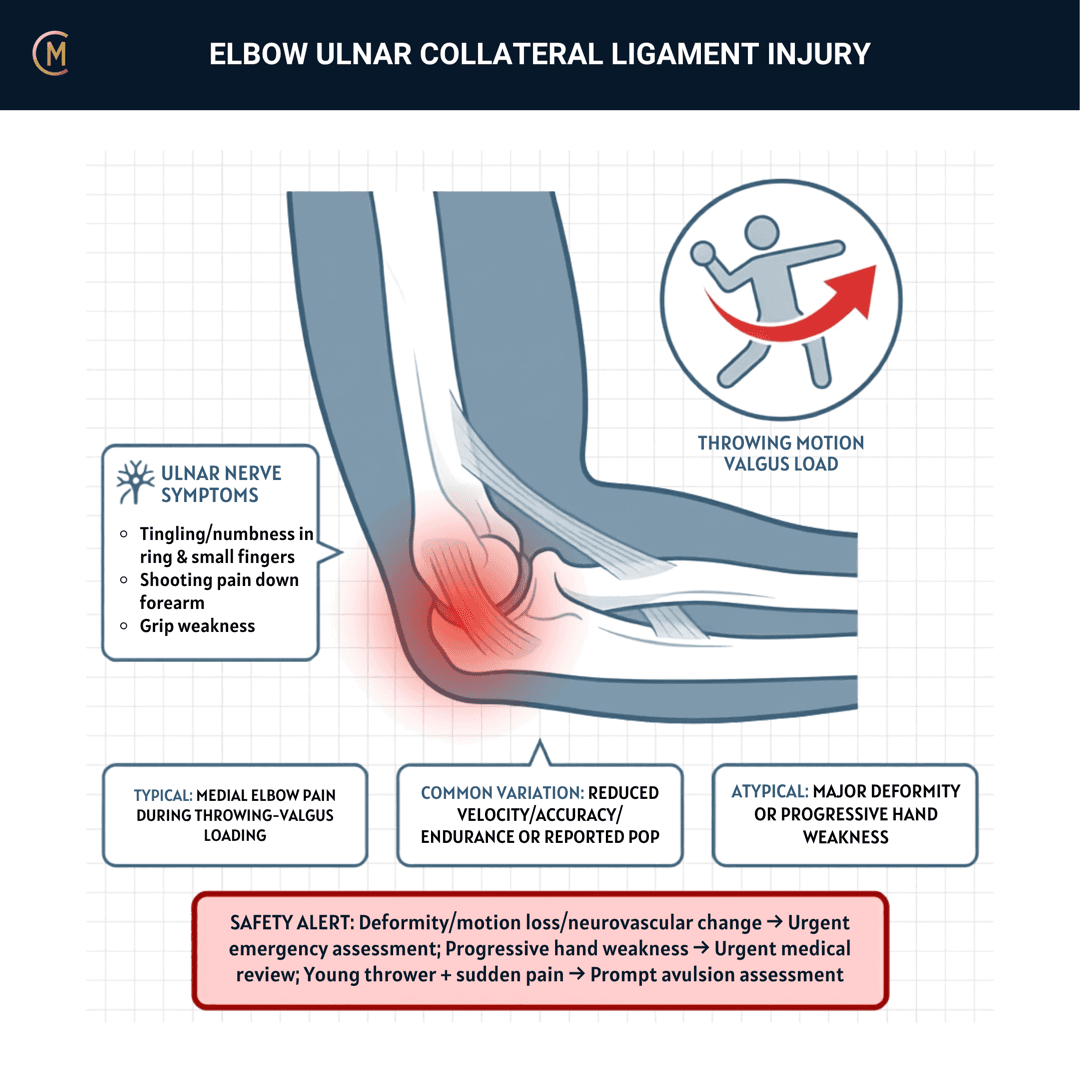
An elbow diagnosis that is almost never an elbow problem.
Illness script in one line: medial elbow pain during throwing, worst in late cocking and acceleration, described as a sharp or unstable "pull" — sometimes with a pop at onset — eased by rest and reproduced by valgus stress, in a baseball pitcher, javelin thrower or cricket bowler.
Caseload frequency: uncommon outside a throwing caseload, and the presenting problem the moment you have one. Read further: epidemiology of medial UCL surgeries in major and minor league baseball [1], incidence of repair and reconstruction in a US population [2]. Both are American baseball datasets. The subjective pattern already names cricket bowlers, which most of this literature doesn't.
The elbow is where a whole-body problem shows up — and it shows up when you're tired
This is the organising idea, and it runs the page: UCL strain commonly secondary to shoulder or trunk deficits. The evidence now supports it and extends it in two directions.
Direction one — it isn't only the shoulder and trunk. It's the forearm too. Read further: the flexor-pronator mass in the Tommy John story [3], the UCL response to valgus stress, repetitive pitching and elbow muscle activity [4], biomechanical risk factors for medial elbow valgus stress in pitchers [5]. This is the same mechanism taught on the golfer's elbow page from the other side: the flexor-pronator mass is a dynamic valgus stabiliser, so the tendon and the ligament are one problem seen from two angles.
Direction two — and this is the practical one — dynamic stability degrades with fatigue. Read further: dynamic elbow valgus stability after repetitive pitching as a risk factor [6], risk factors for a UCL injury resulting in surgery [7].
What that means at the bedside:
| The student version | The useful version |
|---|---|
| "The ligament failed" | "The things protecting the ligament stopped working, and then it failed" |
| Test the elbow | Test the elbow, then screen the shoulder, trunk and hip — they're often stiff or weak |
| Assess them fresh | The elbow fails at the end of the outing, not the start |
| Count symptoms | Count throws. Throwing volume management is critical |
2 · SE — THE SUBJECTIVE PATTERN (the 70%)
Main problem
"Sharp pain on the inside of my elbow when I throw." Medial elbow pain during throwing, especially late cocking or acceleration. Described as sharp or unstable "pull" medially.
And the one that gets under-reported: They may report sharp "pop" or sudden loss of velocity/accuracy. Ask about velocity directly. Throwers will mention pain and forget to mention that the ball stopped going where they aim it.
Body chart
Medial, along the UCL from the medial epicondyle to the sublime tubercle. Tenderness along UCL (medial epicondyle → sublime tubercle).
Ask about the little and ring fingers. Neuro screen — check ulnar nerve (cubital tunnel). The ulnar nerve runs directly behind this, and valgus load irritates it.
Behaviour
Eased with rest; worsened by valgus stress. Often feels "unstable" or "loose" medially.
The two questions that matter most:
- Where in the throw? Late cocking and acceleration is the answer that fits. Follow-through pain is a different conversation.
- How far into the session, or the innings, or the spell? This is the fatigue question, and it comes straight out of the mechanism in section 1. "Fine for the first twenty, sore after that" is the classic answer and it changes the plan.
Aggs: throwing, especially at intensity and volume; anything that valgus-loads the elbow.
Eases: rest from throwing. Note that it usually doesn't hurt in daily life, which is why they present late.
Severity: VAS 0–10 at best / at worst / right now.
History
Either a single event with a pop, or a gradual build across a season. Both belong here, and the pop is section 4.
Ask about the whole workload, not the injury: throws or overs or innings per week, how it has changed, pre-season ramp, whether they play multiple positions or bowl in more than one format, whether they play year-round.
Special / screening questions
Common in baseball, javelin, cricket bowlers.
- Age and skeletal maturity. A growing thrower is a medial epicondyle apophyseal problem, not a ligament one. Section 4.
- Velocity or accuracy change. Section 4.
- Ulnar nerve symptoms.
- Previous medial elbow problems, and previous shoulder problems. Go looking upstream.
- What their coach has changed. Mechanics, volume, a new pitch or delivery.
Assessing this region? Download the Elbow assessment template →
3 · HYPOTHESIS RANKING
| Pattern | The one discriminating feature |
|---|---|
| UCL injury | Pain during throwing in late cocking and acceleration, a feeling of instability, and valgus and moving valgus stress reproduce it. |
| Medial elbow flexor tendinopathy | Gradual, grip- and pronation-dominant, max tenderness at the flexor-pronator origin, and — the key discriminator — valgus stress usually stable. Its own page. And they overlap: the flexor-pronator mass is a valgus stabiliser. |
| Ulnar nerve neuritis / cubital tunnel | Numbness and tingling in the 4th–5th fingers, night symptoms, and — the key line — valgus stress tests do not reproduce primary symptoms. Its own page. Frequently coexists here. |
| Medial epicondyle apophysitis or avulsion | Skeletal immaturity. A growing thrower is a different injury. Section 4, and its own page. |
| Flexor-pronator muscle strain | Acute, with the pain in the muscle belly rather than along the ligament, and valgus stress relatively comfortable. Testing to differentiate the two is an active question in the physiotherapy literature — see the golfer's elbow page. |
| Valgus extension overload / posteromedial impingement | Pain at ball release and follow-through rather than late cocking, and posteromedial rather than medial. Different phase, different postcode. |
The discriminator that does most of the work: which phase of the throw, and does valgus stress reproduce it.
4 · RED FLAGS — DON'T MISS THIS
Free forever. Never gated.
Three things belong, and they're all about stopping.
1. A pop, or a sudden loss of velocity
The subjective pattern already names it: may report sharp "pop" or sudden loss of velocity/accuracy. That line is a stop-throwing trigger and deserves to be read as one.
Why students under-weight it: the elbow may settle quickly and may not hurt much in daily life. A thrower who tells you their velocity dropped and it doesn't hurt much any more is not reassuring — they are describing a ligament that has stopped doing its job. In professional pitchers who went on to UCL surgery, velocity fell progressively across their final outings while matched controls stayed stable [23].
Action: stop throwing, refer for assessment and imaging, and do not start a throwing programme.
2. A skeletally immature thrower
Same flag as the golfer's elbow page, and for the same reason: in a growing athlete the weak link on the medial side is the medial epicondyle apophysis, not the ligament.
Action: stop throwing, refer, and open the Little Leaguer's elbow page. Check it with your educator.
Don't wait for the pop. In youth throwers with a medial epicondyle avulsion fracture, 84% reported elbow pain before the acute injury (Zheng et al. 2025) [21]. Medial elbow pain in a growing thrower is the warning, not the background.
3. Ulnar nerve signs
Neuro screen — check ulnar nerve (cubital tunnel). The nerve sits directly behind the ligament and valgus load irritates it.
Escalate if there is constant numbness, weakness or wasting of the interossei, or impaired pinch — rather than the intermittent tingling that often accompanies a throwing elbow. Its own page.
4. It isn't the elbow
Medial elbow pain in a thrower with no valgus relationship, no load story, or systemic features is a different problem. And a first-time thrower's elbow pain in someone with a stiff, painful or weak shoulder is often a shoulder problem presenting distally — which is the kinetic-chain pearl in its most literal form.
5. Posterior olecranon pain in an adolescent thrower
Olecranon stress fracture sits beside the ligament, not instead of it: in 200 baseball players with one, a concomitant UCL injury and/or medial epicondyle avulsion was present in 71% to 95% (Furushima et al. 2014) [22]. Action: stop throwing and refer for imaging — posteromedial pain isn't automatically impingement.
5 · OE — THE OBJECTIVE (the 30%)
Members
Sections 5 to 7 are for members
The objective exam, management and pearls, plus the six-minute lesson and the debrief. Free with an account.
Sign in or join free6 · MX — MANAGEMENT ESSENTIALS
Members
Sections 5 to 7 are for members
The objective exam, management and pearls, plus the six-minute lesson and the debrief. Free with an account.
Sign in or join free7 · CLINICAL PEARLS + RETRIEVAL CHECK
Members
Sections 5 to 7 are for members
The objective exam, management and pearls, plus the six-minute lesson and the debrief. Free with an account.
Sign in or join freeMembers
The 5-minute lesson is for members
Twelve slides on this pattern: what you'll hear, what to examine, what to do. Free with an account.
Sign in or join freeGuideline anchor
No Australian guideline, and no clinical practice guideline of any kind.
More
The physiotherapy anchors are a systematic review of rehabilitation protocols in elbow medial ulnar collateral ligament injuries in Sports Health (Buchanan et al. 2025, PMID 38702939) and an Instructional Course Lecture on rehabilitation and throwing programs (Da Silva et al. 2025, PMID 39745552). The honesty anchor is a study documenting high variability among surgeons in the evaluation, treatment and rehabilitation of medial UCL injuries (Sambare et al. 2024, PMID 38706672). The prognosis anchor is the Elbow Ulnar Collateral Ligament Injury Prognosis Score in the American Journal of Sports Medicine (Dennis et al. 2025, PMID 40911922). The examination anchor is a review of the physical examination of the throwing elbow (Bi et al. 2025, PMID 40021248).
None of these is a clinical practice guideline. The systematic review of rehabilitation protocols exists because the protocols vary, and a separate study documents high variability among surgeons in evaluation, treatment and rehabilitation. There is no agreed protocol to follow.
Members
The evidence summary is for members
Verified diagnostic accuracy, where the evidence stands and what it doesn't settle. Free with an account.
Sign in or join freeSources · 21
ShowHide
Every source on this page resolves and title-verifies against PubMed. Newest first.
- 2025Meta et al. (2025). Epidemiology of Elbow Medial Ulnar Collateral Ligament Surgeries in Major and Minor League Baseball Pitchers: A Descriptive Study of 2281 Cases. Orthopaedic journal of sports medicine, 13(7), 23259671251352199. https://doi.org/10.1177/23259671251352199
- 2026Guy et al. (2026). Incidence of Elbow Medial Ulnar Collateral Ligament Repair and Reconstruction: A US Population Database Study 2016 to 2022. Orthopaedic journal of sports medicine, 14(5), 23259671261415857. https://doi.org/10.1177/23259671261415857
- 2026Freehill (2026). The Tommy John Saga Continues: Is the Flexor-Pronator Playing the Co-starring Role?. The American journal of sports medicine, 54(3), 507-508. https://doi.org/10.1177/03635465261425943
- 2024van Trigt et al. (2024). The ulnar collateral ligament response to valgus stress, repetitive pitching, and elbow muscle contraction in asymptomatic baseball pitchers. JSES reviews, reports, and techniques, 4(2), 189-195. https://doi.org/10.1016/j.xrrt.2023.11.005
- 2026Matsui et al. (2026). Biomechanical risk factors for medial elbow valgus stress in baseball pitchers: the role of Forearm Whip Angle. Journal of shoulder and elbow surgery, 35(6), 1596-1604. https://doi.org/10.1016/j.jse.2025.11.008
- 2026Sakata et al. (2026). Dysfunction of Dynamic Elbow Valgus Stability After Repetitive Pitching: Risk Factors for Throwing Elbow Injury in College Baseball Pitchers. Clinical journal of sport medicine : official journal of the Canadian Academy of Sport Medicine, 36(5), 561-566. https://doi.org/10.1097/JSM.0000000000001382
- 2025Fleisig et al. (2025). Risk Factors for an Ulnar Collateral Ligament Injury Resulting in Surgery: A Prospective Longitudinal Study of 305 Professional Baseball Pitchers. Orthopaedic journal of sports medicine, 13(7), 23259671251351339. https://doi.org/10.1177/23259671251351339
- 2025Bi et al. (2025). The Physical Examination of the Throwing Elbow. Clinics in sports medicine, 44(2), 129-142. https://doi.org/10.1016/j.csm.2024.05.003
- 2024Chalmers et al. (2024). Elbow Ulnar Collateral Ligament Tears in 2023: Evaluation and Management. Instructional course lectures, 73, 725-736. PubMed 38090936
- 2024Hoshika et al. (2024). Microscopic Magnetic Resonance Imaging Comparing Asymptomatic and Symptomatic Ulnar Collateral Ligament Injuries in Baseball Players. The American journal of sports medicine, 52(9), 2314-2318. https://doi.org/10.1177/03635465241259472
- 2023Patel et al. (2023). Correlation of Joint Space Widening on Valgus Stress Magnetic Resonance Imaging With Level of Play and Innings Pitched in Professional Pitchers. Orthopaedic journal of sports medicine, 11(11), 23259671231209704. https://doi.org/10.1177/23259671231209704
- 2025Buchanan et al. (2025). Rehabilitation Protocols in Elbow Medial Ulnar Collateral Ligament Injuries: A Systematic Review of Articles Published in the Last 20 Years. Sports health, 17(3), 460-469. https://doi.org/10.1177/19417381241249125
- 2025Da Silva et al. (2025). Ulnar Collateral Ligament Tears: Rehabilitation and Throwing Programs. Instructional course lectures, 74, 71-78. PubMed 39745552
- 2024Sambare et al. (2024). High variability among surgeons in evaluation, treatment, and rehabilitation of medial ulnar collateral ligament injuries. JSES reviews, reports, and techniques, 4(2), 182-188. https://doi.org/10.1016/j.xrrt.2024.01.011
- 2024Ishigaki et al. (2024). Elbow valgus stress during towel drills in college baseball players. Journal of shoulder and elbow surgery, 33(4), 765-772. https://doi.org/10.1016/j.jse.2023.09.017
- 2025Nakagawa et al. (2025). Conservative Management of Ulnar Collateral Ligament Injury in a Throwing Elbow Complicated by Ulnar and Median Neuropathy: A Case Report. Cureus, 17(9), e93061. https://doi.org/10.7759/cureus.93061
- 2025Dennis et al. (2025). The Elbow Ulnar Collateral Ligament Injury Prognosis Score. The American journal of sports medicine, 53(12), 2933-2943. https://doi.org/10.1177/03635465251366318
- 2024Spears et al. (2024). Current Concepts in the Surgical Management of Elbow Medial Ulnar Collateral Ligament Injuries. The Journal of the American Academy of Orthopaedic Surgeons, 33(13), 703-710. https://doi.org/10.5435/JAAOS-D-24-00839
- 2026Mavrommatis et al. (2026). Elbow Medial Ulnar Collateral Ligament Repair Versus Reconstruction Versus Augmented Reconstruction: Where Do We Stand?. HSS journal : the musculoskeletal journal of Hospital for Special Surgery, 15563316261472449. https://doi.org/10.1177/15563316261472449
- 2026Negus et al. (2026). Are Suture Spanning Repair Techniques Replacing Traditional Tommy John Surgery? Prevalence and Complication Rates Following Ulnar Collateral Ligament Repair or Reconstruction. Orthopaedic journal of sports medicine, 14(7), 23259671261454330. https://doi.org/10.1177/23259671261454330
- 2025Zheng et al. (2025). Medial Epicondylar Apophyseal Avulsion Fractures in Youth Throwers: A Severe Variant of Little League Elbow. Orthopaedic journal of sports medicine, 13(9), 23259671251365974. https://doi.org/10.1177/23259671251365974
Mapped to this pattern
Generic measures that also apply
- Borg RPE
Borg Rating of Perceived Exertion Scale (6-20)
perceived exertion · 1 items · 1 min
- DASH
Disabilities of the Arm, Shoulder and Hand
upper limb disability · 30 items · 8 min
- GROC
Global Rating of Change Scale
perceived change since baseline · 1 items · 1 min
- NPRS
Numeric Pain Rating Scale
pain intensity · 1 items · 1 min
- PGIC
Patient Global Impression of Change
perceived change since baseline · 1 items · 1 min
- PSFS
Patient-Specific Functional Scale
patient-generated function · 3 items · 2 min
- QuickDASH
QuickDASH
upper limb disability, short form · 11 items · 4 min
- SANE
Single Assessment Numeric Evaluation
patient-rated function as a percentage of normal · 1 items · 1 min
- UEFI
Upper Extremity Functional Index
upper limb function · 20 items · 5 min
- VAS
Visual Analogue Scale
pain intensity · 1 items · 1 min
- Borg CR10
Borg Category Ratio 10 Scale
perceived exertion or symptom intensity, ratio scale · 1 items · 1 min
- GAS
Goal Attainment Scaling
individualised goal achievement · 10 min
Did this page do its job?
CliniStudy is in beta. One tap is enough — it decides what gets fixed first.