
1 · SNAPSHOT
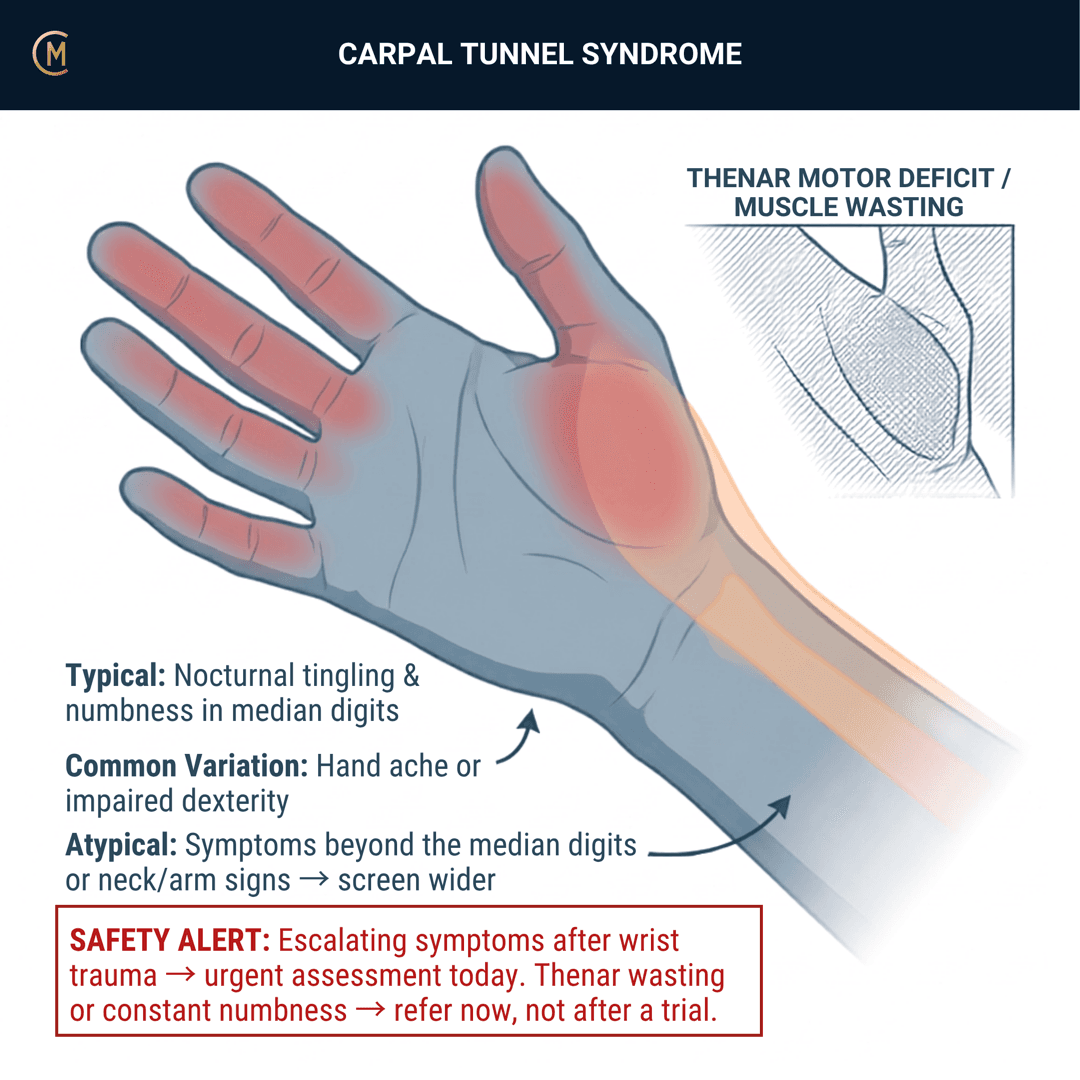
The most common entrapment neuropathy you will see, and the one students over-test.
Illness script in one line: numbness, tingling or burning in the thumb, index, middle and radial half of the ring finger, worst at night, waking them, relieved by shaking or flicking the hand — with dropping things and a vague sense of weakness as it goes on.
Caseload frequency: common, and commoner still on a hand, occupational or women's health caseload. Read further: global and regional prevalence [1], general-population prevalence [2], lifetime prevalence, annual incidence and risk factors for carpal tunnel release [3].
The history makes this diagnosis. Your tests don't.
This is a 70/30 pattern in its purest form: night symptoms are the diagnostic giveaway.
Read further: diagnostic test accuracy of scales, questionnaires and hand symptom diagrams [4], clinical utility of the CTS-6, the Boston-CTS and the hand diagram [5], sensitivity and specificity of electrodiagnostic parameters [6].
The direction, which is all you need:
| What you were taught | What it's actually worth |
|---|---|
| Phalen's, Tinel's, carpal compression | Confirmatory at best. No verified accuracy figure in our library. A negative one does not clear a classic history |
| The symptom pattern — where, when, what relieves it | This is the test. Structured symptom tools are where the diagnostic accuracy work has gone |
| Nerve conduction study | Grades severity and feeds the surgical conversation. Not the arbiter of whether they have it |
That is not a licence to skip the objective exam. It is a reason to spend your objective time on the two things that change management — motor loss and thenar bulk — rather than on three provocative tests you will do badly and interpret worse.
2 · SE — THE SUBJECTIVE PATTERN (the 70%)
Main problem
"My hand goes numb at night." Or dead, or asleep, or on fire. Numbness, tingling or burning in the thumb, index, middle and radial half of the ring finger.
The complaint is sensory first and motor second. A patient whose opening line is weakness, with no sensory story, is a different page.
Body chart
Median distribution — thumb, index, middle, radial half of ring.
Two things students get wrong with it:
- Plenty of genuine carpal tunnel patients report the whole hand. They are not lying and it does not rule it out. Ask them to shade it, then ask specifically about the little finger. Little-finger symptoms don't exclude it either — carpal tunnel can refer outside the median territory — but a clearly ulnar pattern, a neck relationship or a dermatomal march should send you screening wider.
- The palm is often spared, because the palmar cutaneous branch of the median nerve leaves proximal to the tunnel. Numbness over the thenar eminence and central palm points you proximal, not distal.
Proximal ache into the forearm and even the shoulder is common and does not make it cervical.
Behaviour
Worse at night, with gripping, and with sustained wrist flexion. Relief by shaking or flicking the wrist.
Night waking is the single most useful item in the history and it is worth asking about properly: what time, how many times, what they do about it, whether they've started sleeping with the hand out of the bed. The pearl that night symptoms are the diagnostic giveaway is the line the evidence supports, and the structured symptom tools that carry the diagnostic accuracy work are built around exactly this kind of item.
The flick sign is a genuine discriminator. People with cervical radicular pain do not shake their hand at 3am and get relief in thirty seconds.
Aggs: night, sustained wrist flexion or extension, driving, holding a phone or book, gripping, vibration.
Eases: shaking, flicking, changing hand position, hanging the arm out of the bed.
Severity: VAS 0–10 at best / at worst / right now.
History
Gradual, fluctuating, months. Intermittent at first, then more nights, then daytime, then constant. Constant numbness is a change in stage, not just a worse day — see section 4.
Special / screening questions
Repetitive use, pregnancy, diabetes, hypothyroidism. All four earn their place.
- Pregnancy and postpartum. Different prognosis conversation — it commonly settles. Splint, reassure, review. The same patient is often being seen for De Quervain's at the same time. Read further: carpal tunnel syndrome in pregnancy [7].
- Occupation. Ask about vibration and forceful repetitive grip, not just typing. Read further: causes, mechanisms, diagnosis and management of occupational carpal tunnel syndrome [8].
- Diabetes and thyroid disease. Ask. It changes the referral letter.
- Bilateral, older, and no occupational explanation — go to section 4 before you go to section 6.
Assessing this region? Download the Wrist & Hand assessment template →
3 · HYPOTHESIS RANKING
| Pattern | The one discriminating feature |
|---|---|
| Carpal tunnel syndrome | Night waking with median-distribution numbness, relieved by shaking. No neck relationship, no dermatomal march, little finger usually spared. |
| C6/C7 cervical radiculopathy | Neck movement changes it. Symptoms follow a dermatome past the elbow, reflex and myotomal findings, no 3am flick. Can coexist — see section 6. |
| Pronator syndrome (proximal median compression) | The palm is involved, and the forearm is tender. Less night dominance, more forearm ache with resisted pronation. Its own page. Read further: proximal median nerve compression [9]. |
| Cubital tunnel syndrome | Little and ring finger, elbow flexion at night. The other side of the hand. Its own page. |
| Thoracic outlet syndrome | Whole-limb, positional, often ulnar-dominant, with heaviness on overhead work. Its own page. |
| Peripheral polyneuropathy | Symmetrical, stocking-and-glove, feet first. If the feet are involved, this is not a wrist problem. |
The discriminator that does most of the work: what does the little finger do, and does the neck change anything.
4 · RED FLAGS — DON'T MISS THIS
Free forever. Never gated.
This pattern needs a short red-flag layer — not because carpal tunnel syndrome is dangerous, but because two situations change what you do today.
1. Constant numbness, thenar wasting, or weak thumb abduction — this is late, and it is a referral now
Early management prevents irreversible motor loss. That pearl is the red flag. Motor signs are not a more severe version of the same problem you keep treating — they are the point at which conservative care stops being the whole plan.
What that looks like in a session: constant rather than intermittent numbness; visible loss of thenar bulk compared with the other hand; measurable weakness of thumb abduction (APB); dropping things they used to hold.
Action: refer for medical review with a letter that names the motor finding. Keep treating in the meantime — but the referral doesn't wait for six weeks of splinting to fail.
2. Bilateral carpal tunnel syndrome in an older adult with no occupational explanation — think beyond the wrist
Carpal tunnel syndrome has been described as a potential early red-flag sign of amyloidosis in the Journal of Hand Surgery [10], and screening for transthyretin amyloidosis at the time of carpal tunnel release has been examined as an opportunity for earlier diagnosis [11].
Why a student should care: the hand symptoms can precede the cardiac disease by years, and the person most likely to be sitting in front of a physiotherapist at that point is the one with bilateral hands and no obvious cause. You are not diagnosing amyloidosis. You are writing one extra sentence in a referral letter — bilateral presentation in an older adult with no occupational explanation; grateful for your assessment — and that sentence is the entire contribution.
The pattern to notice: bilateral · older adult · no occupational or pregnancy explanation · often with a history of hand or shoulder problems on both sides.
3. It isn't carpal tunnel syndrome
Feet involved → polyneuropathy, not a wrist. Progressive weakness beyond the median distribution → not a wrist. Sudden onset with trauma → not this page: escalating median symptoms after a wrist fracture or injury are urgent and go today. Systemic features, weight loss, night pain that isn't the hand → different page entirely.
5 · OE — THE OBJECTIVE (the 30%)
Members
Sections 5 to 7 are for members
The objective exam, management and pearls, plus the six-minute lesson and the debrief. Free with an account.
Sign in or join free6 · MX — MANAGEMENT ESSENTIALS
Members
Sections 5 to 7 are for members
The objective exam, management and pearls, plus the six-minute lesson and the debrief. Free with an account.
Sign in or join free7 · CLINICAL PEARLS + RETRIEVAL CHECK
Members
Sections 5 to 7 are for members
The objective exam, management and pearls, plus the six-minute lesson and the debrief. Free with an account.
Sign in or join freeMembers
The 4-minute lesson is for members
Twelve slides on this pattern: what you'll hear, what to examine, what to do. Free with an account.
Sign in or join freeGuideline anchor
No Australian management guideline, but one Australian state standard: Safer Care Victoria's best-care guidance says carpal tunnel release should not be performed for mild carpal tunnel syndrome, and that mild cases should be offered conservative management first.
More
The physiotherapy anchor is the JOSPT clinical practice guideline, Hand Pain and Sensory Deficits: Carpal Tunnel Syndrome, Revision 2026 (Erickson et al. 2026, PMID 41919928) — a current, physiotherapy-authored, physiotherapy-facing guideline, which is rare enough to be worth naming. The surgical and medical anchor is the AAOS/ASSH clinical practice guideline summary on management (Shapiro et al. 2025, PMID 39637428). The conservative-treatment anchor is a systematic review and network meta-analysis in Archives of Physical Medicine and Rehabilitation (Chen et al. 2025, PMID 40315975), with Cochrane reviews on splinting (Karjalainen et al. 2023, PMID 36848651) and on surgical versus non-surgical treatment (Lusa et al. 2024, PMID 38189479).
The JOSPT guideline is a genuine physiotherapy management guideline and governs most of this page. The AAOS/ASSH guideline is a surgical and medical decision-making document — it tells you what the conversation on the other end of a referral looks like, not what you do on Monday.
Members
The evidence summary is for members
Verified diagnostic accuracy, where the evidence stands and what it doesn't settle. Free with an account.
Sign in or join freeSources · 20
ShowHide
Every source on this page resolves and title-verifies against PubMed. Newest first.
- 2024Gebrye et al. (2024). Global and Regional Prevalence of Carpal Tunnel Syndrome: A Meta-Analysis Based on a Systematic Review. Musculoskeletal care, 22(4), e70024. https://doi.org/10.1002/msc.70024
- 1999Atroshi et al. (1999). Prevalence of carpal tunnel syndrome in a general population. JAMA, 282(2), 153-8. https://doi.org/10.1001/jama.282.2.153
- 2018Pourmemari et al. (2018). Carpal tunnel release: Lifetime prevalence, annual incidence, and risk factors. Muscle & nerve, 58(4), 497-502. https://doi.org/10.1002/mus.26145
- 2020Dabbagh et al. (2020). Diagnosing Carpal Tunnel Syndrome: Diagnostic Test Accuracy of Scales, Questionnaires, and Hand Symptom Diagrams-A Systematic Review. The Journal of orthopaedic and sports physical therapy, 50(11), 622-631. https://doi.org/10.2519/jospt.2020.9599
- 2021Schulze et al. (2021). Clinical Utility of the 6-Item CTS, Boston-CTS, and Hand-Diagram for Carpal Tunnel Syndrome. Frontiers in neurology, 12, 683807. https://doi.org/10.3389/fneur.2021.683807
- 2024Mazaheri et al. (2024). Sensitivity and specificity of electrodiagnostic parameters in diagnosing carpal tunnel syndrome. Bone & joint open, 5(10), 898-903. https://doi.org/10.1302/2633-1462.510.BJO-2024-0025.R1
- 2023Bland (2023). Carpal tunnel syndrome in pregnancy. Muscle & nerve, 68(4), 345-347. https://doi.org/10.1002/mus.27957
- 2024Rotaru-Zavaleanu et al. (2024). Occupational Carpal Tunnel Syndrome: a scoping review of causes, mechanisms, diagnosis, and intervention strategies. Frontiers in public health, 12, 1407302. https://doi.org/10.3389/fpubh.2024.1407302
- 2020Adler & Wolf (2020). Proximal Median Nerve Compression: Pronator Syndrome. The Journal of hand surgery, 45(12), 1157-1165. https://doi.org/10.1016/j.jhsa.2020.07.006
- 2019Donnelly et al. (2019). Carpal Tunnel Syndrome: A Potential Early, Red-Flag Sign of Amyloidosis. The Journal of hand surgery, 44(10), 868-876. https://doi.org/10.1016/j.jhsa.2019.06.016
- 2026Jeanneteau & Bigorre (2026). Screening for Transthyretin Amyloidosis During Carpal Tunnel Release: An Opportunity for Early Diagnosis. The American journal of cardiology, 275, 4-8. https://doi.org/10.1016/j.amjcard.2026.07.007
- 2023Karjalainen et al. (2023). Splinting for carpal tunnel syndrome. The Cochrane database of systematic reviews, 2(2), CD010003. https://doi.org/10.1002/14651858.CD010003.pub2
- 2017Ballestero-Pérez et al. (2017). Effectiveness of Nerve Gliding Exercises on Carpal Tunnel Syndrome: A Systematic Review. Journal of manipulative and physiological therapeutics, 40(1), 50-59. https://doi.org/10.1016/j.jmpt.2016.10.004
- 2024Lusa et al. (2024). Surgical versus non-surgical treatment for carpal tunnel syndrome. The Cochrane database of systematic reviews, 1(1), CD001552. https://doi.org/10.1002/14651858.CD001552.pub3
- 2025Palmbergen et al. (2025). Surgery versus corticosteroid injection for carpal tunnel syndrome (DISTRICTS): an open-label, multicentre, randomised controlled trial. Lancet (London, England), 405(10495), 2153-2163. https://doi.org/10.1016/S0140-6736(25)00368-X
- 2025Chen et al. (2025). Conservative Treatments of Carpal Tunnel Syndrome: A Systematic Review and Network Meta-analysis. Archives of physical medicine and rehabilitation, 106(9), 1447-1458. https://doi.org/10.1016/j.apmr.2025.04.002
- 2026Erickson et al. (2026). Hand Pain and Sensory Deficits: Carpal Tunnel Syndrome: Revision 2026. The Journal of orthopaedic and sports physical therapy, 56(4), CPG1-CPG79. https://doi.org/10.2519/jospt.2026.0301
- 2009Coppieters et al. (2009). Different nerve-gliding exercises induce different magnitudes of median nerve longitudinal excursion: an in vivo study using dynamic ultrasound imaging. The Journal of orthopaedic and sports physical therapy, 39(3), 164-71. https://doi.org/10.2519/jospt.2009.2913
- 2025Shapiro et al. (2025). American Academy of Orthopaedic Surgeons/ASSH Clinical Practice Guideline Summary Management of Carpal Tunnel Syndrome. The Journal of the American Academy of Orthopaedic Surgeons, 33(7), e356-e366. https://doi.org/10.5435/JAAOS-D-24-01179
- 2016Peters et al. (2016). Rehabilitation following carpal tunnel release. The Cochrane database of systematic reviews, 2(2), CD004158. https://doi.org/10.1002/14651858.CD004158.pub3
Mapped to this pattern
Generic measures that also apply
- Borg RPE
Borg Rating of Perceived Exertion Scale (6-20)
perceived exertion · 1 items · 1 min
- DASH
Disabilities of the Arm, Shoulder and Hand
upper limb disability · 30 items · 8 min
- GROC
Global Rating of Change Scale
perceived change since baseline · 1 items · 1 min
- NPRS
Numeric Pain Rating Scale
pain intensity · 1 items · 1 min
- PGIC
Patient Global Impression of Change
perceived change since baseline · 1 items · 1 min
- PSFS
Patient-Specific Functional Scale
patient-generated function · 3 items · 2 min
- QuickDASH
QuickDASH
upper limb disability, short form · 11 items · 4 min
- SANE
Single Assessment Numeric Evaluation
patient-rated function as a percentage of normal · 1 items · 1 min
- UEFI
Upper Extremity Functional Index
upper limb function · 20 items · 5 min
- VAS
Visual Analogue Scale
pain intensity · 1 items · 1 min
- Borg CR10
Borg Category Ratio 10 Scale
perceived exertion or symptom intensity, ratio scale · 1 items · 1 min
- GAS
Goal Attainment Scaling
individualised goal achievement · 10 min
Did this page do its job?
CliniStudy is in beta. One tap is enough — it decides what gets fixed first.