
1 · SNAPSHOT
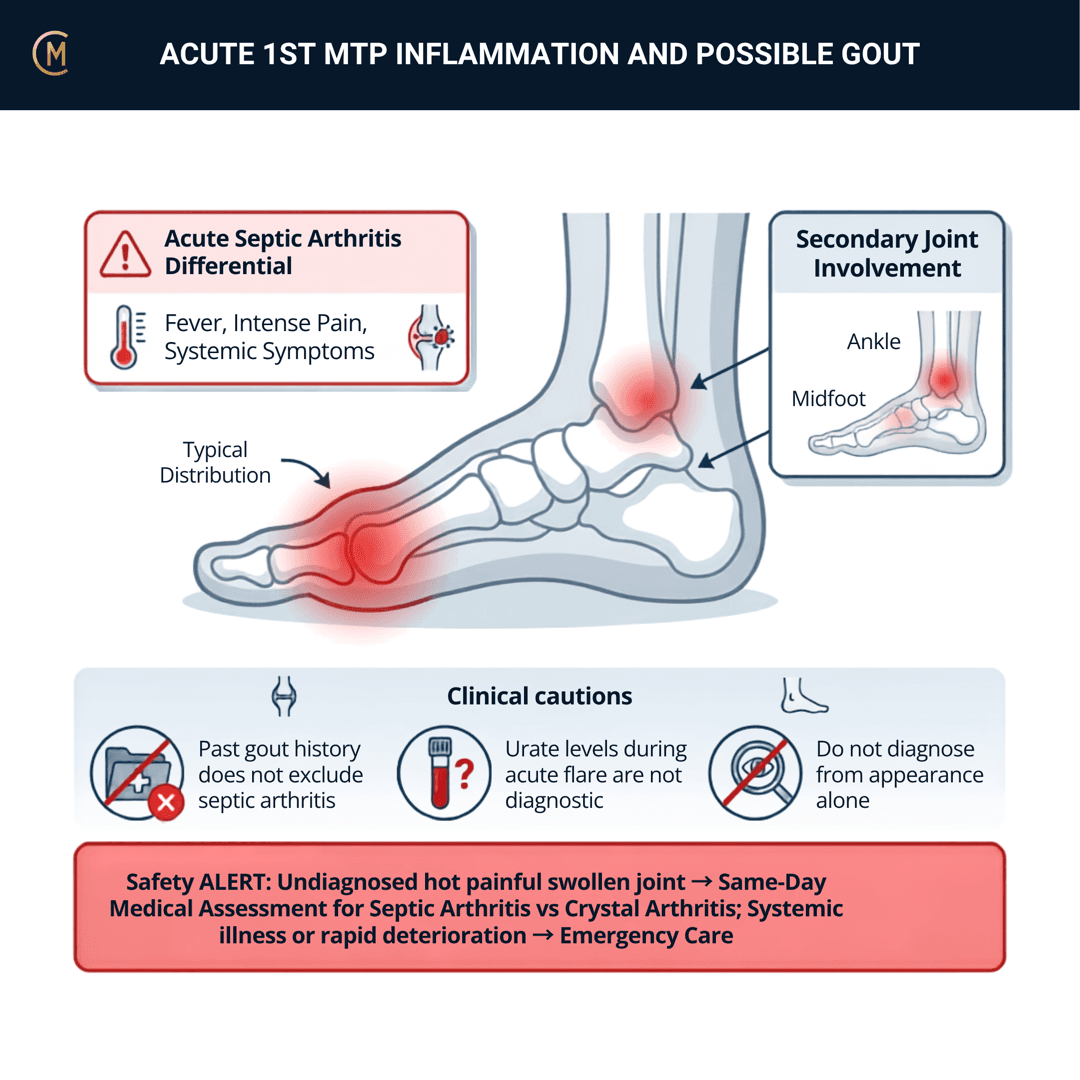
The urgency isn't the gout. It's that you cannot tell it from the thing that is dangerous.
Illness script in one line: sudden, severe pain in a single joint — classically the big toe — coming on overnight, with the joint red, hot, swollen and so tender that a bedsheet hurts, in someone who has often had an attack like it before.
Caseload frequency: more common than students expect, and it arrives disguised as something mechanical. Read further: global burden and trends in incidence and prevalence [1], aetiology, genetics and co-morbidities [2].
You can't diagnose it — but you can collect most of what the diagnosis needs
Here is the thing worth knowing, and it changes what your referral is worth.
Read further: a diagnostic rule for acute gouty arthritis in primary care without joint fluid analysis [3], the ACR/EULAR gout classification criteria [4], a G-CAN consensus statement [5].
But the existence of a rule built for primary care, that does not need aspiration, tells you something usable: this diagnosis is carried substantially by history — and history is the part you take.
| What a physiotherapist cannot do | What a physiotherapist can do |
|---|---|
| Aspirate the joint | Take a history that answers most of the questions a GP is about to ask |
| Order urate, imaging or DECT | Notice the pattern is not mechanical and say so |
| Diagnose it | Write a referral that names gout as a possibility, with the features listed |
| Prescribe anything | Refer today, and not treat it in the meantime |
That's not a small contribution. A same-day referral with the history already done is the difference between a diagnosis this week and a diagnosis next month.
2 · SE — THE SUBJECTIVE PATTERN (the 70%)
Acute presentation, so the order changes: MAIN PROBLEM → BODY CHART → HISTORY → BEHAVIOUR.
Main problem
"My toe blew up overnight and I can't put a shoe on." sudden severe 1st MTP pain, red, hot, swollen. Often nocturnal onset.
Two words carry this: sudden and severe. Mechanical foot pain builds. This arrives.
Body chart
One joint, sharply demarcated, exquisitely tender. 1st MTP.
But it is not only the big toe — and that is the page's first correction. The big toe is where it is classically taught, not where gout stops. Midfoot, ankle, knee, wrist and the olecranon bursa all present — and the olecranon page already carries gout as a differential it cannot separate from sepsis.
A student who only knows "podagra" will miss the ankle and the midfoot, which is where you'll actually be confused.
History
Often nocturnal onset.
The questions worth asking, and asking properly:
- How fast? Hours, not days. "Worst it had ever been by the morning" is the answer that fits.
- Has this happened before, in this joint or another one? Previous self-reported attacks matter, and patients rarely volunteer them.
- Any fever, chills, or feeling unwell? Every time — section 4.
- Any break in the skin? Section 4.
- Cardiovascular, renal or metabolic history — blood pressure, kidney disease, diabetes? Gout travels with these (Robinson et al. 2018; and hyperuricaemia with high cardiovascular risk has its own expert consensus [6]).
- Medications, especially diuretics.
- Alcohol, and what changed in the last few days.
Every one of those is history a GP will want and a physiotherapist can take in three minutes.
Behaviour
Aggs: weight-bearing, the bedsheet, a shoe, anything touching it.
Eases: almost nothing in the first 48 hours. Elevation and rest, marginally.
The trap that comes next: it settles by itself. An untreated flare resolves over days to weeks. So a patient can be treated with anything at all, improve, and both of you conclude the treatment worked. That is how a wrong model survives a whole placement.
Assessing this region? Download the Ankle & Foot assessment template →
3 · HYPOTHESIS RANKING
Acute monoarthritis in adults has its own diagnostic literature [7], which is the honest framing for this section: the question isn't "is this gout", it's "what is this hot joint".
| Pattern | The one discriminating feature |
|---|---|
| Septic arthritis | Systemically unwell, and pain on any passive movement through the whole arc. You cannot reliably separate it from gout at the bedside — which is why the answer is the same. Section 4. |
| Gout | Sudden, overnight, monoarticular, exquisite, with previous attacks. But see the row above. |
| Cellulitis | Spreading erythema with a margin, tracking beyond the joint. Cellulitis mimics have been reviewed in the Journal of Emergency Medicine and gout is one of them [8]. It runs both ways. |
| Pseudogout (CPPD) | Older, often knee or wrist rather than 1st MTP. Clinically similar enough that the distinction is a laboratory one. |
| Hallux rigidus (1st MTP OA) | Gradual, stiffness with push-off, dorsal osteophyte, no redness or heat. Its own page. |
| Turf toe / sesamoiditis | A mechanism, and load-related pain without systemic features. Their own pages. |
| Stress fracture | A load history, focal bony tenderness, no erythema. Its own page. |
The discriminator that does most of the work: is the joint hot and red, and did it arrive overnight.
And the honest note that governs the whole page: the top two rows are not separable by you, and the correct response to that is not to guess harder.
4 · RED FLAGS — DON'T MISS THIS
Free forever. Never gated. This whole page is free forever.
1. You cannot tell this from septic arthritis. Act accordingly.
This is the entire reason gout sits with the red flags.
A hot, red, swollen, exquisitely tender joint is a same-day medical problem until someone with a needle and a laboratory says otherwise. Acute monoarthritis in adults has been reviewed as its own diagnostic problem (Becker et al. 2016) — because it is one.
Escalate the same day, every time, if there is:
- A single hot, red, swollen joint, whatever you think caused it.
- Fever, rigors, sweats, or feeling systemically unwell.
- Pain on every passive movement through the whole range, not just at end range.
- Any break in the skin near the joint.
- Immunosuppression, diabetes, chronic kidney disease, or long-term steroids.
- A prosthetic joint.
Action: GP today, or ED if febrile or unwell. Not a review next week. Do exactly what the septic olecranon bursitis page says — record a temperature, draw the margin of any erythema and write the time on it, and name the concern in the letter.
2. It runs both ways with cellulitis
Gout has been described as a cellulitis mimic in an emergency-medicine review (Blumberg et al. 2017). So a red, hot foot is not automatically cellulitis, and it is not automatically gout — it is a doctor's problem either way.
3. The company it keeps
Gout is not an isolated joint problem. Read further: aetiology, genetics and co-morbidities (Robinson et al. 2018), management in chronic kidney disease [9], expert consensus on hyperuricaemia with high cardiovascular risk (Johnson et al. 2026).
What that means for you: a patient telling you they get gout is telling you something about their cardiovascular and renal risk. You are not managing it. But "does your GP know how often you're getting these?" is a fair and useful question — and the Australian primary-care literature says it often needs asking (see section 6).
4. It isn't gout
Gradual onset, no redness, no heat, a clear load history → a mechanical 1st MTP problem. Its own page. Focal bony tenderness after a load change → stress fracture. Polyarticular, symmetrical, morning stiffness → inflammatory arthritis, and a different referral.
5 · OE — THE OBJECTIVE (the 30%)
Members
Sections 5 to 7 are for members
The objective exam, management and pearls, plus the six-minute lesson and the debrief. Free with an account.
Sign in or join free6 · MX — MANAGEMENT ESSENTIALS
Members
Sections 5 to 7 are for members
The objective exam, management and pearls, plus the six-minute lesson and the debrief. Free with an account.
Sign in or join free7 · CLINICAL PEARLS + RETRIEVAL CHECK
Members
Sections 5 to 7 are for members
The objective exam, management and pearls, plus the six-minute lesson and the debrief. Free with an account.
Sign in or join freeMembers
The 4-minute lesson is for members
Twelve slides on this pattern: what you'll hear, what to examine, what to do. Free with an account.
Sign in or join freeGuideline anchor
The Australian anchor is the Australian and New Zealand gout recommendations from the 3e Initiative (Graf et al. 2015, PMID 25884565): eleven recommendations on diagnosis and management.
More
They are more than ten years old and not college-endorsed, and no newer national guideline exists. Two Australian primary-care papers sit beside them. Barriers to effective management of chronic gout have been described in the Australian Journal of General Practice (Rogenmoser et al. 2018, PMID 29966174) and the challenges of managing gout in Australian primary care reported as a best-practice audit (Stamp et al. 2019, PMID 31476837). The diagnostic anchors are the 2015 ACR/EULAR gout classification criteria (Neogi et al. 2015, PMID 26352873) and a diagnostic rule for acute gouty arthritis in primary care without joint fluid analysis (Janssens et al. 2010, PMID 20625017), with a G-CAN consensus statement (Filippou et al. 2026, PMID 42264993). The differential anchor is a review of acute monoarthritis in adults (Becker et al. 2016, PMID 27929277).
None of these is a physiotherapy document. The classification criteria are for research and the management guidance is medical. There is no physiotherapy guideline for gout, because the physiotherapy contribution to an acute flare is recognition and referral.
Members
The evidence summary is for members
Verified diagnostic accuracy, where the evidence stands and what it doesn't settle. Free with an account.
Sign in or join freeSources · 20
ShowHide
Every source on this page resolves and title-verifies against PubMed. Newest first.
- 2025Jin et al. (2025). Global burden and trends of gout incidence and prevalence. Chinese medical journal, 138(23), 3153-3162. https://doi.org/10.1097/CM9.0000000000003631
- 2018Robinson (2018). Gout - An update of aetiology, genetics, co-morbidities and management. Maturitas, 118, 67-73. https://doi.org/10.1016/j.maturitas.2018.10.012
- 2010Janssens et al. (2010). A diagnostic rule for acute gouty arthritis in primary care without joint fluid analysis. Archives of internal medicine, 170(13), 1120-6. https://doi.org/10.1001/archinternmed.2010.196
- 2015Neogi et al. (2015). 2015 Gout Classification Criteria: an American College of Rheumatology/European League Against Rheumatism collaborative initiative. Arthritis & rheumatology (Hoboken, N.J.), 67(10), 2557-68. https://doi.org/10.1002/art.39254
- 2026Filippou et al. (2026). Gout, Hyperuricemia and Crystal-Associated Disease Network (G-CAN) consensus statement regarding labels and definitions for disease elements in calcium pyrophosphate crystal deposition (CPPD). Annals of the rheumatic diseases. https://doi.org/10.1016/j.ard.2026.05.019
- 2026Johnson et al. (2026). Expert consensus for the diagnosis and treatment of patients with hyperuricemia and high cardiovascular risk: 2025 update. European journal of internal medicine, 146, 106727. https://doi.org/10.1016/j.ejim.2026.106727
- 2016Becker et al. (2016). Acute Monoarthritis: Diagnosis in Adults. American family physician, 94(10), 810-816. PubMed 27929277
- 2017Blumberg et al. (2017). Clinical Mimics: An Emergency Medicine-Focused Review of Cellulitis Mimics. The Journal of emergency medicine, 53(4), 475-484. https://doi.org/10.1016/j.jemermed.2017.06.002
- 2025Ostrowski (2025). Gout Management in Patients With CKD: A Review. American journal of kidney diseases : the official journal of the National Kidney Foundation, 86(4), 516-524. https://doi.org/10.1053/j.ajkd.2025.04.020
- 2018Yu et al. (2018). Diagnostic accuracy of dual-energy CT in gout: a systematic review and meta-analysis. Skeletal radiology, 47(12), 1587-1593. https://doi.org/10.1007/s00256-018-2948-y
- 2017Chen et al. (2017). Diagnostic accuracy of dual-energy CT and ultrasound in gouty arthritis : A systematic review. Zeitschrift fur Rheumatologie, 76(8), 723-729. https://doi.org/10.1007/s00393-016-0250-8
- 2019Gamala et al. (2019). The diagnostic performance of dual energy CT for diagnosing gout: a systematic literature review and meta-analysis. Rheumatology (Oxford, England), 58(12), 2117-2121. https://doi.org/10.1093/rheumatology/kez180
- 2025Zhang et al. (2025). Exploration of acute gout diagnosis based on ultrasound viscoelastic imaging: quantitative parameter analysis and clinical validation. Frontiers in medicine, 12, 1729517. https://doi.org/10.3389/fmed.2025.1729517
- 2010Terkeltaub et al. (2010). High versus low dosing of oral colchicine for early acute gout flare: Twenty-four-hour outcome of the first multicenter, randomized, double-blind, placebo-controlled, parallel-group, dose-comparison colchicine study. Arthritis and rheumatism, 62(4), 1060-8. https://doi.org/10.1002/art.27327
- 2023Stamp et al. (2023). Is colchicine prophylaxis required with start-low go-slow allopurinol dose escalation in gout? A non-inferiority randomised double-blind placebo-controlled trial. Annals of the rheumatic diseases, 82(12), 1626-1634. https://doi.org/10.1136/ard-2023-224731
- 2025Sun et al. (2025). 2024 Update of Chinese Guidelines for Diagnosis and Treatment of Hyperuricemia and Gout Part I: Recommendations for General Patients. International journal of rheumatic diseases, 28(7), e70375. https://doi.org/10.1111/1756-185x.70375
- 2025Li et al. (2025). 2024 Update of Chinese Guidelines for Management of Hyperuricemia and Gout Part II: Recommendations for Patients With Common Comorbidities. International journal of rheumatic diseases, 28(8), e70402. https://doi.org/10.1111/1756-185x.70402
- 2025Punzi et al. (2025). Gout: one year in review 2025. Clinical and experimental rheumatology, 43(5), 799-808. https://doi.org/10.55563/clinexprheumatol/9sdln5
- 2018Rogenmoser & Arnold (2018). Chronic gout: Barriers to effective management. Australian journal of general practice, 47(6), 351-356. https://doi.org/10.31128/AJGP-11-17-4384
- 2019Stamp et al. (2019). The challenges of managing gout in primary care: Results of a best-practice audit. Australian journal of general practice, 48(9), 631-637. https://doi.org/10.31128/AJGP-04-19-4909
Mapped to this pattern
Generic measures that also apply
- Borg RPE
Borg Rating of Perceived Exertion Scale (6-20)
perceived exertion · 1 items · 1 min
- GROC
Global Rating of Change Scale
perceived change since baseline · 1 items · 1 min
- NPRS
Numeric Pain Rating Scale
pain intensity · 1 items · 1 min
- PGIC
Patient Global Impression of Change
perceived change since baseline · 1 items · 1 min
- PSFS
Patient-Specific Functional Scale
patient-generated function · 3 items · 2 min
- SANE
Single Assessment Numeric Evaluation
patient-rated function as a percentage of normal · 1 items · 1 min
- VAS
Visual Analogue Scale
pain intensity · 1 items · 1 min
- Borg CR10
Borg Category Ratio 10 Scale
perceived exertion or symptom intensity, ratio scale · 1 items · 1 min
- GAS
Goal Attainment Scaling
individualised goal achievement · 10 min
Did this page do its job?
CliniStudy is in beta. One tap is enough — it decides what gets fixed first.