
1 · SNAPSHOT
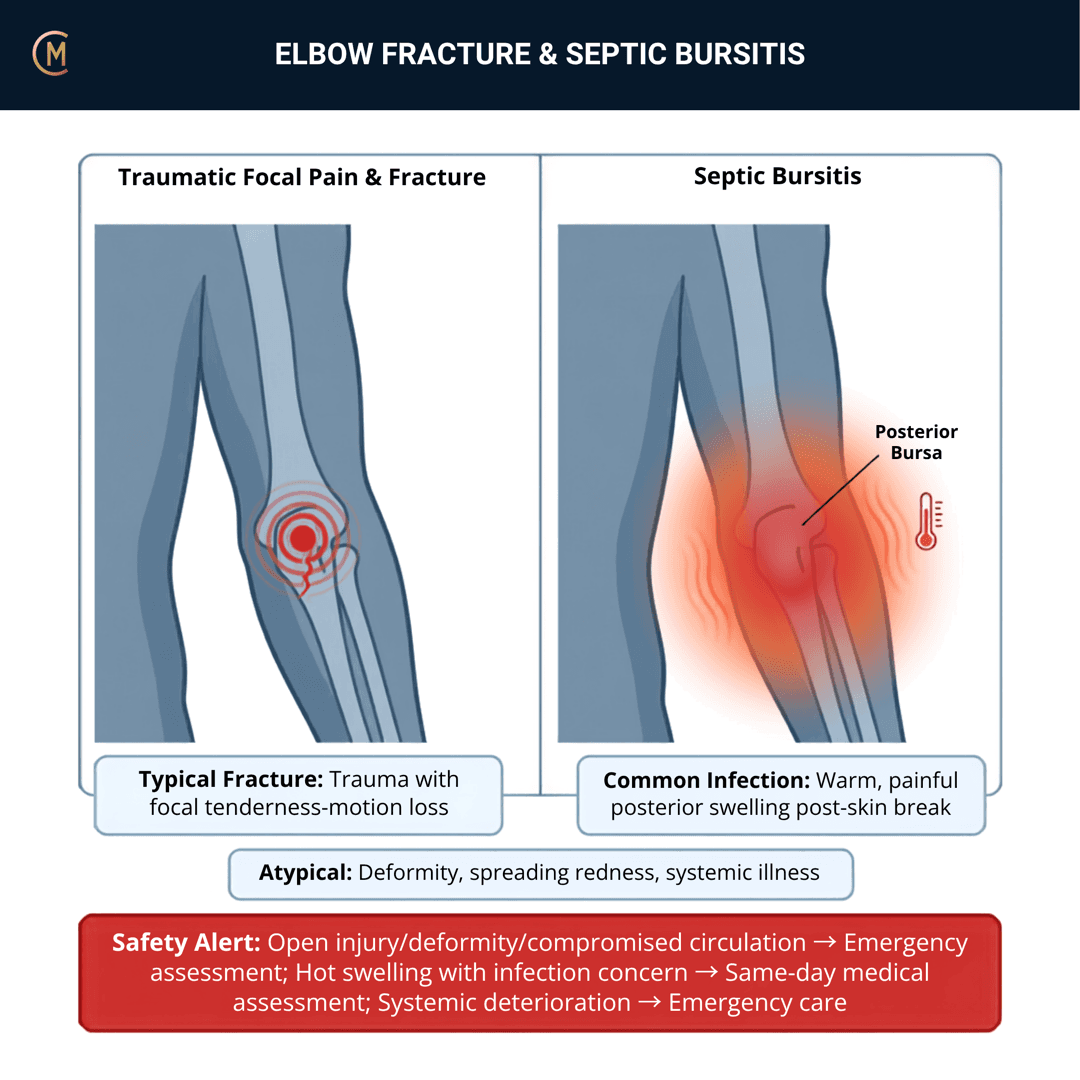
Two emergencies sharing one swollen elbow.
Illness script in one line: acute posterior elbow pain after a direct blow or a fall onto the point of the elbow, with local swelling, warmth and tenderness over the olecranon — possibly with fever, malaise, or a graze that broke the skin — and difficulty fully extending the elbow.
Caseload frequency: uncommon as a referral, and the one you must not miss when it arrives. Read further: risk factors for olecranon bursitis [1], bursitis secondary to trauma [2].
One line in the subjective is a validated decision rule
Look again at one line in the subjective: "difficulty fully extending the elbow."
That is the elbow extension test, and it has been multicentre prospectively validated in the BMJ [3]. No verified accuracy data in our library for this test. Read further: clinical tests to rule out elbow fracture [4].
The direction is the whole clinical point, and it is the same asymmetry as snuffbox tenderness on the scaphoid page:
| What it means | |
|---|---|
| They CANNOT fully extend the elbow | Film. Not "try some movement and review" — a film. |
| They CAN fully extend the elbow | A fracture becomes much less likely. It does not become impossible — focal bony tenderness or a mechanism that worries you still gets imaged |
It rules out far better than it rules in. That single sentence is worth more to a student than any number, because it tells you what to do with each result.
2 · SE — THE SUBJECTIVE PATTERN (the 70%)
Trauma presentation, so the order changes: MAIN PROBLEM → BODY CHART → HISTORY → BEHAVIOUR.
Main problem
"I landed on my elbow and now it's swollen and hot." Acute posterior elbow pain following direct blow or fall.
Body chart
Posterior, over the olecranon. Local. Local swelling, warmth, and tenderness over the olecranon.
Two things worth asking about immediately:
- Is the redness spreading, and can they draw the edge of it? A spreading margin is a different urgency from a localised one.
- Any pain, numbness or weakness down the forearm? The ulnar nerve runs right there. Worth a line in your notes.
History
Possible fever, malaise, or history of skin abrasion/infection.
One pearl is the structure of this section: always check for trauma + infection + rheumatologic history. Three branches, asked every time.
| Branch | What you ask |
|---|---|
| Trauma | Mechanism, force, direction. Did they land on the point of the elbow? Could they use the arm afterwards? |
| Infection | Fever, chills, sweats, feeling generally unwell. Any graze, cut, scratch or skin break — including one they think is trivial. Any recent skin infection anywhere. Diabetes, immunosuppression, steroids, dialysis. |
| Rheumatologic | Gout, pseudogout, rheumatoid arthritis, previous crystal attacks anywhere, previous episodes of this same elbow. |
The trap: these are not alternatives. The graze that let the bacteria in is often the same graze that came from the fall. Trauma does not exclude infection, and finding a mechanism is not a reason to stop asking about fever.
Behaviour
Difficulty fully extending the elbow. See section 1 — this line is doing more work than it looks like.
Pain with end-range flexion > extension — because flexion stretches the skin over a distended bursa.
Aggs: leaning on it, bending it fully, any pressure on the point of the elbow.
Eases: not much, which is itself informative. This does not have good days and bad days.
Special / screening questions
- Are they systemically unwell right now? Fever, rigors, feeling wrong. That is a same-day medical question, not a physiotherapy one.
- Have they been on antibiotics already? Changes what the referral needs to say.
- Have they had this elbow drained before?
- Children and adolescents: an unusual cause of septic bursitis in an adolescent has been reported [5]. Lower your threshold, don't raise it.
Assessing this region? Download the Elbow assessment template →
3 · HYPOTHESIS RANKING
| Pattern | The one discriminating feature |
|---|---|
| Septic olecranon bursitis | Warmth, erythema, and systemic symptoms — fever, malaise, feeling unwell — with a skin break in the story. Read further: characteristics and management [6][7]. Same-day medical referral. |
| Olecranon fracture | A fall or blow onto the point of the elbow, and they cannot fully extend it. Section 1. Film. |
| Aseptic (traumatic) olecranon bursitis | Swelling without warmth, erythema, or systemic symptoms, and full or near-full extension. Its own page. Read further: non-surgical treatment [8]. |
| Crystal arthropathy — gout or pseudogout | Sudden, exquisitely painful, hot and red, often with a previous attack elsewhere. Clinically almost indistinguishable from septic bursitis on the surface. Which is exactly why the answer is the same: refer. |
| Septic arthritis of the elbow joint | The whole joint, not just the bursa. Pain through the whole arc, marked pain on any passive movement, held in mid-flexion. Its own page. Higher urgency again. |
| Osteomyelitis | A complication rather than a competitor. Septic olecranon bursitis with osteomyelitis has been reported [9]. The reason a missed septic bursitis matters. |
The discriminator that does most of the work: is there warmth and erythema, and can they fully extend.
And the honest note: separating septic from crystal from aseptic at the bedside is not reliably done, and the reviews exist because it is difficult. You are not making that call. You are noticing that it needs making, and by whom.
4 · RED FLAGS — DON'T MISS THIS
Free forever. Never gated. This whole page is free forever.
These two emergencies share a page because they present together. A student needs them separated, because the action differs.
Branch A — infection
The most important line on the page: immediate medical referral if red flags: fever, spreading redness, systemic symptoms.
Escalate the same day if any of these are present:
- Fever, rigors, sweats, or feeling systemically unwell.
- Erythema spreading beyond the bursa, particularly a margin that has moved since yesterday.
- Heat, marked tenderness, and a fluctuant swelling — erythema, warmth, fluctuant feel → infection likely.
- A break in the skin, however small, in the story.
- Immunosuppression, diabetes, long-term steroids, or dialysis.
- Rapidly worsening over hours rather than days.
Why the urgency is real: septic olecranon bursitis with osteomyelitis has been reported (Skedros et al. 2023), unusual organisms are described including a Nocardia case with a scoping literature review [10] and in an adolescent (Cottrell et al. 2026), and antibiotic duration after surgical management has needed its own study [11]. This is a condition that escalates into bone and into theatre when it is left.
What "same day" means in practice: GP today, or ED if they are febrile, if the redness is spreading, or if you cannot get them seen today. Do not book them in for a review next week.
Branch B — fracture
Escalate for imaging if:
- They cannot fully extend the elbow — section 1.
- Focal bony tenderness over the olecranon, particularly with a palpable step or gap.
- They could not use the arm after the injury.
- A high-energy mechanism, or a fall in an older adult.
- Any suspicion of a fracture-dislocation. Posterior olecranon fracture dislocations in adults have been systematically reviewed [12]. This is a different injury with a different urgency: an open wound, deformity or compromised hand circulation goes to the emergency department.
Immobilise in sling if fracture suspected; avoid pressure on bursa.
Branch C — the ones that aren't either
- Septic arthritis of the elbow joint. Marked pain on any passive movement, held in mid-flexion, systemically unwell. Higher urgency than bursitis. Its own page.
- New ulnar nerve symptoms — numbness in the little and ring fingers, weakness. Document and name it in the referral.
- A chronically swollen, thickened bursa that has changed character — new pain, ulceration, or a non-healing wound over it — needs a medical opinion rather than more padding.
And the one you don't do
Clinical pearl: don't aspirate in clinic unless trained — refer for sterile technique.
There is a live medical debate behind this pearl, which is worth knowing but does not change your action. Read further: empiric antibiotics without bursal aspiration [13], a knowledge-translation piece [14], French recommendations on prepatellar and olecranon septic bursitis [15].
Whether to aspirate before antibiotics is genuinely unsettled among the people whose decision it is. It is not a physiotherapy decision either way.
5 · OE — THE OBJECTIVE (the 30%)
Members
Sections 5 to 7 are for members
The objective exam, management and pearls, plus the six-minute lesson and the debrief. Free with an account.
Sign in or join free6 · MX — MANAGEMENT ESSENTIALS
Members
Sections 5 to 7 are for members
The objective exam, management and pearls, plus the six-minute lesson and the debrief. Free with an account.
Sign in or join free7 · CLINICAL PEARLS + RETRIEVAL CHECK
Members
Sections 5 to 7 are for members
The objective exam, management and pearls, plus the six-minute lesson and the debrief. Free with an account.
Sign in or join freeMembers
The 4-minute lesson is for members
Twelve slides on this pattern: what you'll hear, what to examine, what to do. Free with an account.
Sign in or join freeGuideline anchor
No Australian guideline — but unlike most red-flag pages here, a national recommendation set exists.
More
The 2023 French recommendations for diagnosing and managing prepatellar and olecranon septic bursitis have been published in Joint Bone Spine (Darrieutort-Laffite et al. 2024, PMID 37995861). The fracture-exclusion anchor is the elbow extension test, multicentre prospectively validated in the BMJ (Appelboam et al. 2008, PMID 19066257), with the diagnostic accuracy of clinical tests to rule out elbow fracture systematically reviewed (Breda et al. 2023, PMID 35971600). The fracture-management anchors are two randomised trials of non-operative versus operative management of olecranon fractures (Joshi et al. 2025, PMID 39787259 — the SOFIE trial; Duckworth et al. 2017, PMID 28663405).
The French recommendations govern medical diagnosis and antibiotic management, not physiotherapy. There is no physiotherapy guideline for this presentation, because the physiotherapy job here is recognition and referral.
Members
The evidence summary is for members
Verified diagnostic accuracy, where the evidence stands and what it doesn't settle. Free with an account.
Sign in or join freeSources · 20
ShowHide
Every source on this page resolves and title-verifies against PubMed. Newest first.
- 2024Shemesh et al. (2024). Risk Factors for the Development of Olecranon Bursitis-A Large-Scale Population-Based Study. Journal of clinical medicine, 13(24). https://doi.org/10.3390/jcm13247801
- 2022Subramanian et al. (2022). Olecranon Bursitis Secondary to Trauma. Cureus, 14(7), e27306. https://doi.org/10.7759/cureus.27306
- 2008Appelboam et al. (2008). Elbow extension test to rule out elbow fracture: multicentre, prospective validation and observational study of diagnostic accuracy in adults and children. BMJ (Clinical research ed.), 337, a2428. https://doi.org/10.1136/bmj.a2428
- 2023Breda et al. (2023). Diagnostic accuracy of clinical tests to rule out elbow fracture: a systematic review. Clinics in shoulder and elbow, 26(2), 182-190. https://doi.org/10.5397/cise.2022.00948
- 2026Cottrell et al. (2026). An Unusual Cause of Septic Bursitis in an Adolescent. The Pediatric infectious disease journal, 45(5), e184-e185. https://doi.org/10.1097/INF.0000000000005107
- 2023Nguyen et al. (2023). Characteristics and management of olecranon or prepatellar septic bursitis. Infectious diseases now, 53(2), 104652. https://doi.org/10.1016/j.idnow.2023.104652
- 2021Charret et al. (2021). Clinical characteristics and management of olecranon and prepatellar septic bursitis in a multicentre study. The Journal of antimicrobial chemotherapy, 76(11), 3029-3032. https://doi.org/10.1093/jac/dkab265
- 2023Kaur et al. (2023). Non-surgical treatment of aseptic olecranon bursitis: A systematic review. Reumatologia clinica, 19(9), 482-487. https://doi.org/10.1016/j.reumae.2023.05.004
- 2023Skedros et al. (2023). Septic Olecranon Bursitis With Osteomyelitis Attributed to Cutibacterium acnes: Case Report and Literature Overview of the Dilemma of Potential Contaminants and False-Positives. Cureus, 15(2), e34563. https://doi.org/10.7759/cureus.34563
- 2026Maai et al. (2026). Nocardia farcinica septic bursitis - a case report and scoping literature review. Swiss medical weekly, 156, 5110. https://doi.org/10.57187/5110
- 2024El Zein et al. (2024). Optimal antibiotics duration following surgical management of septic olecranon bursitis: a 12-year retrospective analysis. Journal of bone and joint infection, 9(2), 107-115. https://doi.org/10.5194/jbji-9-107-2024
- 2023Xiong et al. (2023). Posterior Olecranon Fracture Dislocations in Adults: A Systematic Review. Orthopaedic surgery, 15(9), 2235-2243. https://doi.org/10.1111/os.13820
- 2022Beyde et al. (2022). Efficacy of empiric antibiotic management of septic olecranon bursitis without bursal aspiration in emergency department patients. Academic emergency medicine : official journal of the Society for Academic Emergency Medicine, 29(1), 6-14. https://doi.org/10.1111/acem.14406
- 2022Heitz et al. (2022). Hot off the press: SGEM #358-I would do anything for septic olecranon bursitis but I won't tap that. Academic emergency medicine : official journal of the Society for Academic Emergency Medicine, 29(5), 665-667. https://doi.org/10.1111/acem.14469
- 2024Darrieutort-Laffite et al. (2024). 2023 French recommendations for diagnosing and managing prepatellar and olecranon septic bursitis. Joint bone spine, 91(2), 105664. https://doi.org/10.1016/j.jbspin.2023.105664
- 2025Joshi et al. (2025). Surgery for Olecranon Fractures in the Elderly (SOFIE): Results of the SOFIE Randomized Controlled Trial. The Journal of bone and joint surgery. American volume, 107(5), 452-458. https://doi.org/10.2106/JBJS.24.00655
- 2017Duckworth et al. (2017). Prospective randomised trial of non-operative versus operative management of olecranon fractures in the elderly. The bone & joint journal, 99-B(7), 964-972. https://doi.org/10.1302/0301-620X.99B7.BJJ-2016-1112.R2
- 2017Powell et al. (2017). The treatment of olecranon fractures in adults. Musculoskeletal surgery, 101(1), 1-9. https://doi.org/10.1007/s12306-016-0449-5
- 2023Ahmad et al. (2023). Wound Complications Following Olecranon Fracture Fixation: Implant and Soft Tissue Considerations. Cureus, 15(7), e41730. https://doi.org/10.7759/cureus.41730
- 2021Nchinda & Wolf (2021). Clinical Management of Olecranon Bursitis: A Review. The Journal of hand surgery, 46(6), 501-506. https://doi.org/10.1016/j.jhsa.2021.02.006
Mapped to this pattern
Generic measures that also apply
- Borg RPE
Borg Rating of Perceived Exertion Scale (6-20)
perceived exertion · 1 items · 1 min
- DASH
Disabilities of the Arm, Shoulder and Hand
upper limb disability · 30 items · 8 min
- GROC
Global Rating of Change Scale
perceived change since baseline · 1 items · 1 min
- NPRS
Numeric Pain Rating Scale
pain intensity · 1 items · 1 min
- PGIC
Patient Global Impression of Change
perceived change since baseline · 1 items · 1 min
- PSFS
Patient-Specific Functional Scale
patient-generated function · 3 items · 2 min
- QuickDASH
QuickDASH
upper limb disability, short form · 11 items · 4 min
- SANE
Single Assessment Numeric Evaluation
patient-rated function as a percentage of normal · 1 items · 1 min
- UEFI
Upper Extremity Functional Index
upper limb function · 20 items · 5 min
- VAS
Visual Analogue Scale
pain intensity · 1 items · 1 min
- Borg CR10
Borg Category Ratio 10 Scale
perceived exertion or symptom intensity, ratio scale · 1 items · 1 min
- GAS
Goal Attainment Scaling
individualised goal achievement · 10 min
Did this page do its job?
CliniStudy is in beta. One tap is enough — it decides what gets fixed first.