
1 · SNAPSHOT
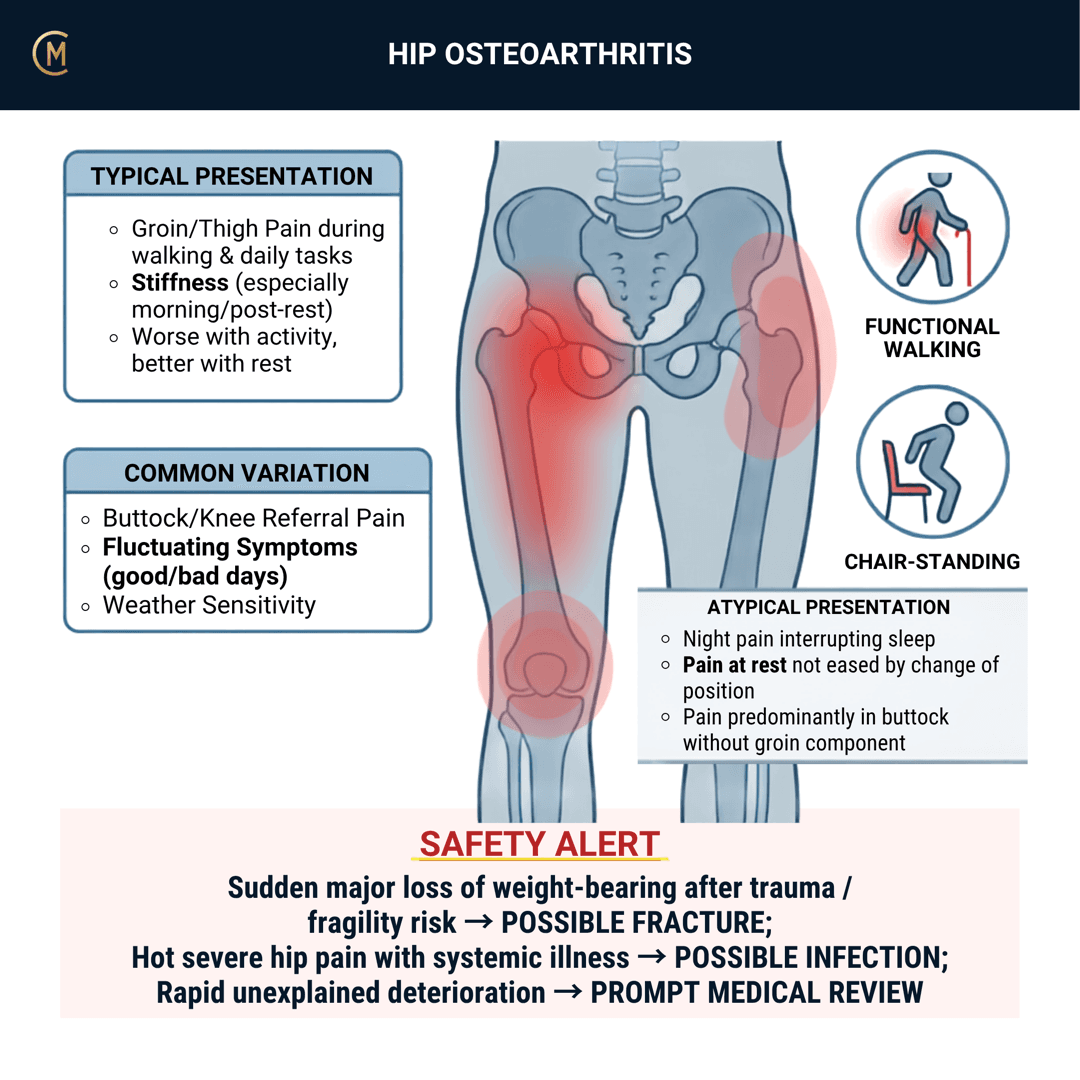
Who: Over about fifty, or post-traumatic.
What: Osteoarthritis of the hip joint.
How it behaves: Gradual groin, buttock or thigh ache. Stiffness in the morning or after inactivity. Pain with walking, stairs, and getting in and out of the car. Eased by rest and heat.
The one thing to take from this page:
Function, not X-ray, dictates management. Exercise and education are first-line in every guideline that exists — and for this pattern, unusually, one of those guidelines is Australian.
Where you actually are on the ladder
| Stage | What it means |
|---|---|
| Mild–moderate | Exercise and education. First-line, everywhere |
| Not progressing | Review the dose, the adherence, the comorbidities — and what else is going on. Adjuncts sit here, added to exercise |
| Severe, function lost | The surgical conversation. A randomised trial found replacement produced greater improvement than resistance training at this end |
✅ An Australian guideline exists — the RACGP knee and hip osteoarthritis guideline. We haven't read it — it is named so you use the local document, not as a source.
2 · SE — THE SUBJECTIVE PATTERN (the 70%)
Five stages, in your course's order. The subjective does most of the work, and the function questions are the ones that decide management.
MAIN PROBLEM
"My groin aches when I walk."
"Getting out of the car is the worst."
"It's stiff first thing, then it eases."
BODY CHART
- Groin, buttock, or thigh. Anterior thigh referral is common and gets mistaken for a quad or hamstring problem.
- Knee pain can be hip pain. Mark the knee, then examine the hip.
- Lateral hip separately — gluteal tendinopathy coexists often.
- Below the knee, or dermatomal? That opens the lumbar question.
BEHAVIOUR
| Fits hip OA | Points elsewhere | |
|---|---|---|
| Aggs | Walking, stairs, in and out of the car, standing | Deep flexion pinch in a young hip → FAI syndrome |
| Stiffness | Morning, and after inactivity, easing with movement | Prolonged, with systemic symptoms → inflammatory |
| Eases | Rest, heat, movement in the middle | Nothing eases it → screen |
| Severity | VAS 0–10 at best / at worst / right now | — |
| Night | Sore after a big day | Constant night pain → screen |
| Course | Slow, over years | Fast decline over months → rapidly progressive OA, or something else |
HISTORY — and this is where management is decided
- What can't they do now that they could? This is the outcome you will track.
- Walking distance, stairs, shoes and socks, getting in and out of the car.
- Current activity — and what they've stopped.
- Comorbidities: weight, sleep, systemic inflammation, diabetes, cardiovascular. They are part of the plan.
- What have they been told about their X-ray? Usually the barrier.
SPECIAL / SCREENING QUESTIONS
- Night pain, rest pain, weight loss, cancer history?
- Any sudden change in function — a step off a kerb, a stumble, then unable to weight-bear? That is a fragility fracture question in an older pelvis.
- Fever, unwell, a hot hip?
- Any inflammatory features — prolonged morning stiffness, other joints, skin, eyes, bowel?
Assessing this region? Download the Hip & Groin assessment template →
3 · HYPOTHESIS RANKING
| Competing pattern | The one discriminating feature |
|---|---|
| FAI syndrome | Younger, motion-related pinch with deep flexion, morphology on imaging. Same joint, not simply an earlier stage: in adults 55 and over, cam morphology was linked to new radiographic hip OA but not to new clinical hip OA [20]. |
| Gluteal tendinopathy (GTPS) | Lateral hip pain over the greater trochanter, worse lying on that side. Coexists often. |
| Lumbar referral | Buttock and posterior thigh dominant, lumbar behaviour, and hip range is preserved. |
| Inflammatory arthritis | Prolonged morning stiffness, other joints, systemic features. |
The two that outrank the table
Fragility fracture of the pelvis, in an older patient. A sudden change in function, weight-bearing pain, and a story that doesn't fit years of slow decline. It has been described as initially diagnosed as hip osteoarthritis.
Rapidly progressive hip osteoarthritis. Functional decline over months rather than years. If the trajectory is wrong, the label is wrong — or it isn't the whole story.
And the framing error that costs the most
Transferring knee osteoarthritis knowledge to the hip. There is a paper written specifically on how the two differ [1]. The location, the examination, the stiffness conventions and the surgical picture are all different — and the knee's morning-stiffness cut-off is not carried over here.
4 · RED FLAGS — DON'T MISS THIS
This section is free, on every pattern, forever. Safety is never gated.
| Finding | What it suggests | What you do |
|---|---|---|
| Sudden functional change, unable to weight-bear, older patient | Fragility fracture of the pelvis or hip | Image |
| Night pain or rest pain, unrelieved | Malignancy, infection | Medical review |
| Cancer history with new hip pain | Metastatic disease | Medical review |
| Unexplained weight loss, fever, unwell | Infection, systemic disease | Medical review |
| Hot, swollen, exquisitely painful hip | Septic arthritis | Emergency |
| Rapid functional decline over months | Rapidly progressive OA, avascular necrosis, malignancy | Image and refer |
| Prolonged morning stiffness with other joints involved | Inflammatory arthritis | Medical review |
| Recent corticosteroid injection then rapid decline | Rapidly progressive OA | Medical review |
The rule: slow, load-related groin and thigh pain with capsular restriction and a clean systemic screen is yours. A sudden change, a fast decline, night pain, systemic symptoms or an inflammatory pattern is not.
Cross-links: Femoroacetabular impingement · Gluteal tendinopathy · Hip labral tear · Knee osteoarthritis
5 · OE — THE OBJECTIVE (the 30%)
Members
Sections 5 to 7 are for members
The objective exam, management and pearls, plus the six-minute lesson and the debrief. Free with an account.
Sign in or join free6 · MX — MANAGEMENT ESSENTIALS
Members
Sections 5 to 7 are for members
The objective exam, management and pearls, plus the six-minute lesson and the debrief. Free with an account.
Sign in or join free7 · CLINICAL PEARLS + RETRIEVAL CHECK
Members
Sections 5 to 7 are for members
The objective exam, management and pearls, plus the six-minute lesson and the debrief. Free with an account.
Sign in or join freeMembers
The 4-minute lesson is for members
Twelve slides on this pattern: what you'll hear, what to examine, what to do. Free with an account.
Sign in or join freeGuideline anchor
An Australian guideline exists for this one — the RACGP Guideline for the management of knee and hip osteoarthritis (2nd edn, 2018).
More
It is not indexed in our citation checker, so it is named as the local anchor and carried in citations_unverified rather than cited with a PMID. International anchors, all verified: OARSI non-surgical management (Bannuru et al. 2019, PMID 31278997), EULAR non-pharmacological core management (Moseng et al. 2024, PMID 38212040), AAOS clinical practice guideline (Hannon et al. 2024, PMID 38781351), and the JOSPT Hip Pain and Mobility Deficits revision (Koc TA et al. 2025, PMID 41165671).
The Australian document is unsighted — it is named because it exists and should be the local reference, not because this page has read it. The ACSQHC Osteoarthritis of the Knee Clinical Care Standard covers the knee only and does not apply here. Everything cited with a PMID on this page is international.
Members
The evidence summary is for members
Verified diagnostic accuracy, where the evidence stands and what it doesn't settle. Free with an account.
Sign in or join freeSources · 20
ShowHide
Every source on this page resolves and title-verifies against PubMed. Newest first.
- 2022Hall et al. (2022). How does hip osteoarthritis differ from knee osteoarthritis?. Osteoarthritis and cartilage, 30(1), 32-41. https://doi.org/10.1016/j.joca.2021.09.010
- 2023Mourad & Vande Berg (2023). Osteoarthritis of the hip: is radiography still needed?. Skeletal radiology, 52(11), 2259-2270. https://doi.org/10.1007/s00256-022-04270-8
- 2026Hall et al. (2026). Exercise for osteoarthritis of the hip. The Cochrane database of systematic reviews, 7(7), CD007912. https://doi.org/10.1002/14651858.CD007912.pub3
- 2019Bannuru et al. (2019). OARSI guidelines for the non-surgical management of knee, hip, and polyarticular osteoarthritis. Osteoarthritis and cartilage, 27(11), 1578-1589. https://doi.org/10.1016/j.joca.2019.06.011
- 2024Moseng et al. (2024). EULAR recommendations for the non-pharmacological core management of hip and knee osteoarthritis: 2023 update. Annals of the rheumatic diseases, 83(6), 730-740. https://doi.org/10.1136/ard-2023-225041
- 2024Hannon et al. (2024). American Academy of Orthopaedic Surgeons Clinical Practice Guideline Summary Management of Osteoarthritis of the Hip. The Journal of the American Academy of Orthopaedic Surgeons, 32(20), e1027-e1034. https://doi.org/10.5435/JAAOS-D-24-00420
- 2025Nandi et al. (2025). 2023 American Academy of Orthopaedic Surgeons Management of Osteoarthritis of the Hip Evidence-Based Clinical Practice Guideline: Case Studies. The Journal of the American Academy of Orthopaedic Surgeons, 33(4), e220-e223. https://doi.org/10.5435/JAAOS-D-24-00427
- 2025Koc TA et al. (2025). Hip Pain and Mobility Deficits-Hip Osteoarthritis: Revision 2025. The Journal of orthopaedic and sports physical therapy, 55(11), CPG1-CPG31. https://doi.org/10.2519/jospt.2025.0301
- 2024Kjeldsen et al. (2024). Progressive Resistance Training or Neuromuscular Exercise for Hip Osteoarthritis : A Multicenter Cluster Randomized Controlled Trial. Annals of internal medicine, 177(5), 573-582. https://doi.org/10.7326/M23-3225
- 2023Teirlinck et al. (2023). Effect of exercise therapy in patients with hip osteoarthritis: A systematic review and cumulative meta-analysis. Osteoarthritis and cartilage open, 5(1), 100338. https://doi.org/10.1016/j.ocarto.2023.100338
- 2016Bartels et al. (2016). Aquatic exercise for the treatment of knee and hip osteoarthritis. The Cochrane database of systematic reviews, 3(3), CD005523. https://doi.org/10.1002/14651858.CD005523.pub3
- 2022Runge et al. (2022). The Benefits of Adding Manual Therapy to Exercise Therapy for Improving Pain and Function in Patients With Knee or Hip Osteoarthritis: A Systematic Review With Meta-analysis. The Journal of orthopaedic and sports physical therapy, 52(10), 675-A13. https://doi.org/10.2519/jospt.2022.11062
- 2022French et al. (2022). Adjunctive therapies in addition to land-based exercise therapy for osteoarthritis of the hip or knee. The Cochrane database of systematic reviews, 10(10), CD011915. https://doi.org/10.1002/14651858.CD011915.pub2
- 2023Weng et al. (2023). Comparative efficacy of exercise therapy and oral non-steroidal anti-inflammatory drugs and paracetamol for knee or hip osteoarthritis: a network meta-analysis of randomised controlled trials. British journal of sports medicine, 57(15), 990-996. https://doi.org/10.1136/bjsports-2022-105898
- 2025Pereira et al. (2025). Effectiveness and safety of intra-articular interventions for knee and hip osteoarthritis based on large randomized trials: A systematic review and network meta-analysis. Osteoarthritis and cartilage, 33(2), 207-217. https://doi.org/10.1016/j.joca.2024.08.014
- 2024Marriott et al. (2024). Are the Effects of Resistance Exercise on Pain and Function in Knee and Hip Osteoarthritis Dependent on Exercise Volume, Duration, and Adherence? A Systematic Review and Meta-Analysis. Arthritis care & research, 76(6), 821-830. https://doi.org/10.1002/acr.25313
- 2023Holden et al. (2023). Moderators of the effect of therapeutic exercise for knee and hip osteoarthritis: a systematic review and individual participant data meta-analysis. The Lancet. Rheumatology, 5(7), e386-e400. https://doi.org/10.1016/S2665-9913(23)00122-4
- 2024Frydendal et al. (2024). Total Hip Replacement or Resistance Training for Severe Hip Osteoarthritis. The New England journal of medicine, 391(17), 1610-1620. https://doi.org/10.1056/NEJMoa2400141
- 2023Fan et al. (2023). The prevalence of hip osteoarthritis: a systematic review and meta-analysis. Arthritis research & therapy, 25(1), 51. https://doi.org/10.1186/s13075-023-03033-7
- 2023Runhaar et al. (2023). Risk Factors and Population-Attributable Fractions for Incident Hip Osteoarthritis. HSS journal : the musculoskeletal journal of Hospital for Special Surgery, 19(4), 407-412. https://doi.org/10.1177/15563316231192461
Mapped to this pattern
- 30CST
30-Second Chair Stand Test
lower limb strength endurance · 2 min
- 5xSTS
Five Times Sit to Stand Test
lower limb power and endurance · 2 min
- HOOS
Hip Disability and Osteoarthritis Outcome Score
hip disability and osteoarthritis outcome · 40 items · 10 min
- TUG
Timed Up and Go Test
functional mobility · 3 min
- 10MWT
10-Metre Walk Test
gait speed · 3 min
- EQ-5D-5L
EuroQol 5-Dimension
generic health-related quality of life · 6 items · 3 min
- FJS-12
Forgotten Joint Score-12
joint awareness after arthroplasty · 12 items · 4 min
- Godin
Godin Leisure-Time Exercise Questionnaire
leisure-time physical activity · 3 items · 2 min
- Hip OA CPR
Hip Osteoarthritis Clinical Prediction Rule
diagnostic test cluster · 5 items · 6 min
Generic measures that also apply
- Borg RPE
Borg Rating of Perceived Exertion Scale (6-20)
perceived exertion · 1 items · 1 min
- GROC
Global Rating of Change Scale
perceived change since baseline · 1 items · 1 min
- NPRS
Numeric Pain Rating Scale
pain intensity · 1 items · 1 min
- PGIC
Patient Global Impression of Change
perceived change since baseline · 1 items · 1 min
- PSFS
Patient-Specific Functional Scale
patient-generated function · 3 items · 2 min
- SANE
Single Assessment Numeric Evaluation
patient-rated function as a percentage of normal · 1 items · 1 min
- VAS
Visual Analogue Scale
pain intensity · 1 items · 1 min
- Borg CR10
Borg Category Ratio 10 Scale
perceived exertion or symptom intensity, ratio scale · 1 items · 1 min
- GAS
Goal Attainment Scaling
individualised goal achievement · 10 min
Did this page do its job?
CliniStudy is in beta. One tap is enough — it decides what gets fixed first.