
1 · SNAPSHOT
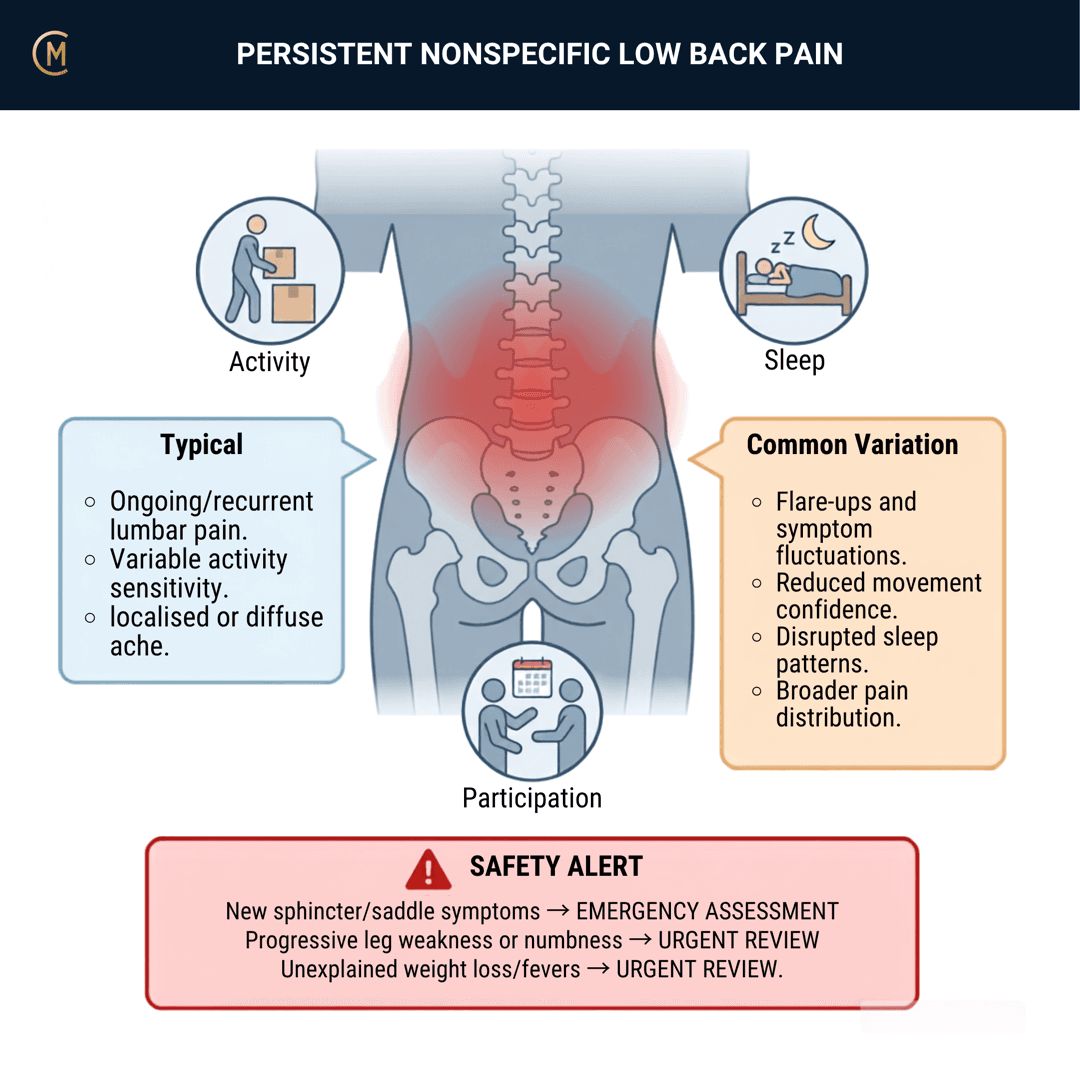
Who: Anyone, and disproportionately people with occupational loading, poor sleep and life stress. Read further: occupational mechanical exposures as a risk factor [1].
What: Persistent low back ache beyond twelve weeks, with no specific pathology found. "Non-specific" is a positive classification, not a shrug — formal diagnostic criteria have been proposed [2].
How it behaves: Variable location. Unpredictable aggravators, not clearly mechanical. Fatigue, poor sleep, fear of movement. Fluctuates with stress and workload. Prior imaging may not correlate with symptoms.
The one thing to take from this page:
You are not short of evidence here — you are short of certainty about how much it helps. Three guidelines agree, there's a Cochrane review, and a Lancet Rheumatology paper on long-term effectiveness is the honest counterweight to all of it. Do the recommended things, and be truthful about what they achieve.
The evidence stack — unusually deep
| What exists | What it tells you |
|---|---|
| A Cochrane review of exercise therapy | The core intervention, reviewed properly |
| A Journal of Physiotherapy companion | Some types of exercise are more effective than others — type is a choice |
| The ACP guideline · the JOSPT CPG | Two independent guidelines |
| A review of recent international guidelines | Written because they converge. That's the story |
| Cochrane multidisciplinary biopsychosocial rehabilitation | The whole-person arm, reviewed |
| Lancet Rheumatology, long-term effectiveness | The counterweight. Agreement ≠ efficacy over years |
2 · SE — THE SUBJECTIVE PATTERN (the 70%)
Here the subjective isn't 70% — it's most of the treatment. Five stages, in your course's order.
MAIN PROBLEM
"It's been three years and nobody's told me what's wrong."
"Some days it's fine and some days I can't get off the couch, and I can't work out why."
"The scan showed degeneration and a bulging disc."
That third sentence is a treatment target, not a finding.
BODY CHART
- Variable, and it moves. Ask them to draw it on a good day and a bad day.
- Widespread or spreading? Note it.
- Any leg symptoms — and do they follow a dermatome?
BEHAVIOUR
- Aggs: unpredictable. That unpredictability is diagnostic, not evasive.
- Eases: variable.
- 24-hr pattern: ask whether there is one at all — time of day, workload, sleep — and write the answer down even when it is 'no'.
- Night: night pain that is new and unremitting is a §4 flag.
- Severity: VAS 0–10 at best / at worst / right now.
- Is there ANY pattern? Time of day, activity, week of the month, workload, sleep.
- What have they stopped doing? This is the outcome measure.
HISTORY — and this is the section that matters
- How long, and what was the original event? Often trivial or absent.
- What have they been told, and by whom? "Degeneration," "crumbling spine," "bone on bone" — write down the exact words. You will be undoing them.
- What imaging, and what did they take from it?
- Sleep. Ask properly.
- Work — physical demands, control, satisfaction. Read further: occupational mechanical exposures as a risk factor (Jahn et al. 2023).
- Mood, stress, and what else is going on.
- What do they think is wrong? Ask it directly and write down the answer.
- What are they afraid of?
SPECIAL / SCREENING QUESTIONS — still, every time
- Any change in walking, bladder, bowel or saddle sensation?
- Any night pain that's new, constant and non-mechanical?
- Any cancer history, weight loss, fever?
- Any new or progressive neurological symptoms?
Assessing this region? Download the Lumbar Spine & SIJ assessment template →
3 · HYPOTHESIS RANKING
Chronic non-specific low back pain is a diagnosis of exclusion made positively — you rule out the specific, then classify what's left rather than shrugging at it.
| Competing pattern | The one discriminating feature |
|---|---|
| Lumbar radicular pain | Dermatomal leg pain, positive SLR or slump, neurological findings. |
| Lumbar spinal canal stenosis | Bilateral leg heaviness, worse walking and standing, eased by flexion. Over sixty. |
| Spondylolisthesis | Extension-provoked, step deformity, adolescent athlete or degenerative. |
| Axial spondyloarthritis | Inflammatory time pattern — morning stiffness easing with movement, over three months, under forty, systemic features. |
| Hip osteoarthritis | Groin pain, restricted internal rotation. Commonly mistaken for back pain. |
| Lumbar postural pain | Clear postural relationship, full ROM, settles with movement. Less entrenched. |
The ones that outrank everything, and still do at year three
Cancer, infection, fracture, cauda equina, AAA. A long history does not confer immunity — a new, different, non-mechanical pain in a chronic back pain patient is exactly the presentation that gets dismissed.
4 · RED FLAGS — DON'T MISS THIS
This section is free, on every pattern, forever. Safety is never gated.
The specific risk on this page: familiarity. You will see these patients repeatedly, and the twentieth visit is where the new symptom gets absorbed into the old story.
| Finding | What it suggests | What you do |
|---|---|---|
| Bladder or bowel change, saddle anaesthesia, bilateral leg symptoms | Cauda equina | EMERGENCY |
| A new, different, constant, non-mechanical pain | Serious pathology | Medical review — do not absorb it into the old story |
| Night pain that is new and unremitting | Malignancy, infection | Medical review |
| Cancer history with a change in the pain | Metastasis | Urgent medical review |
| Unexplained weight loss, fever, night sweats | Malignancy, infection | Urgent medical review |
| Progressive neurological deficit | Cord or root | URGENT |
| New severe pain after minimal trauma, long-term corticosteroid use, or a bruise or graze from the injury | Fracture | Medical review and imaging — and more than one of these together raises the odds further (Downie et al. 2013) [22] |
| Inflammatory time pattern in someone under forty | Axial spondyloarthritis | Rheumatology referral |
| Deep constant pain with a pulsatile abdominal mass | AAA | EMERGENCY |
| Rapidly escalating distress, hopelessness | Mental health | Ask directly, and refer appropriately |
The rule: chronic doesn't mean cleared, and familiar doesn't mean safe. Re-screen when the pain changes character — not when it changes intensity.
Cross-links: Non-specific low back pain · Lumbar postural pain · Spinal metastases · Cauda equina syndrome
5 · OE — THE OBJECTIVE (the 30%)
Members
Sections 5 to 7 are for members
The objective exam, management and pearls, plus the six-minute lesson and the debrief. Free with an account.
Sign in or join free6 · MX — MANAGEMENT ESSENTIALS
Members
Sections 5 to 7 are for members
The objective exam, management and pearls, plus the six-minute lesson and the debrief. Free with an account.
Sign in or join free7 · CLINICAL PEARLS + RETRIEVAL CHECK
Members
Sections 5 to 7 are for members
The objective exam, management and pearls, plus the six-minute lesson and the debrief. Free with an account.
Sign in or join freeMembers
The 4-minute lesson is for members
Twelve slides on this pattern: what you'll hear, what to examine, what to do. Free with an account.
Sign in or join freeGuideline anchor
No Australian guideline for ongoing care: the ACSQHC Low Back Pain Clinical Care Standard (2022) covers only the early management of a flare-up of chronic low back pain, not ongoing management.
More
But this pattern has the deepest evidence stack in the entire product — a Cochrane review of exercise therapy (Hayden et al. 2021, PMID 34580864) with its Journal of Physiotherapy companion showing some types of exercise are more effective than others (Hayden et al. 2021, PMID 34538747), the American College of Physicians guideline on noninvasive treatments (Qaseem et al. 2017, PMID 28192789), the JOSPT clinical practice guideline (George et al. 2021, PMID 34719942), a narrative review of recent international guidelines (Nicol et al. 2023, PMID 36836220), and long-term effectiveness of non-surgical interventions in Lancet Rheumatology (Jenkins et al. 2025, PMID 40449512).
The guidelines are international rather than Australian, but they agree with each other to an unusual degree — a narrative review of recent international guidelines exists precisely because the convergence is the story. The honest counterweight is the long-term effectiveness work: agreeing on what to do is not the same as those things working well.
Members
The evidence summary is for members
Verified diagnostic accuracy, where the evidence stands and what it doesn't settle. Free with an account.
Sign in or join freeSources · 21
ShowHide
Every source on this page resolves and title-verifies against PubMed. Newest first.
- 2023Jahn et al. (2023). Occupational mechanical exposures as risk factor for chronic low-back pain: a systematic review and meta-analysis. Scandinavian journal of work, environment & health, 49(7), 453-465. https://doi.org/10.5271/sjweh.4114
- 2020Markman et al. (2020). AAPT Diagnostic Criteria for Chronic Low Back Pain. The journal of pain, 21(11-12), 1138-1148. https://doi.org/10.1016/j.jpain.2020.01.008
- 2025Bess et al. (2025). Multifidus Dysfunction and Chronic Low Back Pain: Systematic Review and Meta-analysis of the Supporting Data for Accurate Diagnosis and Successful Treatment Outcomes Associated With Restorative Neurostimulation. International journal of spine surgery, 19(S3), S67-S84. https://doi.org/10.14444/8814
- 2024Thiveos et al. (2024). Cognitive Functional Therapy for Chronic Low Back Pain: A Systematic Review and Meta-Analysis. Physical therapy, 104(12). https://doi.org/10.1093/ptj/pzae128
- 2021Hayden et al. (2021). Exercise therapy for chronic low back pain. The Cochrane database of systematic reviews, 9(9), CD009790. https://doi.org/10.1002/14651858.CD009790.pub2
- 2021Hayden et al. (2021). Some types of exercise are more effective than others in people with chronic low back pain: a network meta-analysis. Journal of physiotherapy, 67(4), 252-262. https://doi.org/10.1016/j.jphys.2021.09.004
- 2022Fernández-Rodríguez et al. (2022). Best Exercise Options for Reducing Pain and Disability in Adults With Chronic Low Back Pain: Pilates, Strength, Core-Based, and Mind-Body. A Network Meta-analysis. The Journal of orthopaedic and sports physical therapy, 52(8), 505-521. https://doi.org/10.2519/jospt.2022.10671
- 2017Coulombe et al. (2017). Core Stability Exercise Versus General Exercise for Chronic Low Back Pain. Journal of athletic training, 52(1), 71-72. https://doi.org/10.4085/1062-6050-51.11.16
- 2014Kamper et al. (2014). Multidisciplinary biopsychosocial rehabilitation for chronic low back pain. The Cochrane database of systematic reviews, 2014(9), CD000963. https://doi.org/10.1002/14651858.CD000963.pub3
- 2015Kamper et al. (2015). Multidisciplinary biopsychosocial rehabilitation for chronic low back pain: Cochrane systematic review and meta-analysis. BMJ (Clinical research ed.), 350, h444. https://doi.org/10.1136/bmj.h444
- 2019Rubinstein et al. (2019). Benefits and harms of spinal manipulative therapy for the treatment of chronic low back pain: systematic review and meta-analysis of randomised controlled trials. BMJ (Clinical research ed.), 364, l689. https://doi.org/10.1136/bmj.l689
- 2007Chou & Huffman (2007). Nonpharmacologic therapies for acute and chronic low back pain: a review of the evidence for an American Pain Society/American College of Physicians clinical practice guideline. Annals of internal medicine, 147(7), 492-504. https://doi.org/10.7326/0003-4819-147-7-200710020-00007
- 2017Qaseem et al. (2017). Noninvasive Treatments for Acute, Subacute, and Chronic Low Back Pain: A Clinical Practice Guideline From the American College of Physicians. Annals of internal medicine, 166(7), 514-530. https://doi.org/10.7326/M16-2367
- 2021George et al. (2021). Interventions for the Management of Acute and Chronic Low Back Pain: Revision 2021. The Journal of orthopaedic and sports physical therapy, 51(11), CPG1-CPG60. https://doi.org/10.2519/jospt.2021.0304
- 2023Nicol et al. (2023). Chronic Low Back Pain: A Narrative Review of Recent International Guidelines for Diagnosis and Conservative Treatment. Journal of clinical medicine, 12(4). https://doi.org/10.3390/jcm12041685
- 2025Jenkins et al. (2025). Long-term effectiveness of non-surgical interventions for chronic low back pain: a systematic review and meta-analysis. The Lancet. Rheumatology, 7(9), e607-e617. https://doi.org/10.1016/S2665-9913(25)00064-5
- 2016Mannion et al. (2016). Consensus at last! Long-term results of all randomized controlled trials show that fusion is no better than non-operative care in improving pain and disability in chronic low back pain. The spine journal : official journal of the North American Spine Society, 16(5), 588-90. https://doi.org/10.1016/j.spinee.2015.12.001
- 2020Ebadi et al. (2020). Therapeutic ultrasound for chronic low back pain. The Cochrane database of systematic reviews, 7(7), CD009169. https://doi.org/10.1002/14651858.CD009169.pub3
- 2015Meucci et al. (2015). Prevalence of chronic low back pain: systematic review. Revista de saude publica, 49, 1. https://doi.org/10.1590/S0034-8910.2015049005874
- 2022Wong et al. (2022). Prevalence, Incidence, and Factors Associated With Non-Specific Chronic Low Back Pain in Community-Dwelling Older Adults Aged 60 Years and Older: A Systematic Review and Meta-Analysis. The journal of pain, 23(4), 509-534. https://doi.org/10.1016/j.jpain.2021.07.012
- 2013Downie et al. (2013). Red flags to screen for malignancy and fracture in patients with low back pain: systematic review. BMJ (Clinical research ed.), 347, f7095. https://doi.org/10.1136/bmj.f7095
Mapped to this pattern
- OMPSQ-SF
Orebro Musculoskeletal Pain Screening Questionnaire - Short Form
psychosocial risk of prolonged disability · 10 items · 5 min
- PSEQ
Pain Self-Efficacy Questionnaire
confidence to function despite pain · 10 items · 3 min
- RMDQ
Roland-Morris Disability Questionnaire
low back pain disability · 24 items · 5 min
- STarT Back
STarT Back Screening Tool
risk stratification for persistent disability · 9 items · 3 min
- TSK-11
Tampa Scale of Kinesiophobia
fear of movement and re-injury · 11 items · 3 min
- DPQ
Dallas Pain Questionnaire
chronic pain impact, four dimensions · 16 items · 6 min
- FIQ
Fibromyalgia Impact Questionnaire
fibromyalgia impact · 20 items · 6 min
- FIQR
Revised Fibromyalgia Impact Questionnaire
fibromyalgia impact, revised · 21 items · 6 min
- SSS
Symptom Severity Scale
fibromyalgia symptom severity · 3 min
- WPI
Widespread Pain Index
extent of widespread pain · 19 items · 3 min
- BPI
Brief Pain Inventory
pain severity and interference · 6 min
- CSI
Central Sensitization Inventory
central sensitisation-related symptoms · 25 items · 6 min
- EQ-5D-5L
EuroQol 5-Dimension
generic health-related quality of life · 6 items · 3 min
- FABQ
Fear-Avoidance Beliefs Questionnaire
fear-avoidance beliefs about work and activity · 16 items · 4 min
- GCPS
Graded Chronic Pain Scale
chronic pain severity grading · 7 items · 3 min
- Godin
Godin Leisure-Time Exercise Questionnaire
leisure-time physical activity · 3 items · 2 min
- IEQ
Injustice Experience Questionnaire
perceived injustice related to injury · 12 items · 3 min
- IPAQ
International Physical Activity Questionnaire
physical activity across domains · 8 min
- OMPSQ
Orebro Musculoskeletal Pain Screening Questionnaire
psychosocial risk of prolonged disability · 25 items · 10 min
- PCS
Pain Catastrophizing Scale
catastrophic thinking about pain · 13 items · 4 min
- PDI
Pain Disability Index
pain-related disability across life domains · 7 items · 3 min
- QBPDS
Quebec Back Pain Disability Scale
low back pain disability · 20 items · 5 min
- SF-MPQ
Short-Form McGill Pain Questionnaire
pain quality — sensory and affective · 15 items · 5 min
- SF-MPQ-2
Short-Form McGill Pain Questionnaire-2
pain quality including neuropathic descriptors · 22 items · 6 min
- WAI
Work Ability Index
perceived work ability · 7 items · 5 min
Generic measures that also apply
- Borg RPE
Borg Rating of Perceived Exertion Scale (6-20)
perceived exertion · 1 items · 1 min
- GROC
Global Rating of Change Scale
perceived change since baseline · 1 items · 1 min
- NPRS
Numeric Pain Rating Scale
pain intensity · 1 items · 1 min
- PGIC
Patient Global Impression of Change
perceived change since baseline · 1 items · 1 min
- PSFS
Patient-Specific Functional Scale
patient-generated function · 3 items · 2 min
- SANE
Single Assessment Numeric Evaluation
patient-rated function as a percentage of normal · 1 items · 1 min
- VAS
Visual Analogue Scale
pain intensity · 1 items · 1 min
- Borg CR10
Borg Category Ratio 10 Scale
perceived exertion or symptom intensity, ratio scale · 1 items · 1 min
- GAS
Goal Attainment Scaling
individualised goal achievement · 10 min
Did this page do its job?
CliniStudy is in beta. One tap is enough — it decides what gets fixed first.